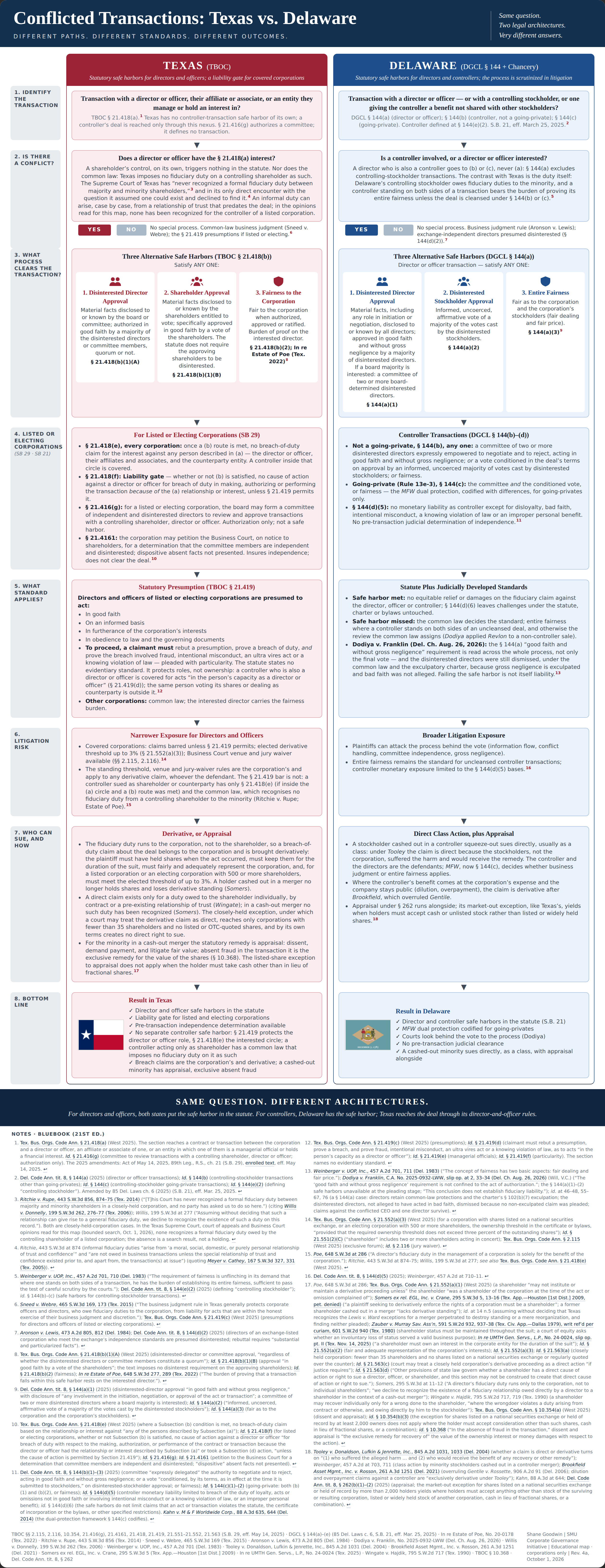
How to read it. Follow either column top to bottom. The grey rail on the left names the question each row answers; the two columns give each state’s answer with the section that supplies it. Where the Texas column says a controller is not covered, that is the statute’s silence, not an omission of ours: Texas has no controller-transaction provision, and a controller’s deal is reached only through the director-and-officer nexus in § 21.418(a).
Conflicted Transactions: Texas vs. Delaware
Two legal architectures.
Very different answers.
Transaction with a director or officer, their affiliate or associate, or an entity they manage or hold an interest in?
TBOC § 21.418(a).1 Texas has no controller-transaction safe harbor of its own; a controller’s deal is reached only through this nexus. § 21.416(g) authorizes a committee; it defines no transaction.
Transaction with a director or officer — or with a controlling stockholder, or one giving the controller a benefit not shared with other stockholders?
DGCL § 144(a) (director or officer); § 144(b) (controller, not a going-private); § 144(c) (going-private). Controller defined at § 144(e)(2). S.B. 21, eff. March 25, 2025.2
Does a director or officer have the § 21.418(a) interest?
A shareholder’s control, on its own, triggers nothing in the statute. Nor does the common law: Texas imposes no fiduciary duty on a controlling shareholder as such. The Supreme Court of Texas has “never recognized a formal fiduciary duty between majority and minority shareholders,”3 and in its only direct encounter with the question it assumed one could exist and declined to find it.4 An informal duty can arise, case by case, from a relationship of trust that predates the deal; in the opinions read for this map, none has been recognized for the controller of a listed corporation.
Is a controller involved, or a director or officer interested?
A director who is also a controller goes to (b) or (c), never (a): § 144(a) excludes controlling-stockholder transactions. The contrast with Texas is the duty itself: Delaware’s controlling stockholder owes fiduciary duties to the minority, and a controller standing on both sides of a transaction bears the burden of proving its entire fairness unless the deal is cleansed under § 144(b) or (c).5
Three Alternative Safe Harbors (TBOC § 21.418(b))Satisfy ANY ONE:
Three Alternative Safe Harbors (DGCL § 144(a))Director or officer transaction — satisfy ANY ONE:
For Listed or Electing Corporations (SB 29)
- § 21.418(e), every corporation: once a (b) route is met, no breach-of-duty claim for the interest against any person described in (a) — the director or officer, their affiliates and associates, and the counterparty entity. A controller inside that circle is covered.
- § 21.418(f): Liability gate — whether or not (b) is satisfied, no cause of action against a director or officer for breach of duty in making, authorizing or performing the transaction because of the (a) relationship or interest, unless § 21.419 permits it.
- § 21.416(g): for a listed or electing corporation, the board may form a committee of independent and disinterested directors to review and approve transactions with a controlling shareholder, director or officer. Authorization only; not a safe harbor.
- § 21.4161: the corporation may petition the Business Court, on notice to shareholders, for a determination that the committee members are independent and disinterested; dispositive absent facts not presented. Insures independence; does not clear the deal.10
Controller Transactions (DGCL § 144(b)–(d))
- Not a going-private, § 144(b), any one: a committee of two or more disinterested directors expressly empowered to negotiate and to reject, acting in good faith and without gross negligence; or a vote conditioned in the deal’s terms on approval by an informed, uncoerced majority of votes cast by disinterested stockholders; or fairness.
- Going-private (Rule 13e-3), § 144(c): the committee and the conditioned vote, or fairness — the MFW dual protection, codified with differences, for going-privates only.
- § 144(d)(5): no monetary liability as controller except for disloyalty, bad faith, intentional misconduct, a knowing violation of law or an improper personal benefit. No pre-transaction judicial determination of independence.11
Statutory Presumption (TBOC § 21.419)
Directors and officers of listed or electing corporations are presumed to act:
- In good faith
- On an informed basis
- In furtherance of the corporation’s interests
- In obedience to law and the governing documents
- To proceed, a claimant must rebut a presumption, prove a breach of duty, and prove the breach involved fraud, intentional misconduct, an ultra vires act or a knowing violation of law — pleaded with particularity. The statute states no evidentiary standard. It protects roles, not ownership: a controller who is also a director or officer is covered for acts “in the person’s capacity as a director or officer” (§ 21.419(d)); the same person voting its shares or dealing as counterparty is outside it.12
- Other corporations: common law; the interested director carries the fairness burden.
Statute Plus Judicially Developed Standards
- Safe harbor met: no equitable relief or damages on the fiduciary claim against the director, officer or controller; § 144(d)(6) leaves challenges under the statute, charter or bylaws untouched.
- Safe harbor missed: the common law decides the standard; entire fairness where a controller stands on both sides of an uncleansed deal, and otherwise the review the common law assigns (Dodiya applied Revlon to a non-controller sale).
- Dodiya v. Franklin (Del. Ch. Aug. 26, 2026): the § 144(a) “good faith and without gross negligence” requirement is read across the whole process, not only the final vote — and the disinterested directors were still dismissed, under the common law and the exculpatory charter, because gross negligence is exculpated and bad faith was not alleged. Failing the safe harbor is not itself liability.13
Narrower Exposure for Directors and Officers
- Covered corporations: claims barred unless § 21.419 permits; elected derivative threshold up to 3% (§ 21.552(a)(3)); Business Court venue and jury waiver available (§§ 2.115, 2.116).14
- The standing threshold, venue and jury-waiver rules are the corporation’s and apply to any derivative claim, whoever the defendant. The § 21.419 bar is not: a controller sued as shareholder or counterparty has only § 21.418(e) (if inside the (a) circle and a (b) route was met) and the common law, which recognises no fiduciary duty from a controlling shareholder to the minority (Ritchie v. Rupe; Estate of Poe).15
Broader Litigation Exposure
- Plaintiffs can attack the process behind the vote (information flow, conflict handling, committee independence, gross negligence).
- Entire fairness remains the standard for uncleansed controller transactions; controller monetary exposure limited to the § 144(d)(5) bases.16
Derivative, or Appraisal
- The fiduciary duty runs to the corporation, not to the shareholder, so a breach-of-duty claim about the deal belongs to the corporation and is brought derivatively: the plaintiff must have held shares when the act occurred, must keep them for the duration of the suit, must fairly and adequately represent the corporation, and, for a listed corporation or an electing corporation with 500 or more shareholders, must meet the elected threshold of up to 3%. A holder cashed out in a merger no longer holds shares and loses derivative standing (Somers).
- A direct claim exists only for a duty owed to the shareholder individually, by contract or a pre-existing relationship of trust (Wingate); in a cash-out merger no such duty has been recognized (Somers). The closely-held exception, under which a court may treat the derivative claim as direct, reaches only corporations with fewer than 35 shareholders and no listed or OTC-quoted shares, and by its own terms creates no direct right to sue.
- For the minority in a cash-out merger the statutory remedy is appraisal: dissent, demand payment, and litigate fair value; absent fraud in the transaction it is the exclusive remedy for the value of the shares (§ 10.368). The listed-share exception to appraisal does not apply when the holder must take cash other than in lieu of fractional shares.17
Direct Class Action, plus Appraisal
- A stockholder cashed out in a controller squeeze-out sues directly, usually as a class: under Tooley the claim is direct because the stockholders, not the corporation, suffered the harm and would receive the remedy. The controller and the directors are the defendants; MFW, now § 144(c), decides whether business judgment or entire fairness applies.
- Where the controller’s benefit comes at the corporation’s expense and the company stays public (dilution, overpayment), the claim is derivative after Brookfield, which overruled Gentile.
- Appraisal under § 262 runs alongside; its market-out exception, like Texas’s, yields when holders must accept cash or unlisted stock rather than listed or widely held shares.18

Result in Texas
- Director and officer safe harbors in the statute
- Liability gate for listed and electing corporations
- Pre-transaction independence determination available
- No separate controller safe harbor: § 21.419 protects the director or officer role, § 21.418(e) the interested circle; a controller acting only as shareholder has a common law that imposes no fiduciary duty on it as such
- Breach claims are the corporation’s and derivative; a cashed-out minority has appraisal, exclusive absent fraud

Result in Delaware
- Director and controller safe harbors in the statute (S.B. 21)
- MFW dual protection codified for going-privates
- Courts look behind the vote to the process (Dodiya)
- No pre-transaction judicial clearance
- A cashed-out minority sues directly, as a class, with appraisal alongside
Notes · Bluebook (21st ed.)
- Tex. Bus. Orgs. Code Ann. § 21.418(a) (West 2025). The section reaches a contract or transaction between the corporation and a director or officer, an affiliate or associate of one, or an entity in which one of them is a managerial official or holds a financial interest. Id. § 21.416(g) (committee to review transactions with a controlling shareholder, director or officer; authorization only). The 2025 amendments: Act of May 14, 2025, 89th Leg., R.S., ch. 21 (S.B. 29), enrolled text, eff. May 14, 2025. ↩
- Del. Code Ann. tit. 8, § 144(a) (2025) (director or officer transactions); Id. § 144(b) (controlling-stockholder transactions other than going-privates); Id. § 144(c) (controlling-stockholder going-private transactions); Id. § 144(e)(2) (defining “controlling stockholder”). Amended by 85 Del. Laws ch. 6 (2025) (S.B. 21), eff. Mar. 25, 2025. ↩
- Ritchie v. Rupe, 443 S.W.3d 856, 874–75 (Tex. 2014) (“[T]his Court has never recognized a formal fiduciary duty between majority and minority shareholders in a closely-held corporation, and no party has asked us to do so here.”) (citing Willis v. Donnelly, 199 S.W.3d 262, 276–77 (Tex. 2006)); Willis, 199 S.W.3d at 277 (“Assuming without deciding that such a relationship can give rise to a general fiduciary duty, we decline to recognize the existence of such a duty on this record.”). Both are closely-held-corporation cases. In the Texas Supreme Court, court of appeals and Business Court opinions read for this map (bounded search, Oct. 1, 2026), none recognizes a formal fiduciary duty owed by the controlling shareholder of a listed corporation; the absence is a search result, not a holding. ↩
- Ritchie, 443 S.W.3d at 874 (informal fiduciary duties “arise from ‘a moral, social, domestic, or purely personal relationship of trust and confidence’” and “are not owed in business transactions unless the special relationship of trust and confidence existed prior to, and apart from, the transaction(s) at issue”) (quoting Meyer v. Cathey, 167 S.W.3d 327, 331 (Tex. 2005)). ↩
- Weinberger v. UOP, Inc., 457 A.2d 701, 710 (Del. 1983) (“The requirement of fairness is unflinching in its demand that where one stands on both sides of a transaction, he has the burden of establishing its entire fairness, sufficient to pass the test of careful scrutiny by the courts.”); Del. Code Ann. tit. 8, § 144(e)(2) (2025) (defining “controlling stockholder”); id. § 144(b)–(c) (safe harbors for controlling-stockholder transactions). ↩
- Sneed v. Webre, 465 S.W.3d 169, 173 (Tex. 2015) (“The business judgment rule in Texas generally protects corporate officers and directors, who owe fiduciary duties to the corporation, from liability for acts that are within the honest exercise of their business judgment and discretion.”); Tex. Bus. Orgs. Code Ann. § 21.419(c) (West 2025) (presumptions for directors and officers of listed or electing corporations). ↩
- Aronson v. Lewis, 473 A.2d 805, 812 (Del. 1984); Del. Code Ann. tit. 8, § 144(d)(2) (2025) (directors of an exchange-listed corporation who meet the exchange’s independence standards are presumed disinterested; rebuttal requires “substantial and particularized facts”). ↩
- Tex. Bus. Orgs. Code Ann. § 21.418(b)(1)(A) (West 2025) (disinterested-director or committee approval, “regardless of whether the disinterested directors or committee members constitute a quorum”); Id. § 21.418(b)(1)(B) (approval “in good faith by a vote of the shareholders”; the text imposes no disinterest requirement on the approving shareholders); Id. § 21.418(b)(2) (fairness); In re Estate of Poe, 648 S.W.3d 277, 289 (Tex. 2022) (“The burden of proving that a transaction falls within this safe harbor rests on the interested director.”). ↩
- Del. Code Ann. tit. 8, § 144(a)(1) (2025) (disinterested-director approval “in good faith and without gross negligence,” with disclosure of “any involvement in the initiation, negotiation, or approval of the act or transaction”; a committee of two or more disinterested directors where a board majority is interested); Id. § 144(a)(2) (“informed, uncoerced, affirmative vote of a majority of the votes cast by the disinterested stockholders”); Id. § 144(a)(3) (fair as to the corporation and the corporation’s stockholders). ↩
- Tex. Bus. Orgs. Code Ann. § 21.418(e) (West 2025) (where a Subsection (b) condition is met, no breach-of-duty claim based on the relationship or interest against “any of the persons described by Subsection (a)”); Id. § 21.418(f) (for listed or electing corporations, whether or not Subsection (b) is satisfied, no cause of action against a director or officer “for breach of duty with respect to the making, authorization, or performance of the contract or transaction because the director or officer had the relationship or interest described by Subsection (a)” or took a Subsection (d) action, “unless the cause of action is permitted by Section 21.419”); Id. § 21.416(g); Id. § 21.4161 (petition to the Business Court for a determination that committee members are independent and disinterested; “dispositive” absent facts not presented). ↩
- Del. Code Ann. tit. 8, § 144(b)(1)–(3) (2025) (committee “expressly delegated” the authority to negotiate and to reject, acting in good faith and without gross negligence; or a vote “conditioned, by its terms, as in effect at the time it is submitted to stockholders,” on disinterested-stockholder approval; or fairness); Id. § 144(c)(1)–(2) (going-private: both (b)(1) and (b)(2), or fairness); Id. § 144(d)(5) (controller monetary liability limited to breach of the duty of loyalty, acts or omissions not in good faith or involving intentional misconduct or a knowing violation of law, or an improper personal benefit); id. § 144(d)(6) (the safe harbors do not limit claims that an act or transaction violates the statute, the certificate of incorporation or the bylaws, or other specified restrictions). Kahn v. M & F Worldwide Corp., 88 A.3d 635, 644 (Del. 2014) (the dual-protection framework § 144(c) codifies). ↩
- Tex. Bus. Orgs. Code Ann. § 21.419(c) (West 2025) (presumptions); Id. § 21.419(d) (claimant must rebut a presumption, prove a breach, and prove fraud, intentional misconduct, an ultra vires act or a knowing violation of law, as to acts “in the person’s capacity as a director or officer”); Id. § 21.419(e) (managerial officials); Id. § 21.419(f) (particularity). The section names no evidentiary standard. ↩
- Weinberger v. UOP, Inc., 457 A.2d 701, 711 (Del. 1983) (“The concept of fairness has two basic aspects: fair dealing and fair price.”); Dodiya v. Franklin, C.A. No. 2025-0932-LWW, slip op. at 2, 33–34 (Del. Ch. Aug. 26, 2026) (Will, V.C.) (“The ‘good faith and without gross negligence’ requirement is not confined to the act of authorization.”; the § 144(a)(1)–(2) safe harbors unavailable at the pleading stage; “This conclusion does not establish fiduciary liability.”); id. at 46–48, 55–67, 76 (a § 144(a) case: directors retain common-law protections and the charter’s § 102(b)(7) exculpation; the disinterested directors, not alleged to have acted in bad faith, dismissed because no non-exculpated claim was pleaded; claims against the conflicted CEO and one director survive). ↩
- Tex. Bus. Orgs. Code Ann. § 21.552(a)(3) (West 2025) (for a corporation with shares listed on a national securities exchange, or an electing corporation with 500 or more shareholders, the ownership threshold in the certificate or bylaws, “provided that the required ownership threshold does not exceed three percent of the outstanding shares”); Id. § 21.551(2)(C) (“shareholder” includes two or more shareholders acting in concert); Tex. Bus. Orgs. Code Ann. § 2.115 (West 2025) (exclusive forum); id. § 2.116 (jury waiver). ↩
- Poe, 648 S.W.3d at 286 (“A director’s fiduciary duty in the management of a corporation is solely for the benefit of the corporation.”); Ritchie, 443 S.W.3d at 874–75; Willis, 199 S.W.3d at 277; see also Tex. Bus. Orgs. Code Ann. § 21.418(e) (West 2025). ↩
- Del. Code Ann. tit. 8, § 144(d)(5) (2025); Weinberger, 457 A.2d at 710–11. ↩
- Poe, 648 S.W.3d at 286; Tex. Bus. Orgs. Code Ann. § 21.552(a)(1) (West 2025) (a shareholder “may not institute or maintain a derivative proceeding unless” the shareholder “was a shareholder of the corporation at the time of the act or omission complained of”); Somers ex rel. EGL, Inc. v. Crane, 295 S.W.3d 5, 13–16 (Tex. App.—Houston [1st Dist.] 2009, pet. denied) (“a plaintiff seeking to derivatively enforce the rights of a corporation must be a shareholder”; a former shareholder cashed out in a merger “lacks derivative standing”); id. at 14 n.5 (assuming without deciding that Texas recognizes the Lewis v. Ward exceptions for a merger perpetrated to destroy standing or a mere reorganization, and finding neither pleaded); Zauber v. Murray Sav. Ass’n, 591 S.W.2d 932, 937–38 (Tex. Civ. App.—Dallas 1979), writ ref’d per curiam, 601 S.W.2d 940 (Tex. 1980) (shareholder status must be maintained throughout the suit; a court of equity asks whether an involuntary loss of status served a valid business purpose); In re UMTH Gen. Servs., L.P., No. 24-0024, slip op. pt. II (Tex. Nov. 14, 2025) (“a shareholder must own an interest in the corporate entity for the duration of the suit”); Id. § 21.552(a)(2) (fair and adequate representation of the corporation’s interests); Id. § 21.552(a)(3); Id. § 21.563(a) (closely held corporation: fewer than 35 shareholders and no shares listed on a national securities exchange or regularly quoted over the counter); Id. § 21.563(c) (court may treat a closely held corporation’s derivative proceeding as a direct action “if justice requires”); Id. § 21.563(d) (“Other provisions of state law govern whether a shareholder has a direct cause of action or right to sue a director, officer, or shareholder, and this section may not be construed to create that direct cause of action or right to sue.”); Somers, 295 S.W.3d at 11–12 (“A director’s fiduciary duty runs only to the corporation, not to individual shareholders”; “we decline to recognize the existence of a fiduciary relationship owed directly by a director to a shareholder in the context of a cash-out merger”); Wingate v. Hajdik, 795 S.W.2d 717, 719 (Tex. 1990) (a shareholder may recover individually only for a wrong done to the shareholder, “where the wrongdoer violates a duty arising from contract or otherwise, and owing directly by him to the stockholder”); Tex. Bus. Orgs. Code Ann. § 10.354(a) (West 2025) (dissent and appraisal); id. § 10.354(b)(3) (the exception for shares listed on a national securities exchange or held of record by at least 2,000 owners does not apply where the holder must accept consideration other than such shares, cash in lieu of fractional shares, or a combination); id. § 10.368 (“In the absence of fraud in the transaction,” dissent and appraisal is “the exclusive remedy for recovery of” the value of the ownership interest or money damages with respect to the action). ↩
- Tooley v. Donaldson, Lufkin & Jenrette, Inc., 845 A.2d 1031, 1033 (Del. 2004) (whether a claim is direct or derivative turns on “(1) who suffered the alleged harm … and (2) who would receive the benefit of any recovery or other remedy”); Weinberger, 457 A.2d at 703, 711 (class action by minority stockholders cashed out in a controller merger); Brookfield Asset Mgmt., Inc. v. Rosson, 261 A.3d 1251 (Del. 2021) (overruling Gentile v. Rossette, 906 A.2d 91 (Del. 2006); dilution and overpayment claims against a controller are “exclusively derivative under Tooley”); Kahn, 88 A.3d at 644; Del. Code Ann. tit. 8, § 262(b)(1)–(2) (2025) (appraisal; the market-out exception for shares listed on a national securities exchange or held of record by more than 2,000 holders yields where holders must accept anything other than stock of the surviving or resulting corporation, listed or widely held stock of another corporation, cash in lieu of fractional shares, or a combination). ↩
Read the statutes
- Tex. S.B. 29, 89th Leg., R.S. (2025) (enrolled) — §§ 21.416(g), 21.4161, 21.418, 21.419, 21.552(a)(3), 2.115, 2.116, eff. May 14, 2025.
- Tex. Bus. Orgs. Code ch. 21 (codified text as maintained by the Texas Legislative Council).
- Del. Code Ann. tit. 8, § 144 (as amended by 85 Del. Laws c. 6, S.B. 21, eff. Mar. 25, 2025); § 262 (appraisal).
- Tex. Bus. Orgs. Code ch. 10, subch. H (dissent and appraisal, § 10.354).
- In re Estate of Poe, 648 S.W.3d 277 (Tex. 2022); Ritchie v. Rupe, 443 S.W.3d 856 (Tex. 2014); Willis v. Donnelly, 199 S.W.3d 262 (Tex. 2006); Sneed v. Webre, 465 S.W.3d 169 (Tex. 2015); Aronson v. Lewis, 473 A.2d 805 (Del. 1984); Weinberger v. UOP, Inc., 457 A.2d 701 (Del. 1983); Tooley v. Donaldson, Lufkin & Jenrette, Inc., 845 A.2d 1031 (Del. 2004); Kahn v. M & F Worldwide Corp., 88 A.3d 635 (Del. 2014); Brookfield Asset Mgmt., Inc. v. Rosson, 261 A.3d 1251 (Del. 2021); Dodiya v. Franklin, C.A. No. 2025-0932-LWW (Del. Ch. Aug. 26, 2026); Somers ex rel. EGL, Inc. v. Crane, 295 S.W.3d 5 (Tex. App.—Houston [1st Dist.] 2009, pet. denied); In re UMTH Gen. Servs., L.P., No. 24-0024 (Tex. Nov. 14, 2025); Wingate v. Hajdik, 795 S.W.2d 717 (Tex. 1990). Each map carries its own Bluebook notes beneath the chart. Opinions are collected on the vertical’s sources page.
Educational map. Corporations only; LLC and partnership analogues differ. Nothing here is legal advice.