Sheet 01 of 10
Standard of review: Texas vs. Delaware.
One gate. One sliding scale
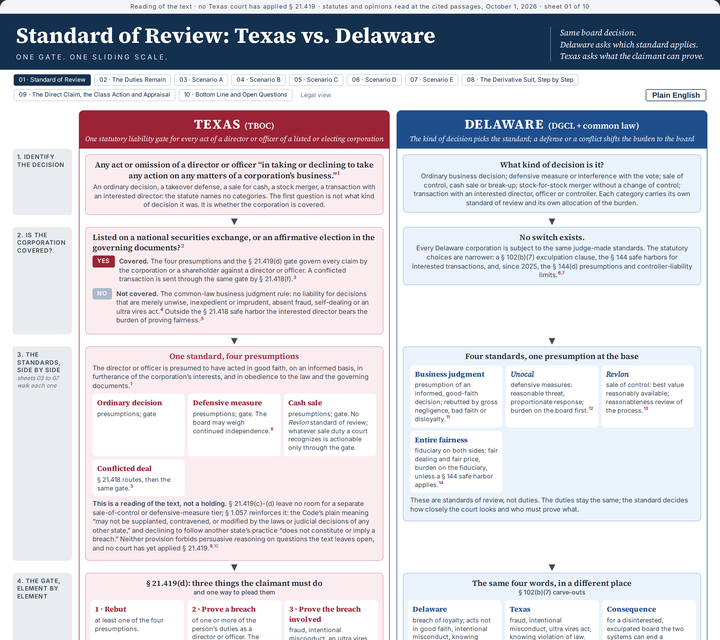
Same board decision. Delaware asks which standard applies. Texas asks what the claimant can prove.
Texas Corporate Law · Standard of review
Delaware asks which standard of review applies and shifts the burden when a defense or a conflict appears. For a listed or electing Texas corporation, § 21.419 asks instead what the claimant can prove: fraud, intentional misconduct, an ultra vires act or a knowing violation of law. Ten sheets follow that difference from an ordinary board decision to a cash sale, a conflicted deal, the derivative suit and appraisal.
Built from the enrolled texts · October 1, 2026 · a reading of the text; no Texas court has applied § 21.419
How the series is built. Every sheet puts the same question to both states and answers it from the section or the opinion, cited in Bluebook form beneath the chart, with a link to the official compilation or the opinion itself. Each sheet has a Plain English view for readers who are not lawyers. The sheets were read against the primary sources and corrected through two rounds of external review; the bottom-line sheet lists what was adopted, what was declined and what no court has decided.
Sheet 01 of 10
One gate. One sliding scale
Same board decision. Delaware asks which standard applies. Texas asks what the claimant can prove.
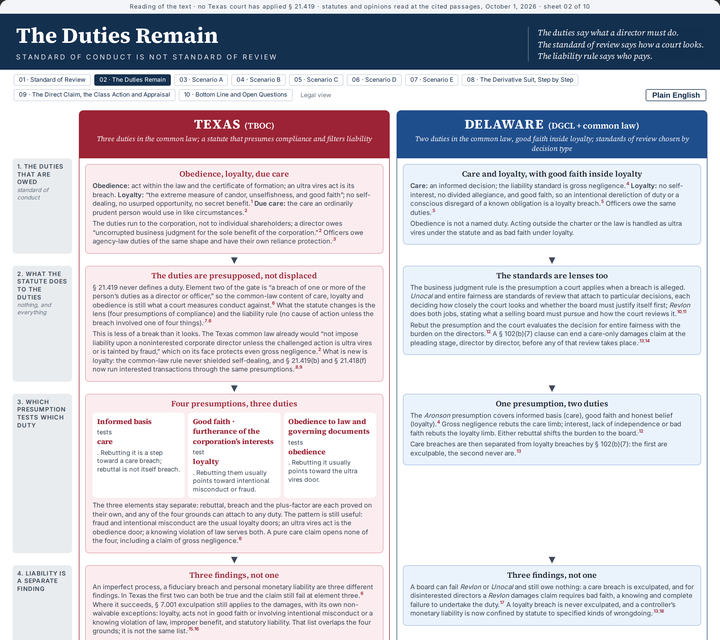
Sheet 02 of 10
Standard of conduct is not standard of review
The duties say what a director must do. The standard of review says how a court looks. The liability rule says who pays.
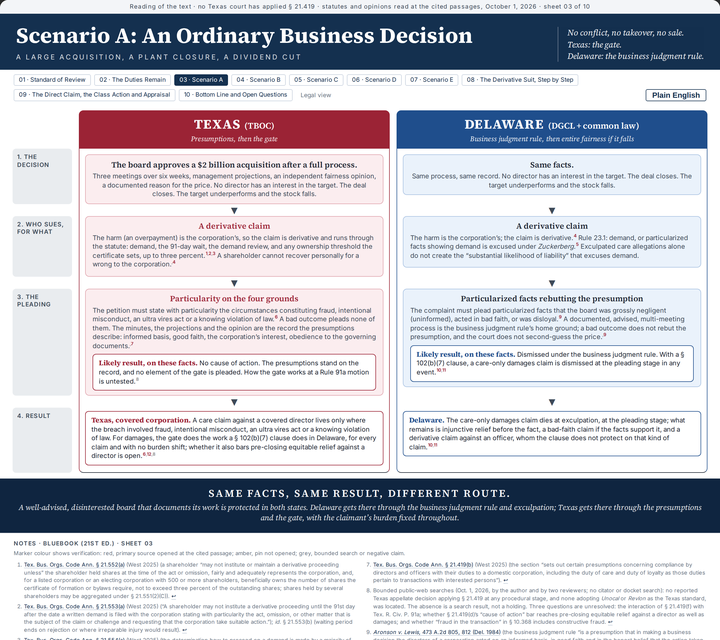
Sheet 03 of 10
A large acquisition, a plant closure, a dividend cut
No conflict, no takeover, no sale. Texas: the gate. Delaware: the business judgment rule.
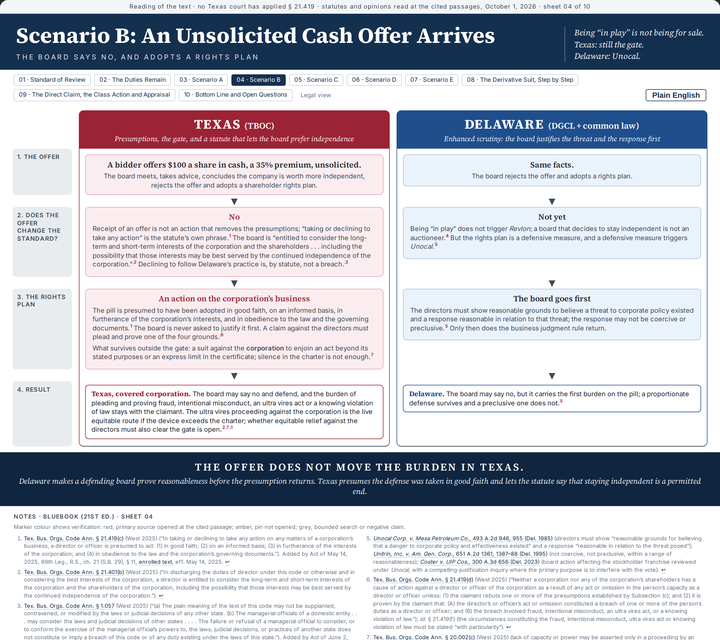
Sheet 04 of 10
The board says no, and adopts a rights plan
Being “in play” is not being for sale. Texas: still the gate. Delaware: Unocal.
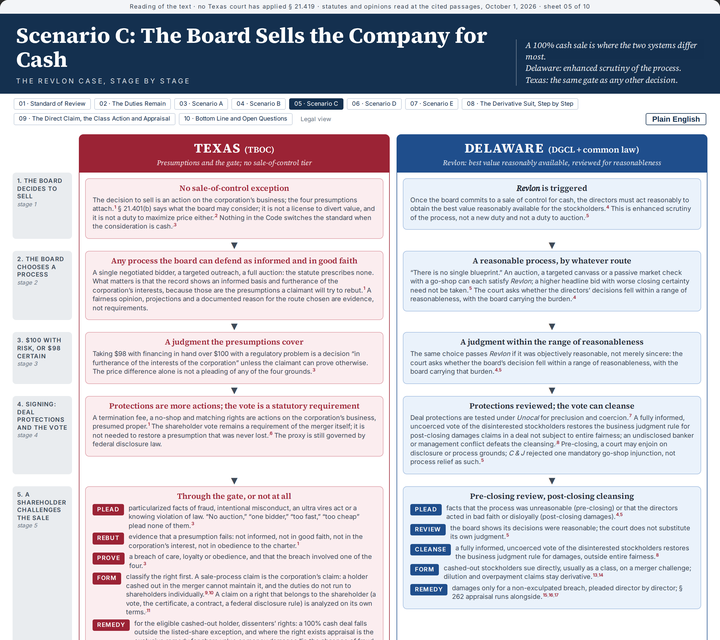
Sheet 05 of 10
The Revlon case, stage by stage
A 100% cash sale is where the two systems differ most. Delaware: enhanced scrutiny of the process. Texas: the same gate as any other decision.
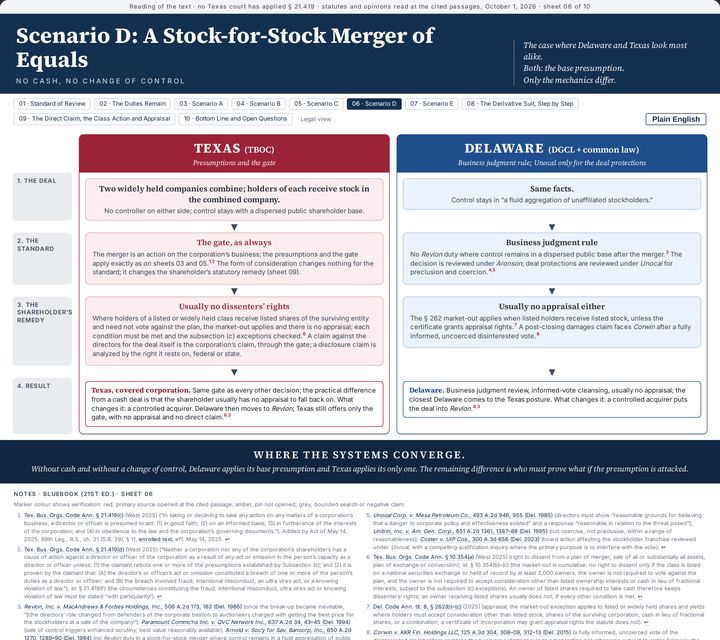
Sheet 06 of 10
No cash, no change of control
The case where Delaware and Texas look most alike. Both: the base presumption. Only the mechanics differ.
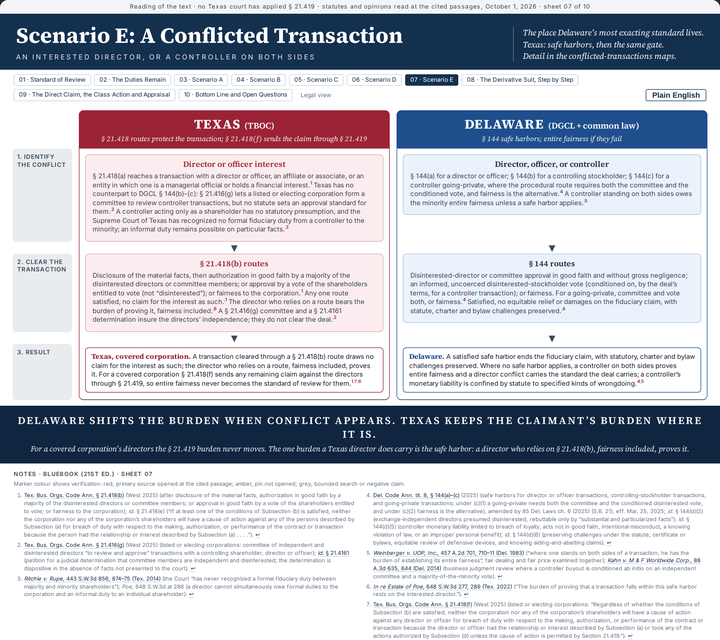
Sheet 07 of 10
An interested director, or a controller on both sides
The place Delaware’s most exacting standard lives. Texas: safe harbors, then the same gate. Detail in the conflicted-transactions maps.
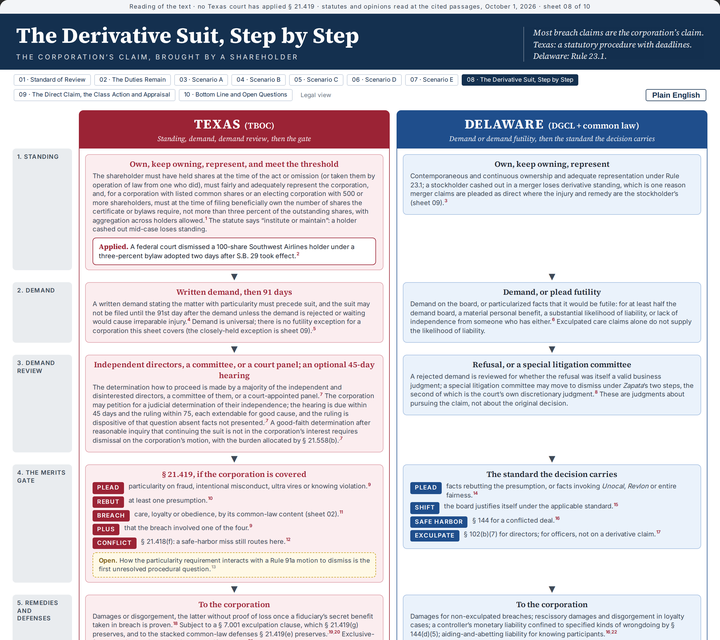
Sheet 08 of 10
The corporation’s claim, brought by a shareholder
Most breach claims are the corporation’s claim. Texas: a statutory procedure with deadlines. Delaware: Rule 23.1.
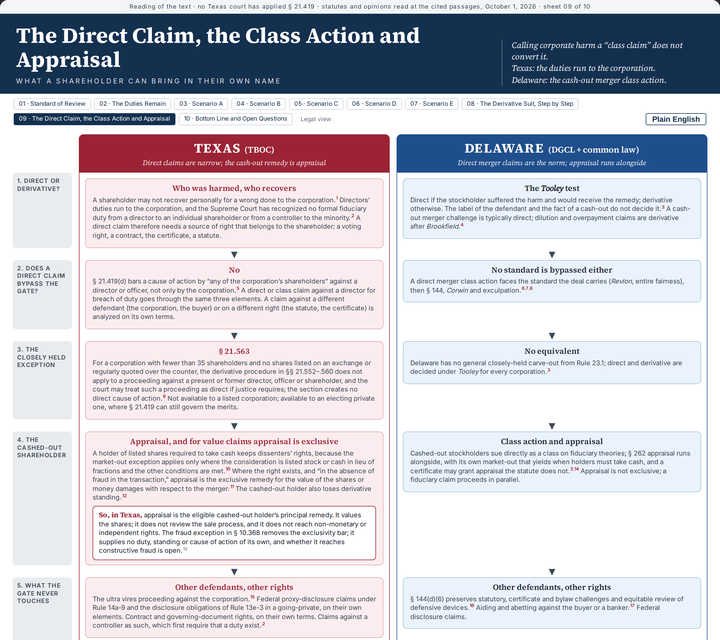
Sheet 09 of 10
What a shareholder can bring in their own name
Calling corporate harm a “class claim” does not convert it. Texas: the duties run to the corporation. Delaware: the cash-out merger class action.
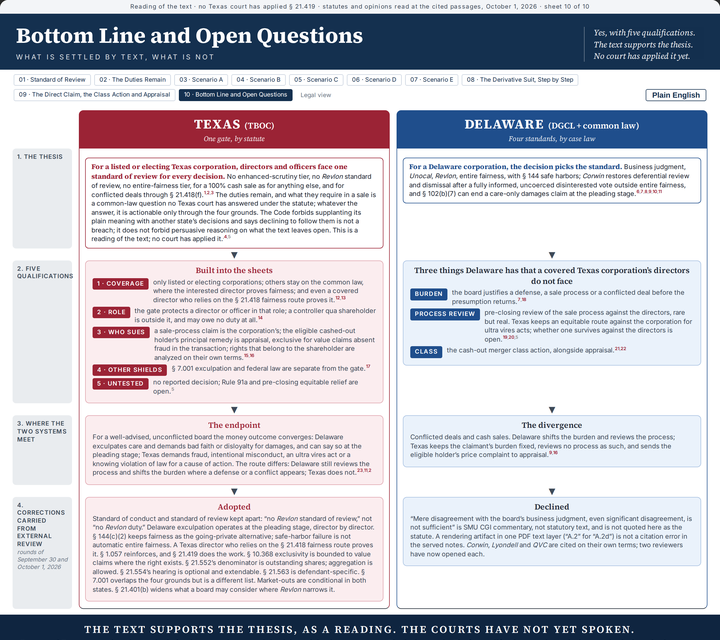
Sheet 10 of 10
What is settled by text, what is not
Yes, with five qualifications. The text supports the thesis. No court has applied it yet.
Educational map. Corporations only; LLC and partnership analogues differ. A reading of the statutory text: no Texas court has applied § 21.419 to a sale, a defense or a conflicted deal. Nothing here is legal advice.