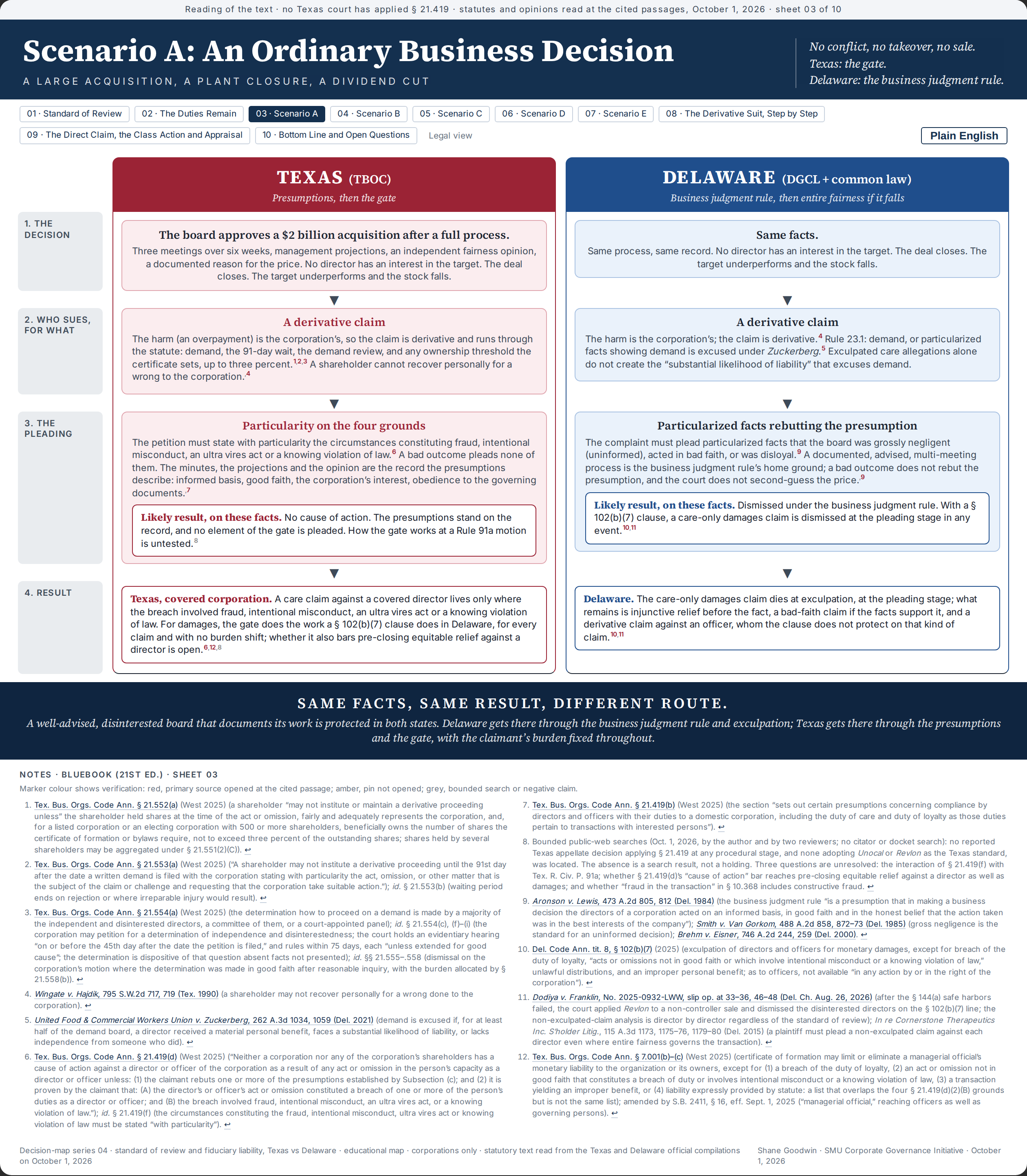
How to read it. Follow either column top to bottom. The grey rail names the question each row answers; the Texas and Delaware columns give each state’s answer with the section or opinion that supplies it. Markers lead to the Bluebook notes under the sheet. The Plain English button at the top of the sheet swaps every cell for an everyday-words version; the legal view and its notes remain the text of record.
The sheets read in order, and each stands alone: 01 and 02 set the frame, 03 to 07 walk one board decision each down both columns, 08 and 09 walk the lawsuit, 10 is the bottom line and the open questions.
Reading of the text · no Texas court has applied § 21.419 · statutes and opinions read at the cited passages, October 1, 2026 · sheet 03 of 10
Scenario A: An Ordinary Business Decision
A large acquisition, a plant closure, a dividend cut
No conflict, no takeover, no sale.
Texas: the gate.
Delaware: the business judgment rule.
Plain-English view: the same sheet in everyday words, for readers who are not lawyers. It summarizes; the legal view and its notes are the source of record. Click the button again to return.
TEXAS (TBOC)Presumptions, then the gate
DELAWARE (DGCL + common law)Business judgment rule, then entire fairness if it falls
1. The decision
The board approves a $2 billion acquisition after a full process.
Three meetings over six weeks, management projections, an independent fairness opinion, a documented reason for the price. No director has an interest in the target. The deal closes. The target underperforms and the stock falls.
The board approves a big acquisition after a full process: several meetings, management’s numbers, an outside fairness opinion, a written reason for the price. Nobody on the board has a stake in the target. The deal closes, the target disappoints, and the stock falls.
Same facts.
Same process, same record. No director has an interest in the target. The deal closes. The target underperforms and the stock falls.
Same facts.
2. Who sues, for what
A derivative claim
The harm (an overpayment) is the corporation’s, so the claim is derivative and runs through the statute: demand, the 91-day wait, the demand review, and any ownership threshold the certificate sets, up to three percent.123 A shareholder cannot recover personally for a wrong to the corporation.4
Because the harm was to the company, a shareholder has to sue on the company’s behalf: send a written demand, wait 91 days, go through the board’s review, and own enough shares if the company set a threshold of up to three percent.
A derivative claim
The harm is the corporation’s; the claim is derivative.4 Rule 23.1: demand, or particularized facts showing demand is excused under Zuckerberg.5 Exculpated care allegations alone do not create the “substantial likelihood of liability” that excuses demand.
Same shape of claim. The shareholder must either ask the board to sue or plead specific facts showing the board could not fairly decide.
3. The pleading
Particularity on the four grounds
The petition must state with particularity the circumstances constituting fraud, intentional misconduct, an ultra vires act or a knowing violation of law.6 A bad outcome pleads none of them. The minutes, the projections and the opinion are the record the presumptions describe: informed basis, good faith, the corporation’s interest, obedience to the governing documents.7
Likely result, on these facts. No cause of action. The presumptions stand on the record, and no element of the gate is pleaded. How the gate works at a Rule 91a motion is untested.
8 The complaint must spell out fraud, deliberate wrongdoing, an act outside the company’s powers, or a knowing violation of law, with the who, what and when. A deal that turned out badly is none of those. The minutes, the projections and the fairness opinion are exactly the record the statute presumes, so there is nothing to plead. Likely result: no claim. (How this works on an early motion to dismiss in Texas has not yet been tested in court.)
Particularized facts rebutting the presumption
The complaint must plead particularized facts that the board was grossly negligent (uninformed), acted in bad faith, or was disloyal.9 A documented, advised, multi-meeting process is the business judgment rule’s home ground; a bad outcome does not rebut the presumption, and the court does not second-guess the price.9
Likely result, on these facts. Dismissed under the business judgment rule. With a § 102(b)(7) clause, a care-only damages claim is dismissed at the pleading stage in any event.
1011 The complaint must plead facts showing the board was grossly careless, acted in bad faith, or was disloyal. A documented, well-advised process is where the business judgment rule is strongest: a bad outcome does not undo it, and the court does not second-guess the price. Likely result: dismissed. Where the charter has the usual clause excusing directors from money damages for carelessness, a carelessness-only claim is dismissed at the outset in any event.
4. Result
Texas, covered corporation. A care claim against a covered director lives only where the breach involved fraud, intentional misconduct, an ultra vires act or a knowing violation of law. For damages, the gate does the work a § 102(b)(7) clause does in Delaware, for every claim and with no burden shift; whether it also bars pre-closing equitable relief against a director is open.
6128 Bottom line in Texas: a carelessness claim against a covered board goes nowhere unless the facts show fraud, deliberate wrongdoing, an act beyond the company’s powers or a knowing violation of law. For money claims, the statute does what Delaware’s charter clause does. Whether it also blocks a request to stop a deal before it closes is an open question.
Delaware. The care-only damages claim dies at exculpation, at the pleading stage; what remains is injunctive relief before the fact, a bad-faith claim if the facts support it, and a derivative claim against an officer, whom the clause does not protect on that kind of claim.
1011 Bottom line in Delaware: the carelessness claim dies at the charter clause, usually at the very start; what is left is a request to stop the deal before it closes, a bad-faith claim if the facts support one, or a claim against an officer, whom the clause does not protect on this kind of suit.
SAME FACTS, SAME RESULT, DIFFERENT ROUTE.A well-advised, disinterested board that documents its work is protected in both states. Delaware gets there through the business judgment rule and exculpation; Texas gets there through the presumptions and the gate, with the claimant’s burden fixed throughout.
Notes · Bluebook (21st ed.) · sheet 03
Marker colour shows verification: red, primary source opened at the cited passage; amber, pin not opened; grey, bounded search or negative claim.
- Tex. Bus. Orgs. Code Ann. § 21.552(a) (West 2025) (a shareholder “may not institute or maintain a derivative proceeding unless” the shareholder held shares at the time of the act or omission, fairly and adequately represents the corporation, and, for a listed corporation or an electing corporation with 500 or more shareholders, beneficially owns the number of shares the certificate of formation or bylaws require, not to exceed three percent of the outstanding shares; shares held by several shareholders may be aggregated under § 21.551(2)(C)). ↩
- Tex. Bus. Orgs. Code Ann. § 21.553(a) (West 2025) (“A shareholder may not institute a derivative proceeding until the 91st day after the date a written demand is filed with the corporation stating with particularity the act, omission, or other matter that is the subject of the claim or challenge and requesting that the corporation take suitable action.”); id. § 21.553(b) (waiting period ends on rejection or where irreparable injury would result). ↩
- Tex. Bus. Orgs. Code Ann. § 21.554(a) (West 2025) (the determination how to proceed on a demand is made by a majority of the independent and disinterested directors, a committee of them, or a court-appointed panel); id. § 21.554(c), (f)–(i) (the corporation may petition for a determination of independence and disinterestedness; the court holds an evidentiary hearing “on or before the 45th day after the date the petition is filed,” and rules within 75 days, each “unless extended for good cause”; the determination is dispositive of that question absent facts not presented); id. §§ 21.555–.558 (dismissal on the corporation’s motion where the determination was made in good faith after reasonable inquiry, with the burden allocated by § 21.558(b)). ↩
- Wingate v. Hajdik, 795 S.W.2d 717, 719 (Tex. 1990) (a shareholder may not recover personally for a wrong done to the corporation). ↩
- United Food & Commercial Workers Union v. Zuckerberg, 262 A.3d 1034, 1059 (Del. 2021) (demand is excused if, for at least half of the demand board, a director received a material personal benefit, faces a substantial likelihood of liability, or lacks independence from someone who did). ↩
- Tex. Bus. Orgs. Code Ann. § 21.419(d) (West 2025) (“Neither a corporation nor any of the corporation’s shareholders has a cause of action against a director or officer of the corporation as a result of any act or omission in the person’s capacity as a director or officer unless: (1) the claimant rebuts one or more of the presumptions established by Subsection (c); and (2) it is proven by the claimant that: (A) the director’s or officer’s act or omission constituted a breach of one or more of the person’s duties as a director or officer; and (B) the breach involved fraud, intentional misconduct, an ultra vires act, or a knowing violation of law.”); id. § 21.419(f) (the circumstances constituting the fraud, intentional misconduct, ultra vires act or knowing violation of law must be stated “with particularity”). ↩
- Tex. Bus. Orgs. Code Ann. § 21.419(b) (West 2025) (the section “sets out certain presumptions concerning compliance by directors and officers with their duties to a domestic corporation, including the duty of care and duty of loyalty as those duties pertain to transactions with interested persons”). ↩
- Bounded public-web searches (Oct. 1, 2026, by the author and by two reviewers; no citator or docket search): no reported Texas appellate decision applying § 21.419 at any procedural stage, and none adopting Unocal or Revlon as the Texas standard, was located. The absence is a search result, not a holding. Three questions are unresolved: the interaction of § 21.419(f) with Tex. R. Civ. P. 91a; whether § 21.419(d)’s “cause of action” bar reaches pre-closing equitable relief against a director as well as damages; and whether “fraud in the transaction” in § 10.368 includes constructive fraud. ↩
- Aronson v. Lewis, 473 A.2d 805, 812 (Del. 1984) (the business judgment rule “is a presumption that in making a business decision the directors of a corporation acted on an informed basis, in good faith and in the honest belief that the action taken was in the best interests of the company”); Smith v. Van Gorkom, 488 A.2d 858, 872–73 (Del. 1985) (gross negligence is the standard for an uninformed decision); Brehm v. Eisner, 746 A.2d 244, 259 (Del. 2000). ↩
- Del. Code Ann. tit. 8, § 102(b)(7) (2025) (exculpation of directors and officers for monetary damages, except for breach of the duty of loyalty, “acts or omissions not in good faith or which involve intentional misconduct or a knowing violation of law,” unlawful distributions, and an improper personal benefit; as to officers, not available “in any action by or in the right of the corporation”). ↩
- Dodiya v. Franklin, No. 2025-0932-LWW, slip op. at 33–36, 46–48 (Del. Ch. Aug. 26, 2026) (after the § 144(a) safe harbors failed, the court applied Revlon to a non-controller sale and dismissed the disinterested directors on the § 102(b)(7) line; the non-exculpated-claim analysis is director by director regardless of the standard of review); In re Cornerstone Therapeutics Inc. S’holder Litig., 115 A.3d 1173, 1175–76, 1179–80 (Del. 2015) (a plaintiff must plead a non-exculpated claim against each director even where entire fairness governs the transaction). ↩
- Tex. Bus. Orgs. Code Ann. § 7.001(b)–(c) (West 2025) (certificate of formation may limit or eliminate a managerial official’s monetary liability to the organization or its owners, except for (1) a breach of the duty of loyalty, (2) an act or omission not in good faith that constitutes a breach of duty or involves intentional misconduct or a knowing violation of law, (3) a transaction yielding an improper benefit, or (4) liability expressly provided by statute: a list that overlaps the four § 21.419(d)(2)(B) grounds but is not the same list); amended by S.B. 2411, § 16, eff. Sept. 1, 2025 (“managerial official,” reaching officers as well as governing persons). ↩
Sources behind this sheet (12 notes)
- Tex. Bus. Orgs. Code Ann. § 21.552(a) (West 2025) (a shareholder “may not institute or maintain a derivative proceeding unless” the shareholder held shares at the time of the act or omission, fairly and adequately represents the corporation, and, for a listed corporation or an electing corporation with 500 or more shareholders, beneficially owns the number of shares the certificate of formation or bylaws require, not to exceed three percent of the outstanding shares; shares held by several shareholders may be aggregated under § 21.551(2)(C)). ↩
- Tex. Bus. Orgs. Code Ann. § 21.553(a) (West 2025) (“A shareholder may not institute a derivative proceeding until the 91st day after the date a written demand is filed with the corporation stating with particularity the act, omission, or other matter that is the subject of the claim or challenge and requesting that the corporation take suitable action.”); id. § 21.553(b) (waiting period ends on rejection or where irreparable injury would result). ↩
- Tex. Bus. Orgs. Code Ann. § 21.554(a) (West 2025) (the determination how to proceed on a demand is made by a majority of the independent and disinterested directors, a committee of them, or a court-appointed panel); id. § 21.554(c), (f)–(i) (the corporation may petition for a determination of independence and disinterestedness; the court holds an evidentiary hearing “on or before the 45th day after the date the petition is filed,” and rules within 75 days, each “unless extended for good cause”; the determination is dispositive of that question absent facts not presented); id. §§ 21.555–.558 (dismissal on the corporation’s motion where the determination was made in good faith after reasonable inquiry, with the burden allocated by § 21.558(b)). ↩
- Wingate v. Hajdik, 795 S.W.2d 717, 719 (Tex. 1990) (a shareholder may not recover personally for a wrong done to the corporation). ↩
- United Food & Commercial Workers Union v. Zuckerberg, 262 A.3d 1034, 1059 (Del. 2021) (demand is excused if, for at least half of the demand board, a director received a material personal benefit, faces a substantial likelihood of liability, or lacks independence from someone who did). ↩
- Tex. Bus. Orgs. Code Ann. § 21.419(d) (West 2025) (“Neither a corporation nor any of the corporation’s shareholders has a cause of action against a director or officer of the corporation as a result of any act or omission in the person’s capacity as a director or officer unless: (1) the claimant rebuts one or more of the presumptions established by Subsection (c); and (2) it is proven by the claimant that: (A) the director’s or officer’s act or omission constituted a breach of one or more of the person’s duties as a director or officer; and (B) the breach involved fraud, intentional misconduct, an ultra vires act, or a knowing violation of law.”); id. § 21.419(f) (the circumstances constituting the fraud, intentional misconduct, ultra vires act or knowing violation of law must be stated “with particularity”). ↩
- Tex. Bus. Orgs. Code Ann. § 21.419(b) (West 2025) (the section “sets out certain presumptions concerning compliance by directors and officers with their duties to a domestic corporation, including the duty of care and duty of loyalty as those duties pertain to transactions with interested persons”). ↩
- Bounded public-web searches (Oct. 1, 2026, by the author and by two reviewers; no citator or docket search): no reported Texas appellate decision applying § 21.419 at any procedural stage, and none adopting Unocal or Revlon as the Texas standard, was located. The absence is a search result, not a holding. Three questions are unresolved: the interaction of § 21.419(f) with Tex. R. Civ. P. 91a; whether § 21.419(d)’s “cause of action” bar reaches pre-closing equitable relief against a director as well as damages; and whether “fraud in the transaction” in § 10.368 includes constructive fraud. ↩
- Aronson v. Lewis, 473 A.2d 805, 812 (Del. 1984) (the business judgment rule “is a presumption that in making a business decision the directors of a corporation acted on an informed basis, in good faith and in the honest belief that the action taken was in the best interests of the company”); Smith v. Van Gorkom, 488 A.2d 858, 872–73 (Del. 1985) (gross negligence is the standard for an uninformed decision); Brehm v. Eisner, 746 A.2d 244, 259 (Del. 2000). ↩
- Del. Code Ann. tit. 8, § 102(b)(7) (2025) (exculpation of directors and officers for monetary damages, except for breach of the duty of loyalty, “acts or omissions not in good faith or which involve intentional misconduct or a knowing violation of law,” unlawful distributions, and an improper personal benefit; as to officers, not available “in any action by or in the right of the corporation”). ↩
- Dodiya v. Franklin, No. 2025-0932-LWW, slip op. at 33–36, 46–48 (Del. Ch. Aug. 26, 2026) (after the § 144(a) safe harbors failed, the court applied Revlon to a non-controller sale and dismissed the disinterested directors on the § 102(b)(7) line; the non-exculpated-claim analysis is director by director regardless of the standard of review); In re Cornerstone Therapeutics Inc. S’holder Litig., 115 A.3d 1173, 1175–76, 1179–80 (Del. 2015) (a plaintiff must plead a non-exculpated claim against each director even where entire fairness governs the transaction). ↩
- Tex. Bus. Orgs. Code Ann. § 7.001(b)–(c) (West 2025) (certificate of formation may limit or eliminate a managerial official’s monetary liability to the organization or its owners, except for (1) a breach of the duty of loyalty, (2) an act or omission not in good faith that constitutes a breach of duty or involves intentional misconduct or a knowing violation of law, (3) a transaction yielding an improper benefit, or (4) liability expressly provided by statute: a list that overlaps the four § 21.419(d)(2)(B) grounds but is not the same list); amended by S.B. 2411, § 16, eff. Sept. 1, 2025 (“managerial official,” reaching officers as well as governing persons). ↩
Decision-map series 04 · standard of review and fiduciary liability, Texas vs Delaware · educational map · corporations only · statutory text read from the Texas and Delaware official compilations on October 1, 2026Shane Goodwin · SMU Corporate Governance Initiative · October 1, 2026
Read the statutes and the opinions
- Tex. S.B. 29, 89th Leg., R.S. (2025) (enrolled) — §§ 21.416(g), 21.4161, 21.418, 21.419, 21.552, 2.115, 2.116, eff. May 14, 2025.
- Tex. Bus. Orgs. Code § 21.419 (the liability gate); § 21.401 (what a board may consider); § 21.418 (interested directors and officers); §§ 21.551–21.563 (derivative proceedings); § 7.001 (exculpation); § 20.002 (ultra vires); §§ 10.354 and 10.368 (dissent and appraisal); § 1.057 (construction).
- Del. Code Ann. tit. 8, § 144 (as amended by 85 Del. Laws c. 6, S.B. 21, eff. Mar. 25, 2025); § 102(b)(7) (exculpation); § 262 (appraisal).
- Delaware: Aronson v. Lewis, 473 A.2d 805 (Del. 1984); Unocal Corp. v. Mesa Petroleum Co., 493 A.2d 946 (Del. 1985); Revlon, Inc. v. MacAndrews & Forbes Holdings, Inc., 506 A.2d 173 (Del. 1986); Paramount Communications Inc. v. QVC Network Inc., 637 A.2d 34 (Del. 1994); Weinberger v. UOP, Inc., 457 A.2d 701 (Del. 1983); Cede & Co. v. Technicolor, Inc., 634 A.2d 345 (Del. 1993); Zapata Corp. v. Maldonado, 430 A.2d 779 (Del. 1981); RBC Capital Markets, LLC v. Jervis, 129 A.3d 816 (Del. 2015); Lyondell Chemical Co. v. Ryan, 970 A.2d 235 (Del. 2009); Corwin v. KKR Financial Holdings LLC, 125 A.3d 304 (Del. 2015); Stone v. Ritter, 911 A.2d 362 (Del. 2006); Tooley v. Donaldson, Lufkin & Jenrette, Inc., 845 A.2d 1031 (Del. 2004); Brookfield Asset Management, Inc. v. Rosson, 261 A.3d 1251 (Del. 2021); United Food & Commercial Workers Union v. Zuckerberg, 262 A.3d 1034 (Del. 2021); Dodiya v. Franklin, C.A. No. 2025-0932-LWW (Del. Ch. Aug. 26, 2026).
- Texas: In re Estate of Poe, 648 S.W.3d 277 (Tex. 2022); Ritchie v. Rupe, 443 S.W.3d 856 (Tex. 2014); Sneed v. Webre, 465 S.W.3d 169 (Tex. 2015); Gearhart Industries, Inc. v. Smith International, Inc., 741 F.2d 707 (5th Cir. 1984); Wingate v. Hajdik, 795 S.W.2d 717 (Tex. 1990); International Bankers Life Insurance Co. v. Holloway, 368 S.W.2d 567 (Tex. 1963); Cates v. Sparkman, 73 Tex. 619, 11 S.W. 846 (1889); Gusinsky v. Reynolds, No. 3:25-cv-01816-K (N.D. Tex. Mar. 17, 2026). Each sheet carries its own Bluebook notes beneath the chart, with a link to each opinion; the marker colour says whether the cited passage was opened. Opinions are collected on the vertical’s sources page.
Educational map. Corporations only; LLC and partnership analogues differ. A reading of the statutory text: no Texas court has applied § 21.419 to a sale, a defense or a conflicted deal. Nothing here is legal advice.