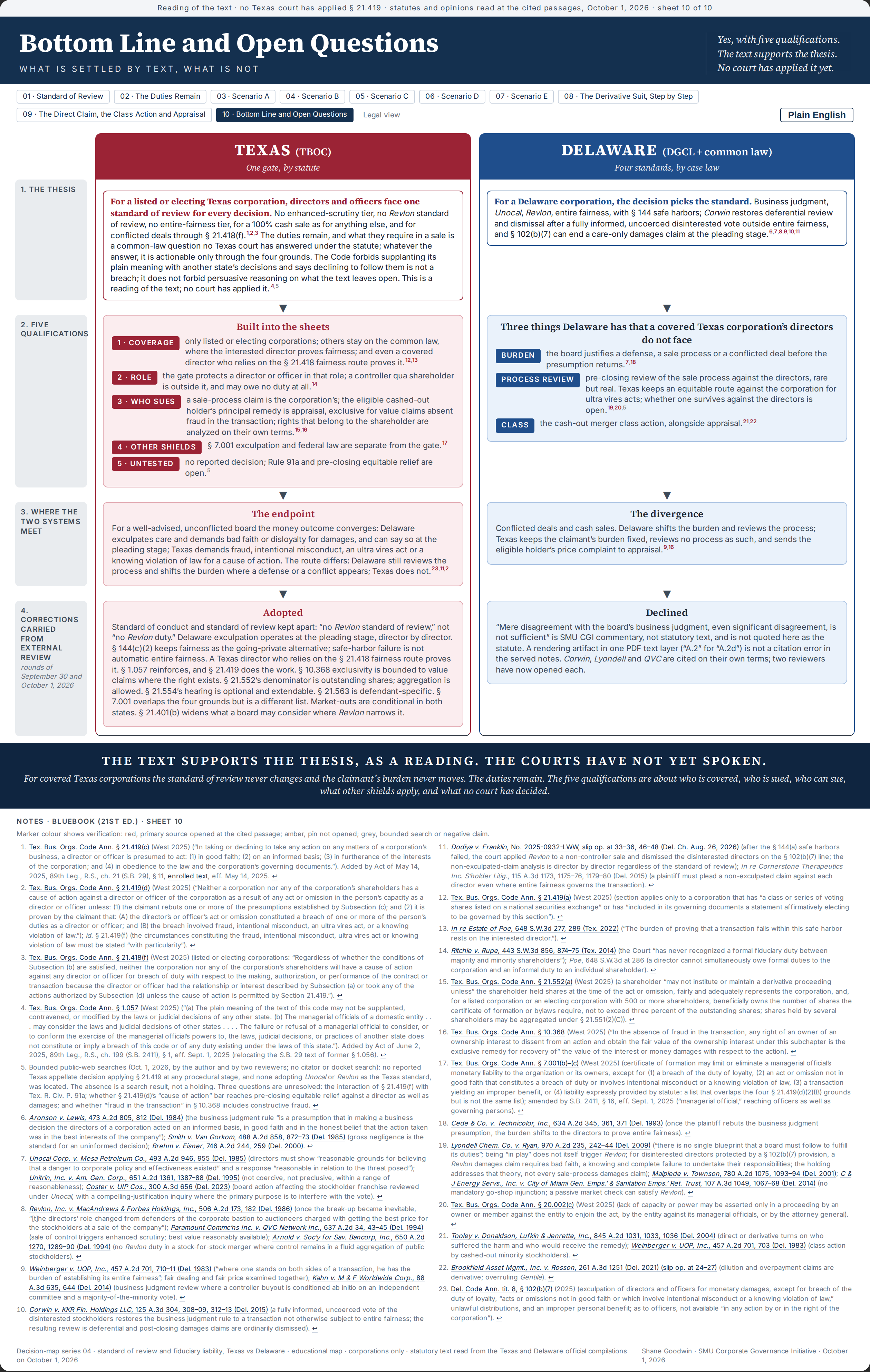
How to read it. Follow either column top to bottom. The grey rail names the question each row answers; the Texas and Delaware columns give each state’s answer with the section or opinion that supplies it. Markers lead to the Bluebook notes under the sheet. The Plain English button at the top of the sheet swaps every cell for an everyday-words version; the legal view and its notes remain the text of record.
The sheets read in order, and each stands alone: 01 and 02 set the frame, 03 to 07 walk one board decision each down both columns, 08 and 09 walk the lawsuit, 10 is the bottom line and the open questions.
Reading of the text · no Texas court has applied § 21.419 · statutes and opinions read at the cited passages, October 1, 2026 · sheet 10 of 10
Bottom Line and Open Questions
What is settled by text, what is not
Yes, with five qualifications.
The text supports the thesis.
No court has applied it yet.
Plain-English view: the same sheet in everyday words, for readers who are not lawyers. It summarizes; the legal view and its notes are the source of record. Click the button again to return.
TEXAS (TBOC)One gate, by statute
DELAWARE (DGCL + common law)Four standards, by case law
1. The thesis
For a listed or electing Texas corporation, directors and officers face one standard of review for every decision. No enhanced-scrutiny tier, no
Revlon standard of review, no entire-fairness tier, for a 100% cash sale as for anything else, and for conflicted deals through § 21.418(f).
123 The duties remain, and what they require in a sale is a common-law question no Texas court has answered under the statute; whatever the answer, it is actionable only through the four grounds. The Code forbids supplanting its plain meaning with another state’s decisions and says declining to follow them is not a breach; it does not forbid persuasive reasoning on what the text leaves open. This is a reading of the text; no court has applied it.
45 For a listed or opted-in Texas company, directors face one standard of review for every decision. No stricter tier for takeover defenses, no best-price test for cash sales, no entire-fairness tier for conflicted deals. The duties themselves remain, and what they require in a sale is not yet decided. The statute says another state’s decisions cannot override its plain words. This is a reading of the text; no court has applied it yet.
For a Delaware corporation, the decision picks the standard. Business judgment,
Unocal,
Revlon, entire fairness, with § 144 safe harbors;
Corwin restores deferential review and dismissal after a fully informed, uncoerced disinterested vote outside entire fairness, and § 102(b)(7) can end a care-only damages claim at the pleading stage.
67891011 For a Delaware company, the decision picks the standard; safe harbors, a clean informed vote and the charter clause can end a money claim early, sometimes at the very start.
2. Five qualifications
Built into the sheets
1 · COVERAGEonly listed or electing corporations; others stay on the common law, where the interested director proves fairness; and even a covered director who relies on the § 21.418 fairness route proves it.1213
2 · ROLEthe gate protects a director or officer in that role; a controller qua shareholder is outside it, and may owe no duty at all.14
3 · WHO SUESa sale-process claim is the corporation’s; the eligible cashed-out holder’s principal remedy is appraisal, exclusive for value claims absent fraud in the transaction; rights that belong to the shareholder are analyzed on their own terms.1516
4 · OTHER SHIELDS§ 7.001 exculpation and federal law are separate from the gate.17
5 · UNTESTEDno reported decision; Rule 91a and pre-closing equitable relief are open.5
Five qualifications: only listed or opted-in companies are covered; only directors and officers are protected; a sale-process claim is the company’s and a cashed-out shareholder’s main remedy is a court-set price; the charter clause and federal law are separate; and no court has applied the statute yet.
Three things Delaware has that a covered Texas corporation’s directors do not face
BURDENthe board justifies a defense, a sale process or a conflicted deal before the presumption returns.718
PROCESS REVIEWpre-closing review of the sale process against the directors, rare but real. Texas keeps an equitable route against the corporation for ultra vires acts; whether one survives against the directors is open.19205
CLASSthe cash-out merger class action, alongside appraisal.2122
Three things Delaware has: the board must justify itself first; a court can review the sale process before closing; and cashed-out shareholders can bring a class action. Texas keeps a route to stop the company itself from acting beyond its powers; whether a court can stop the directors before closing is open.
3. Where the two systems meet
The endpoint
For a well-advised, unconflicted board the money outcome converges: Delaware exculpates care and demands bad faith or disloyalty for damages, and can say so at the pleading stage; Texas demands fraud, intentional misconduct, an ultra vires act or a knowing violation of law for a cause of action. The route differs: Delaware still reviews the process and shifts the burden where a defense or a conflict appears; Texas does not.23112
For an honest, well-advised board the money outcome converges: neither state makes it pay for carelessness. Delaware gets there by review and exculpation; Texas starts there.
The divergence
Conflicted deals and cash sales. Delaware shifts the burden and reviews the process; Texas keeps the claimant’s burden fixed, reviews no process as such, and sends the eligible holder’s price complaint to appraisal.916
The systems diverge on conflicted deals and cash sales, where Delaware shifts the burden and reviews the process and Texas keeps the plaintiff’s burden fixed and reviews no process as such.
4. Corrections carried from external reviewrounds of September 30 and October 1, 2026
Adopted
Standard of conduct and standard of review kept apart: “no Revlon standard of review,” not “no Revlon duty.” Delaware exculpation operates at the pleading stage, director by director. § 144(c)(2) keeps fairness as the going-private alternative; safe-harbor failure is not automatic entire fairness. A Texas director who relies on the § 21.418 fairness route proves it. § 1.057 reinforces, and § 21.419 does the work. § 10.368 exclusivity is bounded to value claims where the right exists. § 21.552’s denominator is outstanding shares; aggregation is allowed. § 21.554’s hearing is optional and extendable. § 21.563 is defendant-specific. § 7.001 overlaps the four grounds but is a different list. Market-outs are conditional in both states. § 21.401(b) widens what a board may consider where Revlon narrows it.
Changes adopted from outside review: keeping ‘what directors owe’ separate from ‘how a court reviews it’; Delaware’s charter shield working at the start of a case; the fairness alternative in Delaware’s controller rule; the Texas insider’s burden to prove a safe harbor; appraisal as a bounded price remedy; the exact standing, hearing and small-company rules.
Declined
“Mere disagreement with the board’s business judgment, even significant disagreement, is not sufficient” is SMU CGI commentary, not statutory text, and is not quoted here as the statute. A rendering artifact in one PDF text layer (“A.2” for “A.2d”) is not a citation error in the served notes. Corwin, Lyondell and QVC are cited on their own terms; two reviewers have now opened each.
Declined: a commentary sentence presented as if it were statutory text, and flags on three Delaware cases that were missing from an earlier source list but are settled law.
THE TEXT SUPPORTS THE THESIS, AS A READING. THE COURTS HAVE NOT YET SPOKEN.For covered Texas corporations the standard of review never changes and the claimant’s burden never moves. The duties remain. The five qualifications are about who is covered, who is sued, who can sue, what other shields apply, and what no court has decided.
Notes · Bluebook (21st ed.) · sheet 10
Marker colour shows verification: red, primary source opened at the cited passage; amber, pin not opened; grey, bounded search or negative claim.
- Tex. Bus. Orgs. Code Ann. § 21.419(c) (West 2025) (“In taking or declining to take any action on any matters of a corporation’s business, a director or officer is presumed to act: (1) in good faith; (2) on an informed basis; (3) in furtherance of the interests of the corporation; and (4) in obedience to the law and the corporation’s governing documents.”). Added by Act of May 14, 2025, 89th Leg., R.S., ch. 21 (S.B. 29), § 11, enrolled text, eff. May 14, 2025. ↩
- Tex. Bus. Orgs. Code Ann. § 21.419(d) (West 2025) (“Neither a corporation nor any of the corporation’s shareholders has a cause of action against a director or officer of the corporation as a result of any act or omission in the person’s capacity as a director or officer unless: (1) the claimant rebuts one or more of the presumptions established by Subsection (c); and (2) it is proven by the claimant that: (A) the director’s or officer’s act or omission constituted a breach of one or more of the person’s duties as a director or officer; and (B) the breach involved fraud, intentional misconduct, an ultra vires act, or a knowing violation of law.”); id. § 21.419(f) (the circumstances constituting the fraud, intentional misconduct, ultra vires act or knowing violation of law must be stated “with particularity”). ↩
- Tex. Bus. Orgs. Code Ann. § 21.418(f) (West 2025) (listed or electing corporations: “Regardless of whether the conditions of Subsection (b) are satisfied, neither the corporation nor any of the corporation’s shareholders will have a cause of action against any director or officer for breach of duty with respect to the making, authorization, or performance of the contract or transaction because the director or officer had the relationship or interest described by Subsection (a) or took any of the actions authorized by Subsection (d) unless the cause of action is permitted by Section 21.419.”). ↩
- Tex. Bus. Orgs. Code Ann. § 1.057 (West 2025) (“(a) The plain meaning of the text of this code may not be supplanted, contravened, or modified by the laws or judicial decisions of any other state. (b) The managerial officials of a domestic entity . . . may consider the laws and judicial decisions of other states . . . . The failure or refusal of a managerial official to consider, or to conform the exercise of the managerial official’s powers to, the laws, judicial decisions, or practices of another state does not constitute or imply a breach of this code or of any duty existing under the laws of this state.”). Added by Act of June 2, 2025, 89th Leg., R.S., ch. 199 (S.B. 2411), § 1, eff. Sept. 1, 2025 (relocating the S.B. 29 text of former § 1.056). ↩
- Bounded public-web searches (Oct. 1, 2026, by the author and by two reviewers; no citator or docket search): no reported Texas appellate decision applying § 21.419 at any procedural stage, and none adopting Unocal or Revlon as the Texas standard, was located. The absence is a search result, not a holding. Three questions are unresolved: the interaction of § 21.419(f) with Tex. R. Civ. P. 91a; whether § 21.419(d)’s “cause of action” bar reaches pre-closing equitable relief against a director as well as damages; and whether “fraud in the transaction” in § 10.368 includes constructive fraud. ↩
- Aronson v. Lewis, 473 A.2d 805, 812 (Del. 1984) (the business judgment rule “is a presumption that in making a business decision the directors of a corporation acted on an informed basis, in good faith and in the honest belief that the action taken was in the best interests of the company”); Smith v. Van Gorkom, 488 A.2d 858, 872–73 (Del. 1985) (gross negligence is the standard for an uninformed decision); Brehm v. Eisner, 746 A.2d 244, 259 (Del. 2000). ↩
- Unocal Corp. v. Mesa Petroleum Co., 493 A.2d 946, 955 (Del. 1985) (directors must show “reasonable grounds for believing that a danger to corporate policy and effectiveness existed” and a response “reasonable in relation to the threat posed”); Unitrin, Inc. v. Am. Gen. Corp., 651 A.2d 1361, 1387–88 (Del. 1995) (not coercive, not preclusive, within a range of reasonableness); Coster v. UIP Cos., 300 A.3d 656 (Del. 2023) (board action affecting the stockholder franchise reviewed under Unocal, with a compelling-justification inquiry where the primary purpose is to interfere with the vote). ↩
- Revlon, Inc. v. MacAndrews & Forbes Holdings, Inc., 506 A.2d 173, 182 (Del. 1986) (once the break-up became inevitable, “[t]he directors’ role changed from defenders of the corporate bastion to auctioneers charged with getting the best price for the stockholders at a sale of the company”); Paramount Commc’ns Inc. v. QVC Network Inc., 637 A.2d 34, 43–45 (Del. 1994) (sale of control triggers enhanced scrutiny; best value reasonably available); Arnold v. Soc’y for Sav. Bancorp, Inc., 650 A.2d 1270, 1289–90 (Del. 1994) (no Revlon duty in a stock-for-stock merger where control remains in a fluid aggregation of public stockholders). ↩
- Weinberger v. UOP, Inc., 457 A.2d 701, 710–11 (Del. 1983) (“where one stands on both sides of a transaction, he has the burden of establishing its entire fairness”; fair dealing and fair price examined together); Kahn v. M & F Worldwide Corp., 88 A.3d 635, 644 (Del. 2014) (business judgment review where a controller buyout is conditioned ab initio on an independent committee and a majority-of-the-minority vote). ↩
- Corwin v. KKR Fin. Holdings LLC, 125 A.3d 304, 308–09, 312–13 (Del. 2015) (a fully informed, uncoerced vote of the disinterested stockholders restores the business judgment rule to a transaction not otherwise subject to entire fairness; the resulting review is deferential and post-closing damages claims are ordinarily dismissed). ↩
- Dodiya v. Franklin, No. 2025-0932-LWW, slip op. at 33–36, 46–48 (Del. Ch. Aug. 26, 2026) (after the § 144(a) safe harbors failed, the court applied Revlon to a non-controller sale and dismissed the disinterested directors on the § 102(b)(7) line; the non-exculpated-claim analysis is director by director regardless of the standard of review); In re Cornerstone Therapeutics Inc. S’holder Litig., 115 A.3d 1173, 1175–76, 1179–80 (Del. 2015) (a plaintiff must plead a non-exculpated claim against each director even where entire fairness governs the transaction). ↩
- Tex. Bus. Orgs. Code Ann. § 21.419(a) (West 2025) (section applies only to a corporation that has “a class or series of voting shares listed on a national securities exchange” or has “included in its governing documents a statement affirmatively electing to be governed by this section”). ↩
- In re Estate of Poe, 648 S.W.3d 277, 289 (Tex. 2022) (“The burden of proving that a transaction falls within this safe harbor rests on the interested director.”). ↩
- Ritchie v. Rupe, 443 S.W.3d 856, 874–75 (Tex. 2014) (the Court “has never recognized a formal fiduciary duty between majority and minority shareholders”); Poe, 648 S.W.3d at 286 (a director cannot simultaneously owe formal duties to the corporation and an informal duty to an individual shareholder). ↩
- Tex. Bus. Orgs. Code Ann. § 21.552(a) (West 2025) (a shareholder “may not institute or maintain a derivative proceeding unless” the shareholder held shares at the time of the act or omission, fairly and adequately represents the corporation, and, for a listed corporation or an electing corporation with 500 or more shareholders, beneficially owns the number of shares the certificate of formation or bylaws require, not to exceed three percent of the outstanding shares; shares held by several shareholders may be aggregated under § 21.551(2)(C)). ↩
- Tex. Bus. Orgs. Code Ann. § 10.368 (West 2025) (“In the absence of fraud in the transaction, any right of an owner of an ownership interest to dissent from an action and obtain the fair value of the ownership interest under this subchapter is the exclusive remedy for recovery of” the value of the interest or money damages with respect to the action). ↩
- Tex. Bus. Orgs. Code Ann. § 7.001(b)–(c) (West 2025) (certificate of formation may limit or eliminate a managerial official’s monetary liability to the organization or its owners, except for (1) a breach of the duty of loyalty, (2) an act or omission not in good faith that constitutes a breach of duty or involves intentional misconduct or a knowing violation of law, (3) a transaction yielding an improper benefit, or (4) liability expressly provided by statute: a list that overlaps the four § 21.419(d)(2)(B) grounds but is not the same list); amended by S.B. 2411, § 16, eff. Sept. 1, 2025 (“managerial official,” reaching officers as well as governing persons). ↩
- Cede & Co. v. Technicolor, Inc., 634 A.2d 345, 361, 371 (Del. 1993) (once the plaintiff rebuts the business judgment presumption, the burden shifts to the directors to prove entire fairness). ↩
- Lyondell Chem. Co. v. Ryan, 970 A.2d 235, 242–44 (Del. 2009) (“there is no single blueprint that a board must follow to fulfill its duties”; being “in play” does not itself trigger Revlon; for disinterested directors protected by a § 102(b)(7) provision, a Revlon damages claim requires bad faith, a knowing and complete failure to undertake their responsibilities; the holding addresses that theory, not every sale-process damages claim); Malpiede v. Townson, 780 A.2d 1075, 1093–94 (Del. 2001); C & J Energy Servs., Inc. v. City of Miami Gen. Emps.’ & Sanitation Emps.’ Ret. Trust, 107 A.3d 1049, 1067–68 (Del. 2014) (no mandatory go-shop injunction; a passive market check can satisfy Revlon). ↩
- Tex. Bus. Orgs. Code Ann. § 20.002(c) (West 2025) (lack of capacity or power may be asserted only in a proceeding by an owner or member against the entity to enjoin the act, by the entity against its managerial officials, or by the attorney general). ↩
- Tooley v. Donaldson, Lufkin & Jenrette, Inc., 845 A.2d 1031, 1033, 1036 (Del. 2004) (direct or derivative turns on who suffered the harm and who would receive the remedy); Weinberger v. UOP, Inc., 457 A.2d 701, 703 (Del. 1983) (class action by cashed-out minority stockholders). ↩
- Brookfield Asset Mgmt., Inc. v. Rosson, 261 A.3d 1251 (Del. 2021) (slip op. at 24–27) (dilution and overpayment claims are derivative; overruling Gentile). ↩
- Del. Code Ann. tit. 8, § 102(b)(7) (2025) (exculpation of directors and officers for monetary damages, except for breach of the duty of loyalty, “acts or omissions not in good faith or which involve intentional misconduct or a knowing violation of law,” unlawful distributions, and an improper personal benefit; as to officers, not available “in any action by or in the right of the corporation”). ↩
Sources behind this sheet (23 notes)
- Tex. Bus. Orgs. Code Ann. § 21.419(c) (West 2025) (“In taking or declining to take any action on any matters of a corporation’s business, a director or officer is presumed to act: (1) in good faith; (2) on an informed basis; (3) in furtherance of the interests of the corporation; and (4) in obedience to the law and the corporation’s governing documents.”). Added by Act of May 14, 2025, 89th Leg., R.S., ch. 21 (S.B. 29), § 11, enrolled text, eff. May 14, 2025. ↩
- Tex. Bus. Orgs. Code Ann. § 21.419(d) (West 2025) (“Neither a corporation nor any of the corporation’s shareholders has a cause of action against a director or officer of the corporation as a result of any act or omission in the person’s capacity as a director or officer unless: (1) the claimant rebuts one or more of the presumptions established by Subsection (c); and (2) it is proven by the claimant that: (A) the director’s or officer’s act or omission constituted a breach of one or more of the person’s duties as a director or officer; and (B) the breach involved fraud, intentional misconduct, an ultra vires act, or a knowing violation of law.”); id. § 21.419(f) (the circumstances constituting the fraud, intentional misconduct, ultra vires act or knowing violation of law must be stated “with particularity”). ↩
- Tex. Bus. Orgs. Code Ann. § 21.418(f) (West 2025) (listed or electing corporations: “Regardless of whether the conditions of Subsection (b) are satisfied, neither the corporation nor any of the corporation’s shareholders will have a cause of action against any director or officer for breach of duty with respect to the making, authorization, or performance of the contract or transaction because the director or officer had the relationship or interest described by Subsection (a) or took any of the actions authorized by Subsection (d) unless the cause of action is permitted by Section 21.419.”). ↩
- Tex. Bus. Orgs. Code Ann. § 1.057 (West 2025) (“(a) The plain meaning of the text of this code may not be supplanted, contravened, or modified by the laws or judicial decisions of any other state. (b) The managerial officials of a domestic entity . . . may consider the laws and judicial decisions of other states . . . . The failure or refusal of a managerial official to consider, or to conform the exercise of the managerial official’s powers to, the laws, judicial decisions, or practices of another state does not constitute or imply a breach of this code or of any duty existing under the laws of this state.”). Added by Act of June 2, 2025, 89th Leg., R.S., ch. 199 (S.B. 2411), § 1, eff. Sept. 1, 2025 (relocating the S.B. 29 text of former § 1.056). ↩
- Bounded public-web searches (Oct. 1, 2026, by the author and by two reviewers; no citator or docket search): no reported Texas appellate decision applying § 21.419 at any procedural stage, and none adopting Unocal or Revlon as the Texas standard, was located. The absence is a search result, not a holding. Three questions are unresolved: the interaction of § 21.419(f) with Tex. R. Civ. P. 91a; whether § 21.419(d)’s “cause of action” bar reaches pre-closing equitable relief against a director as well as damages; and whether “fraud in the transaction” in § 10.368 includes constructive fraud. ↩
- Aronson v. Lewis, 473 A.2d 805, 812 (Del. 1984) (the business judgment rule “is a presumption that in making a business decision the directors of a corporation acted on an informed basis, in good faith and in the honest belief that the action taken was in the best interests of the company”); Smith v. Van Gorkom, 488 A.2d 858, 872–73 (Del. 1985) (gross negligence is the standard for an uninformed decision); Brehm v. Eisner, 746 A.2d 244, 259 (Del. 2000). ↩
- Unocal Corp. v. Mesa Petroleum Co., 493 A.2d 946, 955 (Del. 1985) (directors must show “reasonable grounds for believing that a danger to corporate policy and effectiveness existed” and a response “reasonable in relation to the threat posed”); Unitrin, Inc. v. Am. Gen. Corp., 651 A.2d 1361, 1387–88 (Del. 1995) (not coercive, not preclusive, within a range of reasonableness); Coster v. UIP Cos., 300 A.3d 656 (Del. 2023) (board action affecting the stockholder franchise reviewed under Unocal, with a compelling-justification inquiry where the primary purpose is to interfere with the vote). ↩
- Revlon, Inc. v. MacAndrews & Forbes Holdings, Inc., 506 A.2d 173, 182 (Del. 1986) (once the break-up became inevitable, “[t]he directors’ role changed from defenders of the corporate bastion to auctioneers charged with getting the best price for the stockholders at a sale of the company”); Paramount Commc’ns Inc. v. QVC Network Inc., 637 A.2d 34, 43–45 (Del. 1994) (sale of control triggers enhanced scrutiny; best value reasonably available); Arnold v. Soc’y for Sav. Bancorp, Inc., 650 A.2d 1270, 1289–90 (Del. 1994) (no Revlon duty in a stock-for-stock merger where control remains in a fluid aggregation of public stockholders). ↩
- Weinberger v. UOP, Inc., 457 A.2d 701, 710–11 (Del. 1983) (“where one stands on both sides of a transaction, he has the burden of establishing its entire fairness”; fair dealing and fair price examined together); Kahn v. M & F Worldwide Corp., 88 A.3d 635, 644 (Del. 2014) (business judgment review where a controller buyout is conditioned ab initio on an independent committee and a majority-of-the-minority vote). ↩
- Corwin v. KKR Fin. Holdings LLC, 125 A.3d 304, 308–09, 312–13 (Del. 2015) (a fully informed, uncoerced vote of the disinterested stockholders restores the business judgment rule to a transaction not otherwise subject to entire fairness; the resulting review is deferential and post-closing damages claims are ordinarily dismissed). ↩
- Dodiya v. Franklin, No. 2025-0932-LWW, slip op. at 33–36, 46–48 (Del. Ch. Aug. 26, 2026) (after the § 144(a) safe harbors failed, the court applied Revlon to a non-controller sale and dismissed the disinterested directors on the § 102(b)(7) line; the non-exculpated-claim analysis is director by director regardless of the standard of review); In re Cornerstone Therapeutics Inc. S’holder Litig., 115 A.3d 1173, 1175–76, 1179–80 (Del. 2015) (a plaintiff must plead a non-exculpated claim against each director even where entire fairness governs the transaction). ↩
- Tex. Bus. Orgs. Code Ann. § 21.419(a) (West 2025) (section applies only to a corporation that has “a class or series of voting shares listed on a national securities exchange” or has “included in its governing documents a statement affirmatively electing to be governed by this section”). ↩
- In re Estate of Poe, 648 S.W.3d 277, 289 (Tex. 2022) (“The burden of proving that a transaction falls within this safe harbor rests on the interested director.”). ↩
- Ritchie v. Rupe, 443 S.W.3d 856, 874–75 (Tex. 2014) (the Court “has never recognized a formal fiduciary duty between majority and minority shareholders”); Poe, 648 S.W.3d at 286 (a director cannot simultaneously owe formal duties to the corporation and an informal duty to an individual shareholder). ↩
- Tex. Bus. Orgs. Code Ann. § 21.552(a) (West 2025) (a shareholder “may not institute or maintain a derivative proceeding unless” the shareholder held shares at the time of the act or omission, fairly and adequately represents the corporation, and, for a listed corporation or an electing corporation with 500 or more shareholders, beneficially owns the number of shares the certificate of formation or bylaws require, not to exceed three percent of the outstanding shares; shares held by several shareholders may be aggregated under § 21.551(2)(C)). ↩
- Tex. Bus. Orgs. Code Ann. § 10.368 (West 2025) (“In the absence of fraud in the transaction, any right of an owner of an ownership interest to dissent from an action and obtain the fair value of the ownership interest under this subchapter is the exclusive remedy for recovery of” the value of the interest or money damages with respect to the action). ↩
- Tex. Bus. Orgs. Code Ann. § 7.001(b)–(c) (West 2025) (certificate of formation may limit or eliminate a managerial official’s monetary liability to the organization or its owners, except for (1) a breach of the duty of loyalty, (2) an act or omission not in good faith that constitutes a breach of duty or involves intentional misconduct or a knowing violation of law, (3) a transaction yielding an improper benefit, or (4) liability expressly provided by statute: a list that overlaps the four § 21.419(d)(2)(B) grounds but is not the same list); amended by S.B. 2411, § 16, eff. Sept. 1, 2025 (“managerial official,” reaching officers as well as governing persons). ↩
- Cede & Co. v. Technicolor, Inc., 634 A.2d 345, 361, 371 (Del. 1993) (once the plaintiff rebuts the business judgment presumption, the burden shifts to the directors to prove entire fairness). ↩
- Lyondell Chem. Co. v. Ryan, 970 A.2d 235, 242–44 (Del. 2009) (“there is no single blueprint that a board must follow to fulfill its duties”; being “in play” does not itself trigger Revlon; for disinterested directors protected by a § 102(b)(7) provision, a Revlon damages claim requires bad faith, a knowing and complete failure to undertake their responsibilities; the holding addresses that theory, not every sale-process damages claim); Malpiede v. Townson, 780 A.2d 1075, 1093–94 (Del. 2001); C & J Energy Servs., Inc. v. City of Miami Gen. Emps.’ & Sanitation Emps.’ Ret. Trust, 107 A.3d 1049, 1067–68 (Del. 2014) (no mandatory go-shop injunction; a passive market check can satisfy Revlon). ↩
- Tex. Bus. Orgs. Code Ann. § 20.002(c) (West 2025) (lack of capacity or power may be asserted only in a proceeding by an owner or member against the entity to enjoin the act, by the entity against its managerial officials, or by the attorney general). ↩
- Tooley v. Donaldson, Lufkin & Jenrette, Inc., 845 A.2d 1031, 1033, 1036 (Del. 2004) (direct or derivative turns on who suffered the harm and who would receive the remedy); Weinberger v. UOP, Inc., 457 A.2d 701, 703 (Del. 1983) (class action by cashed-out minority stockholders). ↩
- Brookfield Asset Mgmt., Inc. v. Rosson, 261 A.3d 1251 (Del. 2021) (slip op. at 24–27) (dilution and overpayment claims are derivative; overruling Gentile). ↩
- Del. Code Ann. tit. 8, § 102(b)(7) (2025) (exculpation of directors and officers for monetary damages, except for breach of the duty of loyalty, “acts or omissions not in good faith or which involve intentional misconduct or a knowing violation of law,” unlawful distributions, and an improper personal benefit; as to officers, not available “in any action by or in the right of the corporation”). ↩
Decision-map series 04 · standard of review and fiduciary liability, Texas vs Delaware · educational map · corporations only · statutory text read from the Texas and Delaware official compilations on October 1, 2026Shane Goodwin · SMU Corporate Governance Initiative · October 1, 2026
Read the statutes and the opinions
- Tex. S.B. 29, 89th Leg., R.S. (2025) (enrolled) — §§ 21.416(g), 21.4161, 21.418, 21.419, 21.552, 2.115, 2.116, eff. May 14, 2025.
- Tex. Bus. Orgs. Code § 21.419 (the liability gate); § 21.401 (what a board may consider); § 21.418 (interested directors and officers); §§ 21.551–21.563 (derivative proceedings); § 7.001 (exculpation); § 20.002 (ultra vires); §§ 10.354 and 10.368 (dissent and appraisal); § 1.057 (construction).
- Del. Code Ann. tit. 8, § 144 (as amended by 85 Del. Laws c. 6, S.B. 21, eff. Mar. 25, 2025); § 102(b)(7) (exculpation); § 262 (appraisal).
- Delaware: Aronson v. Lewis, 473 A.2d 805 (Del. 1984); Unocal Corp. v. Mesa Petroleum Co., 493 A.2d 946 (Del. 1985); Revlon, Inc. v. MacAndrews & Forbes Holdings, Inc., 506 A.2d 173 (Del. 1986); Paramount Communications Inc. v. QVC Network Inc., 637 A.2d 34 (Del. 1994); Weinberger v. UOP, Inc., 457 A.2d 701 (Del. 1983); Cede & Co. v. Technicolor, Inc., 634 A.2d 345 (Del. 1993); Zapata Corp. v. Maldonado, 430 A.2d 779 (Del. 1981); RBC Capital Markets, LLC v. Jervis, 129 A.3d 816 (Del. 2015); Lyondell Chemical Co. v. Ryan, 970 A.2d 235 (Del. 2009); Corwin v. KKR Financial Holdings LLC, 125 A.3d 304 (Del. 2015); Stone v. Ritter, 911 A.2d 362 (Del. 2006); Tooley v. Donaldson, Lufkin & Jenrette, Inc., 845 A.2d 1031 (Del. 2004); Brookfield Asset Management, Inc. v. Rosson, 261 A.3d 1251 (Del. 2021); United Food & Commercial Workers Union v. Zuckerberg, 262 A.3d 1034 (Del. 2021); Dodiya v. Franklin, C.A. No. 2025-0932-LWW (Del. Ch. Aug. 26, 2026).
- Texas: In re Estate of Poe, 648 S.W.3d 277 (Tex. 2022); Ritchie v. Rupe, 443 S.W.3d 856 (Tex. 2014); Sneed v. Webre, 465 S.W.3d 169 (Tex. 2015); Gearhart Industries, Inc. v. Smith International, Inc., 741 F.2d 707 (5th Cir. 1984); Wingate v. Hajdik, 795 S.W.2d 717 (Tex. 1990); International Bankers Life Insurance Co. v. Holloway, 368 S.W.2d 567 (Tex. 1963); Cates v. Sparkman, 73 Tex. 619, 11 S.W. 846 (1889); Gusinsky v. Reynolds, No. 3:25-cv-01816-K (N.D. Tex. Mar. 17, 2026). Each sheet carries its own Bluebook notes beneath the chart, with a link to each opinion; the marker colour says whether the cited passage was opened. Opinions are collected on the vertical’s sources page.
Educational map. Corporations only; LLC and partnership analogues differ. A reading of the statutory text: no Texas court has applied § 21.419 to a sale, a defense or a conflicted deal. Nothing here is legal advice.