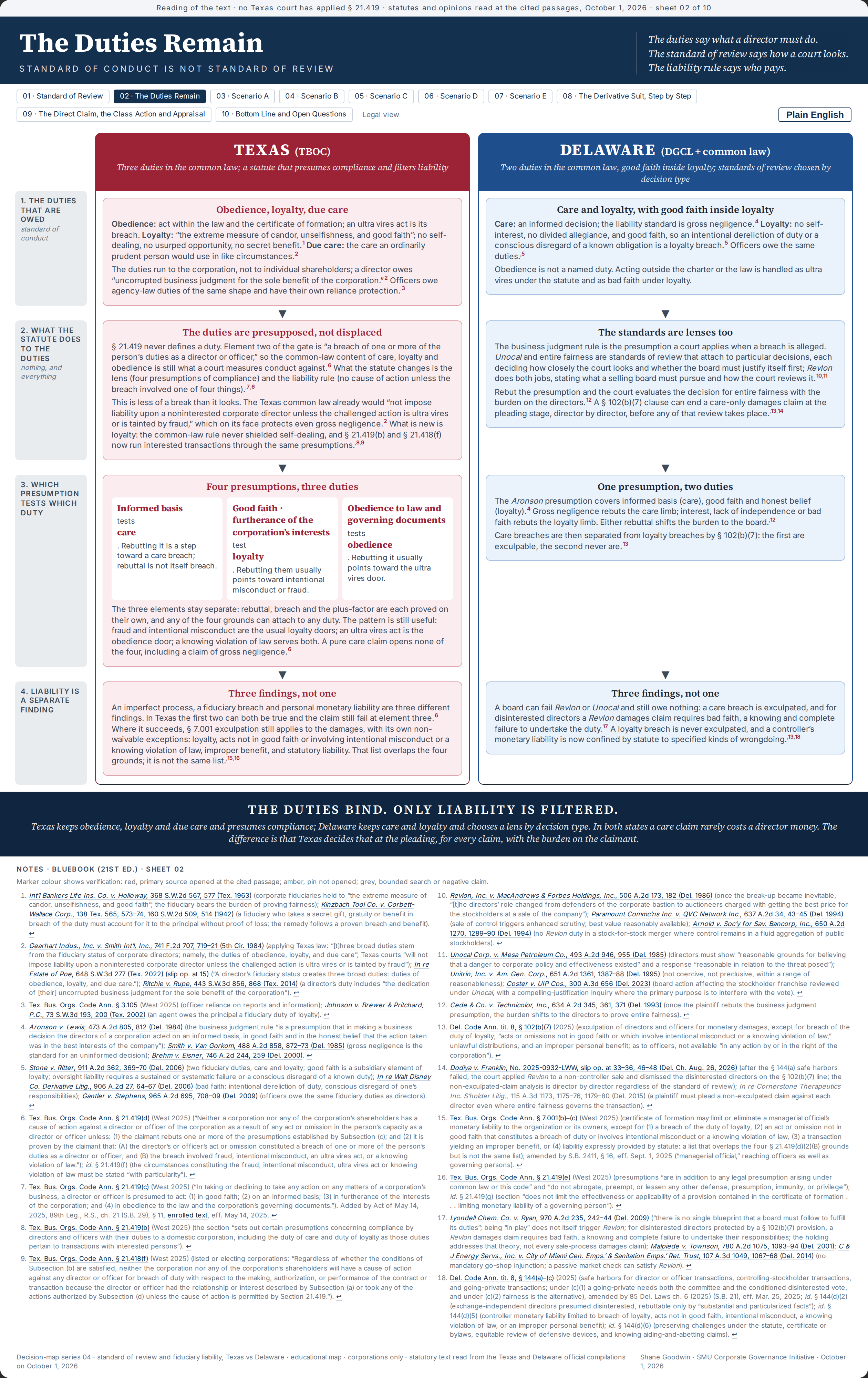
How to read it. Follow either column top to bottom. The grey rail names the question each row answers; the Texas and Delaware columns give each state’s answer with the section or opinion that supplies it. Markers lead to the Bluebook notes under the sheet. The Plain English button at the top of the sheet swaps every cell for an everyday-words version; the legal view and its notes remain the text of record.
The sheets read in order, and each stands alone: 01 and 02 set the frame, 03 to 07 walk one board decision each down both columns, 08 and 09 walk the lawsuit, 10 is the bottom line and the open questions.
Reading of the text · no Texas court has applied § 21.419 · statutes and opinions read at the cited passages, October 1, 2026 · sheet 02 of 10
The Duties Remain
Standard of conduct is not standard of review
The duties say what a director must do.
The standard of review says how a court looks.
The liability rule says who pays.
Plain-English view: the same sheet in everyday words, for readers who are not lawyers. It summarizes; the legal view and its notes are the source of record. Click the button again to return.
TEXAS (TBOC)Three duties in the common law; a statute that presumes compliance and filters liability
DELAWARE (DGCL + common law)Two duties in the common law, good faith inside loyalty; standards of review chosen by decision type
1. The duties that are owedstandard of conduct
Obedience, loyalty, due care
Obedience: act within the law and the certificate of formation; an ultra vires act is its breach. Loyalty: “the extreme measure of candor, unselfishness, and good faith”; no self-dealing, no usurped opportunity, no secret benefit.1 Due care: the care an ordinarily prudent person would use in like circumstances.2
The duties run to the corporation, not to individual shareholders; a director owes “uncorrupted business judgment for the sole benefit of the corporation.”2 Officers owe agency-law duties of the same shape and have their own reliance protection.3
Texas directors owe three duties: obedience (stay within the law and the charter), loyalty (no self-dealing, no secret benefits, complete candor) and care (the diligence a prudent person would use). The duties are owed to the company, not to individual shareholders. Officers owe duties of the same shape.
Care and loyalty, with good faith inside loyalty
Care: an informed decision; the liability standard is gross negligence.4 Loyalty: no self-interest, no divided allegiance, and good faith, so an intentional dereliction of duty or a conscious disregard of a known obligation is a loyalty breach.5 Officers owe the same duties.5
Obedience is not a named duty. Acting outside the charter or the law is handled as ultra vires under the statute and as bad faith under loyalty.
Delaware directors owe two duties: care (make informed decisions) and loyalty (put the company first and act in good faith). Delaware folds good faith into loyalty, so deliberately ignoring a known duty counts as disloyalty. Officers owe the same duties.
2. What the statute does to the dutiesnothing, and everything
The duties are presupposed, not displaced
§ 21.419 never defines a duty. Element two of the gate is “a breach of one or more of the person’s duties as a director or officer,” so the common-law content of care, loyalty and obedience is still what a court measures conduct against.6 What the statute changes is the lens (four presumptions of compliance) and the liability rule (no cause of action unless the breach involved one of four things).76
This is less of a break than it looks. The Texas common law already would “not impose liability upon a noninterested corporate director unless the challenged action is ultra vires or is tainted by fraud,” which on its face protects even gross negligence.2 What is new is loyalty: the common-law rule never shielded self-dealing, and § 21.419(b) and § 21.418(f) now run interested transactions through the same presumptions.89
The statute does not change the duties. It still asks whether a director broke one of them. What it changes is the starting assumption (the four presumptions) and the price of admission to court (the breach must involve fraud, deliberate wrongdoing, an act beyond the company’s powers or a knowing violation of law). Texas judges already protected honest directors this way; the new part is that insider deals now get the same presumptions.
The standards are lenses too
The business judgment rule is the presumption a court applies when a breach is alleged. Unocal and entire fairness are standards of review that attach to particular decisions, each deciding how closely the court looks and whether the board must justify itself first; Revlon does both jobs, stating what a selling board must pursue and how the court reviews it.1011
Rebut the presumption and the court evaluates the decision for entire fairness with the burden on the directors.12 A § 102(b)(7) clause can end a care-only damages claim at the pleading stage, director by director, before any of that review takes place.1314
Delaware’s famous tests are also not duties. They are lenses: how closely the court looks and whether the directors must justify themselves first. If a plaintiff knocks down the presumption, the directors must prove the decision was entirely fair, and a charter clause then decides whether a careless mistake costs them money.
3. Which presumption tests which duty
Four presumptions, three duties
Informed basistests care. Rebutting it is a step toward a care breach; rebuttal is not itself breach.
Good faith · furtherance of the corporation’s intereststest loyalty. Rebutting them usually points toward intentional misconduct or fraud.
Obedience to law and governing documentstests obedience. Rebutting it usually points toward the ultra vires door.
The three elements stay separate: rebuttal, breach and the plus-factor are each proved on their own, and any of the four grounds can attach to any duty. The pattern is still useful: fraud and intentional misconduct are the usual loyalty doors; an ultra vires act is the obedience door; a knowing violation of law serves both. A pure care claim opens none of the four, including a claim of gross negligence.6
Each presumption matches a duty. ‘Informed basis’ tests care. ‘Good faith’ and ‘for the company’s benefit’ test loyalty. ‘Obedience to law and the charter’ tests obedience. Which door a lawsuit can open follows from which duty it alleges, and a pure carelessness claim opens none of the four doors.
One presumption, two duties
The Aronson presumption covers informed basis (care), good faith and honest belief (loyalty).4 Gross negligence rebuts the care limb; interest, lack of independence or bad faith rebuts the loyalty limb. Either rebuttal shifts the burden to the board.12
Care breaches are then separated from loyalty breaches by § 102(b)(7): the first are exculpable, the second never are.13
Delaware’s single presumption covers both duties. Serious carelessness knocks down the care side; a personal interest or bad faith knocks down the loyalty side. Either way the burden moves to the directors. A charter clause then separates the two: carelessness can be excused, disloyalty never is.
4. Liability is a separate finding
Three findings, not one
An imperfect process, a fiduciary breach and personal monetary liability are three different findings. In Texas the first two can both be true and the claim still fail at element three.6 Where it succeeds, § 7.001 exculpation still applies to the damages, with its own non-waivable exceptions: loyalty, acts not in good faith or involving intentional misconduct or a knowing violation of law, improper benefit, and statutory liability. That list overlaps the four grounds; it is not the same list.1516
A bad process, a broken duty and a personal bill are three different findings. In Texas the first two can both be true and the case still fails on the third. Even when it succeeds, a charter clause can still limit the damages, with its own list of exceptions.
Three findings, not one
A board can fail Revlon or Unocal and still owe nothing: a care breach is exculpated, and for disinterested directors a Revlon damages claim requires bad faith, a knowing and complete failure to undertake the duty.17 A loyalty breach is never exculpated, and a controller’s monetary liability is now confined by statute to specified kinds of wrongdoing.1318
A Delaware board can fail the court’s test and still owe nothing, because carelessness is excused by the charter and damages for a sale-process failure require a near-total abdication. Disloyalty is never excused.
THE DUTIES BIND. ONLY LIABILITY IS FILTERED.Texas keeps obedience, loyalty and due care and presumes compliance; Delaware keeps care and loyalty and chooses a lens by decision type. In both states a care claim rarely costs a director money. The difference is that Texas decides that at the pleading, for every claim, with the burden on the claimant.
Notes · Bluebook (21st ed.) · sheet 02
Marker colour shows verification: red, primary source opened at the cited passage; amber, pin not opened; grey, bounded search or negative claim.
- Int’l Bankers Life Ins. Co. v. Holloway, 368 S.W.2d 567, 577 (Tex. 1963) (corporate fiduciaries held to “the extreme measure of candor, unselfishness, and good faith”; the fiduciary bears the burden of proving fairness); Kinzbach Tool Co. v. Corbett-Wallace Corp., 138 Tex. 565, 573–74, 160 S.W.2d 509, 514 (1942) (a fiduciary who takes a secret gift, gratuity or benefit in breach of the duty must account for it to the principal without proof of loss; the remedy follows a proven breach and benefit). ↩
- Gearhart Indus., Inc. v. Smith Int’l, Inc., 741 F.2d 707, 719–21 (5th Cir. 1984) (applying Texas law: “[t]hree broad duties stem from the fiduciary status of corporate directors; namely, the duties of obedience, loyalty, and due care”; Texas courts “will not impose liability upon a noninterested corporate director unless the challenged action is ultra vires or is tainted by fraud”); In re Estate of Poe, 648 S.W.3d 277 (Tex. 2022) (slip op. at 15) (“A director’s fiduciary status creates three broad duties: duties of obedience, loyalty, and due care.”); Ritchie v. Rupe, 443 S.W.3d 856, 868 (Tex. 2014) (a director’s duty includes “the dedication of [their] uncorrupted business judgment for the sole benefit of the corporation”). ↩
- Tex. Bus. Orgs. Code Ann. § 3.105 (West 2025) (officer reliance on reports and information); Johnson v. Brewer & Pritchard, P.C., 73 S.W.3d 193, 200 (Tex. 2002) (an agent owes the principal a fiduciary duty of loyalty). ↩
- Aronson v. Lewis, 473 A.2d 805, 812 (Del. 1984) (the business judgment rule “is a presumption that in making a business decision the directors of a corporation acted on an informed basis, in good faith and in the honest belief that the action taken was in the best interests of the company”); Smith v. Van Gorkom, 488 A.2d 858, 872–73 (Del. 1985) (gross negligence is the standard for an uninformed decision); Brehm v. Eisner, 746 A.2d 244, 259 (Del. 2000). ↩
- Stone v. Ritter, 911 A.2d 362, 369–70 (Del. 2006) (two fiduciary duties, care and loyalty; good faith is a subsidiary element of loyalty; oversight liability requires a sustained or systematic failure or a conscious disregard of a known duty); In re Walt Disney Co. Derivative Litig., 906 A.2d 27, 64–67 (Del. 2006) (bad faith: intentional dereliction of duty, conscious disregard of one’s responsibilities); Gantler v. Stephens, 965 A.2d 695, 708–09 (Del. 2009) (officers owe the same fiduciary duties as directors). ↩
- Tex. Bus. Orgs. Code Ann. § 21.419(d) (West 2025) (“Neither a corporation nor any of the corporation’s shareholders has a cause of action against a director or officer of the corporation as a result of any act or omission in the person’s capacity as a director or officer unless: (1) the claimant rebuts one or more of the presumptions established by Subsection (c); and (2) it is proven by the claimant that: (A) the director’s or officer’s act or omission constituted a breach of one or more of the person’s duties as a director or officer; and (B) the breach involved fraud, intentional misconduct, an ultra vires act, or a knowing violation of law.”); id. § 21.419(f) (the circumstances constituting the fraud, intentional misconduct, ultra vires act or knowing violation of law must be stated “with particularity”). ↩
- Tex. Bus. Orgs. Code Ann. § 21.419(c) (West 2025) (“In taking or declining to take any action on any matters of a corporation’s business, a director or officer is presumed to act: (1) in good faith; (2) on an informed basis; (3) in furtherance of the interests of the corporation; and (4) in obedience to the law and the corporation’s governing documents.”). Added by Act of May 14, 2025, 89th Leg., R.S., ch. 21 (S.B. 29), § 11, enrolled text, eff. May 14, 2025. ↩
- Tex. Bus. Orgs. Code Ann. § 21.419(b) (West 2025) (the section “sets out certain presumptions concerning compliance by directors and officers with their duties to a domestic corporation, including the duty of care and duty of loyalty as those duties pertain to transactions with interested persons”). ↩
- Tex. Bus. Orgs. Code Ann. § 21.418(f) (West 2025) (listed or electing corporations: “Regardless of whether the conditions of Subsection (b) are satisfied, neither the corporation nor any of the corporation’s shareholders will have a cause of action against any director or officer for breach of duty with respect to the making, authorization, or performance of the contract or transaction because the director or officer had the relationship or interest described by Subsection (a) or took any of the actions authorized by Subsection (d) unless the cause of action is permitted by Section 21.419.”). ↩
- Revlon, Inc. v. MacAndrews & Forbes Holdings, Inc., 506 A.2d 173, 182 (Del. 1986) (once the break-up became inevitable, “[t]he directors’ role changed from defenders of the corporate bastion to auctioneers charged with getting the best price for the stockholders at a sale of the company”); Paramount Commc’ns Inc. v. QVC Network Inc., 637 A.2d 34, 43–45 (Del. 1994) (sale of control triggers enhanced scrutiny; best value reasonably available); Arnold v. Soc’y for Sav. Bancorp, Inc., 650 A.2d 1270, 1289–90 (Del. 1994) (no Revlon duty in a stock-for-stock merger where control remains in a fluid aggregation of public stockholders). ↩
- Unocal Corp. v. Mesa Petroleum Co., 493 A.2d 946, 955 (Del. 1985) (directors must show “reasonable grounds for believing that a danger to corporate policy and effectiveness existed” and a response “reasonable in relation to the threat posed”); Unitrin, Inc. v. Am. Gen. Corp., 651 A.2d 1361, 1387–88 (Del. 1995) (not coercive, not preclusive, within a range of reasonableness); Coster v. UIP Cos., 300 A.3d 656 (Del. 2023) (board action affecting the stockholder franchise reviewed under Unocal, with a compelling-justification inquiry where the primary purpose is to interfere with the vote). ↩
- Cede & Co. v. Technicolor, Inc., 634 A.2d 345, 361, 371 (Del. 1993) (once the plaintiff rebuts the business judgment presumption, the burden shifts to the directors to prove entire fairness). ↩
- Del. Code Ann. tit. 8, § 102(b)(7) (2025) (exculpation of directors and officers for monetary damages, except for breach of the duty of loyalty, “acts or omissions not in good faith or which involve intentional misconduct or a knowing violation of law,” unlawful distributions, and an improper personal benefit; as to officers, not available “in any action by or in the right of the corporation”). ↩
- Dodiya v. Franklin, No. 2025-0932-LWW, slip op. at 33–36, 46–48 (Del. Ch. Aug. 26, 2026) (after the § 144(a) safe harbors failed, the court applied Revlon to a non-controller sale and dismissed the disinterested directors on the § 102(b)(7) line; the non-exculpated-claim analysis is director by director regardless of the standard of review); In re Cornerstone Therapeutics Inc. S’holder Litig., 115 A.3d 1173, 1175–76, 1179–80 (Del. 2015) (a plaintiff must plead a non-exculpated claim against each director even where entire fairness governs the transaction). ↩
- Tex. Bus. Orgs. Code Ann. § 7.001(b)–(c) (West 2025) (certificate of formation may limit or eliminate a managerial official’s monetary liability to the organization or its owners, except for (1) a breach of the duty of loyalty, (2) an act or omission not in good faith that constitutes a breach of duty or involves intentional misconduct or a knowing violation of law, (3) a transaction yielding an improper benefit, or (4) liability expressly provided by statute: a list that overlaps the four § 21.419(d)(2)(B) grounds but is not the same list); amended by S.B. 2411, § 16, eff. Sept. 1, 2025 (“managerial official,” reaching officers as well as governing persons). ↩
- Tex. Bus. Orgs. Code Ann. § 21.419(e) (West 2025) (presumptions “are in addition to any legal presumption arising under common law or this code” and “do not abrogate, preempt, or lessen any other defense, presumption, immunity, or privilege”); id. § 21.419(g) (section “does not limit the effectiveness or applicability of a provision contained in the certificate of formation . . . limiting monetary liability of a governing person”). ↩
- Lyondell Chem. Co. v. Ryan, 970 A.2d 235, 242–44 (Del. 2009) (“there is no single blueprint that a board must follow to fulfill its duties”; being “in play” does not itself trigger Revlon; for disinterested directors protected by a § 102(b)(7) provision, a Revlon damages claim requires bad faith, a knowing and complete failure to undertake their responsibilities; the holding addresses that theory, not every sale-process damages claim); Malpiede v. Townson, 780 A.2d 1075, 1093–94 (Del. 2001); C & J Energy Servs., Inc. v. City of Miami Gen. Emps.’ & Sanitation Emps.’ Ret. Trust, 107 A.3d 1049, 1067–68 (Del. 2014) (no mandatory go-shop injunction; a passive market check can satisfy Revlon). ↩
- Del. Code Ann. tit. 8, § 144(a)–(c) (2025) (safe harbors for director or officer transactions, controlling-stockholder transactions, and going-private transactions; under (c)(1) a going-private needs both the committee and the conditioned disinterested vote, and under (c)(2) fairness is the alternative), amended by 85 Del. Laws ch. 6 (2025) (S.B. 21), eff. Mar. 25, 2025; id. § 144(d)(2) (exchange-independent directors presumed disinterested, rebuttable only by “substantial and particularized facts”); id. § 144(d)(5) (controller monetary liability limited to breach of loyalty, acts not in good faith, intentional misconduct, a knowing violation of law, or an improper personal benefit); id. § 144(d)(6) (preserving challenges under the statute, certificate or bylaws, equitable review of defensive devices, and knowing aiding-and-abetting claims). ↩
Sources behind this sheet (18 notes)
- Int’l Bankers Life Ins. Co. v. Holloway, 368 S.W.2d 567, 577 (Tex. 1963) (corporate fiduciaries held to “the extreme measure of candor, unselfishness, and good faith”; the fiduciary bears the burden of proving fairness); Kinzbach Tool Co. v. Corbett-Wallace Corp., 138 Tex. 565, 573–74, 160 S.W.2d 509, 514 (1942) (a fiduciary who takes a secret gift, gratuity or benefit in breach of the duty must account for it to the principal without proof of loss; the remedy follows a proven breach and benefit). ↩
- Gearhart Indus., Inc. v. Smith Int’l, Inc., 741 F.2d 707, 719–21 (5th Cir. 1984) (applying Texas law: “[t]hree broad duties stem from the fiduciary status of corporate directors; namely, the duties of obedience, loyalty, and due care”; Texas courts “will not impose liability upon a noninterested corporate director unless the challenged action is ultra vires or is tainted by fraud”); In re Estate of Poe, 648 S.W.3d 277 (Tex. 2022) (slip op. at 15) (“A director’s fiduciary status creates three broad duties: duties of obedience, loyalty, and due care.”); Ritchie v. Rupe, 443 S.W.3d 856, 868 (Tex. 2014) (a director’s duty includes “the dedication of [their] uncorrupted business judgment for the sole benefit of the corporation”). ↩
- Tex. Bus. Orgs. Code Ann. § 3.105 (West 2025) (officer reliance on reports and information); Johnson v. Brewer & Pritchard, P.C., 73 S.W.3d 193, 200 (Tex. 2002) (an agent owes the principal a fiduciary duty of loyalty). ↩
- Aronson v. Lewis, 473 A.2d 805, 812 (Del. 1984) (the business judgment rule “is a presumption that in making a business decision the directors of a corporation acted on an informed basis, in good faith and in the honest belief that the action taken was in the best interests of the company”); Smith v. Van Gorkom, 488 A.2d 858, 872–73 (Del. 1985) (gross negligence is the standard for an uninformed decision); Brehm v. Eisner, 746 A.2d 244, 259 (Del. 2000). ↩
- Stone v. Ritter, 911 A.2d 362, 369–70 (Del. 2006) (two fiduciary duties, care and loyalty; good faith is a subsidiary element of loyalty; oversight liability requires a sustained or systematic failure or a conscious disregard of a known duty); In re Walt Disney Co. Derivative Litig., 906 A.2d 27, 64–67 (Del. 2006) (bad faith: intentional dereliction of duty, conscious disregard of one’s responsibilities); Gantler v. Stephens, 965 A.2d 695, 708–09 (Del. 2009) (officers owe the same fiduciary duties as directors). ↩
- Tex. Bus. Orgs. Code Ann. § 21.419(d) (West 2025) (“Neither a corporation nor any of the corporation’s shareholders has a cause of action against a director or officer of the corporation as a result of any act or omission in the person’s capacity as a director or officer unless: (1) the claimant rebuts one or more of the presumptions established by Subsection (c); and (2) it is proven by the claimant that: (A) the director’s or officer’s act or omission constituted a breach of one or more of the person’s duties as a director or officer; and (B) the breach involved fraud, intentional misconduct, an ultra vires act, or a knowing violation of law.”); id. § 21.419(f) (the circumstances constituting the fraud, intentional misconduct, ultra vires act or knowing violation of law must be stated “with particularity”). ↩
- Tex. Bus. Orgs. Code Ann. § 21.419(c) (West 2025) (“In taking or declining to take any action on any matters of a corporation’s business, a director or officer is presumed to act: (1) in good faith; (2) on an informed basis; (3) in furtherance of the interests of the corporation; and (4) in obedience to the law and the corporation’s governing documents.”). Added by Act of May 14, 2025, 89th Leg., R.S., ch. 21 (S.B. 29), § 11, enrolled text, eff. May 14, 2025. ↩
- Tex. Bus. Orgs. Code Ann. § 21.419(b) (West 2025) (the section “sets out certain presumptions concerning compliance by directors and officers with their duties to a domestic corporation, including the duty of care and duty of loyalty as those duties pertain to transactions with interested persons”). ↩
- Tex. Bus. Orgs. Code Ann. § 21.418(f) (West 2025) (listed or electing corporations: “Regardless of whether the conditions of Subsection (b) are satisfied, neither the corporation nor any of the corporation’s shareholders will have a cause of action against any director or officer for breach of duty with respect to the making, authorization, or performance of the contract or transaction because the director or officer had the relationship or interest described by Subsection (a) or took any of the actions authorized by Subsection (d) unless the cause of action is permitted by Section 21.419.”). ↩
- Revlon, Inc. v. MacAndrews & Forbes Holdings, Inc., 506 A.2d 173, 182 (Del. 1986) (once the break-up became inevitable, “[t]he directors’ role changed from defenders of the corporate bastion to auctioneers charged with getting the best price for the stockholders at a sale of the company”); Paramount Commc’ns Inc. v. QVC Network Inc., 637 A.2d 34, 43–45 (Del. 1994) (sale of control triggers enhanced scrutiny; best value reasonably available); Arnold v. Soc’y for Sav. Bancorp, Inc., 650 A.2d 1270, 1289–90 (Del. 1994) (no Revlon duty in a stock-for-stock merger where control remains in a fluid aggregation of public stockholders). ↩
- Unocal Corp. v. Mesa Petroleum Co., 493 A.2d 946, 955 (Del. 1985) (directors must show “reasonable grounds for believing that a danger to corporate policy and effectiveness existed” and a response “reasonable in relation to the threat posed”); Unitrin, Inc. v. Am. Gen. Corp., 651 A.2d 1361, 1387–88 (Del. 1995) (not coercive, not preclusive, within a range of reasonableness); Coster v. UIP Cos., 300 A.3d 656 (Del. 2023) (board action affecting the stockholder franchise reviewed under Unocal, with a compelling-justification inquiry where the primary purpose is to interfere with the vote). ↩
- Cede & Co. v. Technicolor, Inc., 634 A.2d 345, 361, 371 (Del. 1993) (once the plaintiff rebuts the business judgment presumption, the burden shifts to the directors to prove entire fairness). ↩
- Del. Code Ann. tit. 8, § 102(b)(7) (2025) (exculpation of directors and officers for monetary damages, except for breach of the duty of loyalty, “acts or omissions not in good faith or which involve intentional misconduct or a knowing violation of law,” unlawful distributions, and an improper personal benefit; as to officers, not available “in any action by or in the right of the corporation”). ↩
- Dodiya v. Franklin, No. 2025-0932-LWW, slip op. at 33–36, 46–48 (Del. Ch. Aug. 26, 2026) (after the § 144(a) safe harbors failed, the court applied Revlon to a non-controller sale and dismissed the disinterested directors on the § 102(b)(7) line; the non-exculpated-claim analysis is director by director regardless of the standard of review); In re Cornerstone Therapeutics Inc. S’holder Litig., 115 A.3d 1173, 1175–76, 1179–80 (Del. 2015) (a plaintiff must plead a non-exculpated claim against each director even where entire fairness governs the transaction). ↩
- Tex. Bus. Orgs. Code Ann. § 7.001(b)–(c) (West 2025) (certificate of formation may limit or eliminate a managerial official’s monetary liability to the organization or its owners, except for (1) a breach of the duty of loyalty, (2) an act or omission not in good faith that constitutes a breach of duty or involves intentional misconduct or a knowing violation of law, (3) a transaction yielding an improper benefit, or (4) liability expressly provided by statute: a list that overlaps the four § 21.419(d)(2)(B) grounds but is not the same list); amended by S.B. 2411, § 16, eff. Sept. 1, 2025 (“managerial official,” reaching officers as well as governing persons). ↩
- Tex. Bus. Orgs. Code Ann. § 21.419(e) (West 2025) (presumptions “are in addition to any legal presumption arising under common law or this code” and “do not abrogate, preempt, or lessen any other defense, presumption, immunity, or privilege”); id. § 21.419(g) (section “does not limit the effectiveness or applicability of a provision contained in the certificate of formation . . . limiting monetary liability of a governing person”). ↩
- Lyondell Chem. Co. v. Ryan, 970 A.2d 235, 242–44 (Del. 2009) (“there is no single blueprint that a board must follow to fulfill its duties”; being “in play” does not itself trigger Revlon; for disinterested directors protected by a § 102(b)(7) provision, a Revlon damages claim requires bad faith, a knowing and complete failure to undertake their responsibilities; the holding addresses that theory, not every sale-process damages claim); Malpiede v. Townson, 780 A.2d 1075, 1093–94 (Del. 2001); C & J Energy Servs., Inc. v. City of Miami Gen. Emps.’ & Sanitation Emps.’ Ret. Trust, 107 A.3d 1049, 1067–68 (Del. 2014) (no mandatory go-shop injunction; a passive market check can satisfy Revlon). ↩
- Del. Code Ann. tit. 8, § 144(a)–(c) (2025) (safe harbors for director or officer transactions, controlling-stockholder transactions, and going-private transactions; under (c)(1) a going-private needs both the committee and the conditioned disinterested vote, and under (c)(2) fairness is the alternative), amended by 85 Del. Laws ch. 6 (2025) (S.B. 21), eff. Mar. 25, 2025; id. § 144(d)(2) (exchange-independent directors presumed disinterested, rebuttable only by “substantial and particularized facts”); id. § 144(d)(5) (controller monetary liability limited to breach of loyalty, acts not in good faith, intentional misconduct, a knowing violation of law, or an improper personal benefit); id. § 144(d)(6) (preserving challenges under the statute, certificate or bylaws, equitable review of defensive devices, and knowing aiding-and-abetting claims). ↩
Decision-map series 04 · standard of review and fiduciary liability, Texas vs Delaware · educational map · corporations only · statutory text read from the Texas and Delaware official compilations on October 1, 2026Shane Goodwin · SMU Corporate Governance Initiative · October 1, 2026
Read the statutes and the opinions
- Tex. S.B. 29, 89th Leg., R.S. (2025) (enrolled) — §§ 21.416(g), 21.4161, 21.418, 21.419, 21.552, 2.115, 2.116, eff. May 14, 2025.
- Tex. Bus. Orgs. Code § 21.419 (the liability gate); § 21.401 (what a board may consider); § 21.418 (interested directors and officers); §§ 21.551–21.563 (derivative proceedings); § 7.001 (exculpation); § 20.002 (ultra vires); §§ 10.354 and 10.368 (dissent and appraisal); § 1.057 (construction).
- Del. Code Ann. tit. 8, § 144 (as amended by 85 Del. Laws c. 6, S.B. 21, eff. Mar. 25, 2025); § 102(b)(7) (exculpation); § 262 (appraisal).
- Delaware: Aronson v. Lewis, 473 A.2d 805 (Del. 1984); Unocal Corp. v. Mesa Petroleum Co., 493 A.2d 946 (Del. 1985); Revlon, Inc. v. MacAndrews & Forbes Holdings, Inc., 506 A.2d 173 (Del. 1986); Paramount Communications Inc. v. QVC Network Inc., 637 A.2d 34 (Del. 1994); Weinberger v. UOP, Inc., 457 A.2d 701 (Del. 1983); Cede & Co. v. Technicolor, Inc., 634 A.2d 345 (Del. 1993); Zapata Corp. v. Maldonado, 430 A.2d 779 (Del. 1981); RBC Capital Markets, LLC v. Jervis, 129 A.3d 816 (Del. 2015); Lyondell Chemical Co. v. Ryan, 970 A.2d 235 (Del. 2009); Corwin v. KKR Financial Holdings LLC, 125 A.3d 304 (Del. 2015); Stone v. Ritter, 911 A.2d 362 (Del. 2006); Tooley v. Donaldson, Lufkin & Jenrette, Inc., 845 A.2d 1031 (Del. 2004); Brookfield Asset Management, Inc. v. Rosson, 261 A.3d 1251 (Del. 2021); United Food & Commercial Workers Union v. Zuckerberg, 262 A.3d 1034 (Del. 2021); Dodiya v. Franklin, C.A. No. 2025-0932-LWW (Del. Ch. Aug. 26, 2026).
- Texas: In re Estate of Poe, 648 S.W.3d 277 (Tex. 2022); Ritchie v. Rupe, 443 S.W.3d 856 (Tex. 2014); Sneed v. Webre, 465 S.W.3d 169 (Tex. 2015); Gearhart Industries, Inc. v. Smith International, Inc., 741 F.2d 707 (5th Cir. 1984); Wingate v. Hajdik, 795 S.W.2d 717 (Tex. 1990); International Bankers Life Insurance Co. v. Holloway, 368 S.W.2d 567 (Tex. 1963); Cates v. Sparkman, 73 Tex. 619, 11 S.W. 846 (1889); Gusinsky v. Reynolds, No. 3:25-cv-01816-K (N.D. Tex. Mar. 17, 2026). Each sheet carries its own Bluebook notes beneath the chart, with a link to each opinion; the marker colour says whether the cited passage was opened. Opinions are collected on the vertical’s sources page.
Educational map. Corporations only; LLC and partnership analogues differ. A reading of the statutory text: no Texas court has applied § 21.419 to a sale, a defense or a conflicted deal. Nothing here is legal advice.