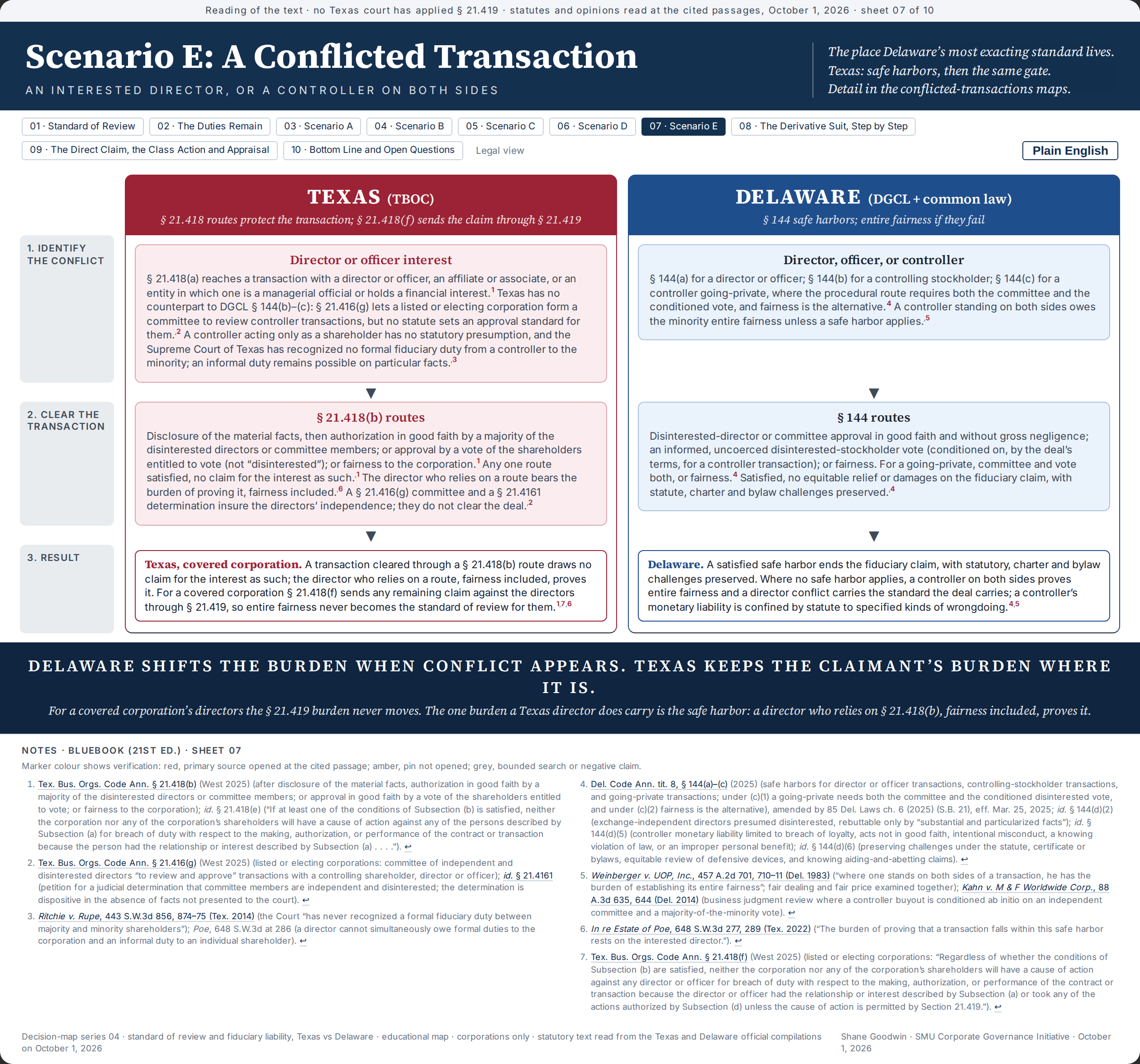
How to read it. Follow either column top to bottom. The grey rail names the question each row answers; the Texas and Delaware columns give each state’s answer with the section or opinion that supplies it. Markers lead to the Bluebook notes under the sheet. The Plain English button at the top of the sheet swaps every cell for an everyday-words version; the legal view and its notes remain the text of record.
The sheets read in order, and each stands alone: 01 and 02 set the frame, 03 to 07 walk one board decision each down both columns, 08 and 09 walk the lawsuit, 10 is the bottom line and the open questions.
Reading of the text · no Texas court has applied § 21.419 · statutes and opinions read at the cited passages, October 1, 2026 · sheet 07 of 10
Scenario E: A Conflicted Transaction
An interested director, or a controller on both sides
The place Delaware’s most exacting standard lives.
Texas: safe harbors, then the same gate.
Detail in the conflicted-transactions maps.
Plain-English view: the same sheet in everyday words, for readers who are not lawyers. It summarizes; the legal view and its notes are the source of record. Click the button again to return.
TEXAS (TBOC)§ 21.418 routes protect the transaction; § 21.418(f) sends the claim through § 21.419
DELAWARE (DGCL + common law)§ 144 safe harbors; entire fairness if they fail
1. Identify the conflict
Director or officer interest
§ 21.418(a) reaches a transaction with a director or officer, an affiliate or associate, or an entity in which one is a managerial official or holds a financial interest.1 Texas has no counterpart to DGCL § 144(b)–(c): § 21.416(g) lets a listed or electing corporation form a committee to review controller transactions, but no statute sets an approval standard for them.2 A controller acting only as a shareholder has no statutory presumption, and the Supreme Court of Texas has recognized no formal fiduciary duty from a controller to the minority; an informal duty remains possible on particular facts.3
The statute reaches deals where a director or officer, or someone connected to one, is on the other side. Texas has no approval rule for controlling shareholders like Delaware’s, only a provision letting the board set up a review committee, and the Texas Supreme Court has never recognized a formal duty from a controlling shareholder to the minority, though one could arise on particular facts.
Director, officer, or controller
§ 144(a) for a director or officer; § 144(b) for a controlling stockholder; § 144(c) for a controller going-private, where the procedural route requires both the committee and the conditioned vote, and fairness is the alternative.4 A controller standing on both sides owes the minority entire fairness unless a safe harbor applies.5
Delaware has separate safe harbors for a conflicted director, for a controlling shareholder, and for a controller buying out the minority, where the procedural route needs both an independent committee and a minority vote, with proving fairness as the alternative. A controller on both sides must otherwise prove the deal was entirely fair.
2. Clear the transaction
§ 21.418(b) routes
Disclosure of the material facts, then authorization in good faith by a majority of the disinterested directors or committee members; or approval by a vote of the shareholders entitled to vote (not “disinterested”); or fairness to the corporation.1 Any one route satisfied, no claim for the interest as such.1 The director who relies on a route bears the burden of proving it, fairness included.6 A § 21.416(g) committee and a § 21.4161 determination insure the directors’ independence; they do not clear the deal.2
Three ways to clear a conflicted deal: approval by the uninterested directors after full disclosure, approval by the shareholders, or proof the deal was fair. Any one works, and the insider who relies on one has to prove it. A special committee and a court ruling on its independence protect the directors; they do not themselves clear the deal.
§ 144 routes
Disinterested-director or committee approval in good faith and without gross negligence; an informed, uncoerced disinterested-stockholder vote (conditioned on, by the deal’s terms, for a controller transaction); or fairness. For a going-private, committee and vote both, or fairness.4 Satisfied, no equitable relief or damages on the fiduciary claim, with statute, charter and bylaw challenges preserved.4
Delaware’s routes are similar, but the shareholder vote must be by uninterested shareholders and the committee must have real power. A controller buyout needs both the committee and the vote, or proof of fairness. If a route is satisfied, the fiduciary claim ends, though challenges under the statute, the charter or the bylaws survive.
3. Result
Texas, covered corporation. A transaction cleared through a § 21.418(b) route draws no claim for the interest as such; the director who relies on a route, fairness included, proves it. For a covered corporation § 21.418(f) sends any remaining claim against the directors through § 21.419, so entire fairness never becomes the standard of review for them.
176 Texas: a conflicted deal that was cleared through one of the statute’s routes draws no claim for the conflict itself, and the director who relies on a route has to prove it was satisfied. For a listed or electing company, any other claim against the directors goes through the same four-ground gate as everything else, so the Delaware-style ‘prove the whole deal was fair’ test never becomes the standard for them.
Delaware. A satisfied safe harbor ends the fiduciary claim, with statutory, charter and bylaw challenges preserved. Where no safe harbor applies, a controller on both sides proves entire fairness and a director conflict carries the standard the deal carries; a controller’s monetary liability is confined by statute to specified kinds of wrongdoing.
45 Delaware: a satisfied safe harbor ends the fiduciary claim, though challenges under the statute, charter or bylaws survive. Where no safe harbor applies, a controller on both sides of a deal must prove it was entirely fair, and an ordinary director conflict is judged by whatever standard the deal itself carries. A controller’s liability for money is now limited by statute to specified kinds of wrongdoing.
DELAWARE SHIFTS THE BURDEN WHEN CONFLICT APPEARS. TEXAS KEEPS THE CLAIMANT’S BURDEN WHERE IT IS.For a covered corporation’s directors the § 21.419 burden never moves. The one burden a Texas director does carry is the safe harbor: a director who relies on § 21.418(b), fairness included, proves it.
Notes · Bluebook (21st ed.) · sheet 07
Marker colour shows verification: red, primary source opened at the cited passage; amber, pin not opened; grey, bounded search or negative claim.
- Tex. Bus. Orgs. Code Ann. § 21.418(b) (West 2025) (after disclosure of the material facts, authorization in good faith by a majority of the disinterested directors or committee members; or approval in good faith by a vote of the shareholders entitled to vote; or fairness to the corporation); id. § 21.418(e) (“If at least one of the conditions of Subsection (b) is satisfied, neither the corporation nor any of the corporation’s shareholders will have a cause of action against any of the persons described by Subsection (a) for breach of duty with respect to the making, authorization, or performance of the contract or transaction because the person had the relationship or interest described by Subsection (a) . . . .”). ↩
- Tex. Bus. Orgs. Code Ann. § 21.416(g) (West 2025) (listed or electing corporations: committee of independent and disinterested directors “to review and approve” transactions with a controlling shareholder, director or officer); id. § 21.4161 (petition for a judicial determination that committee members are independent and disinterested; the determination is dispositive in the absence of facts not presented to the court). ↩
- Ritchie v. Rupe, 443 S.W.3d 856, 874–75 (Tex. 2014) (the Court “has never recognized a formal fiduciary duty between majority and minority shareholders”); Poe, 648 S.W.3d at 286 (a director cannot simultaneously owe formal duties to the corporation and an informal duty to an individual shareholder). ↩
- Del. Code Ann. tit. 8, § 144(a)–(c) (2025) (safe harbors for director or officer transactions, controlling-stockholder transactions, and going-private transactions; under (c)(1) a going-private needs both the committee and the conditioned disinterested vote, and under (c)(2) fairness is the alternative), amended by 85 Del. Laws ch. 6 (2025) (S.B. 21), eff. Mar. 25, 2025; id. § 144(d)(2) (exchange-independent directors presumed disinterested, rebuttable only by “substantial and particularized facts”); id. § 144(d)(5) (controller monetary liability limited to breach of loyalty, acts not in good faith, intentional misconduct, a knowing violation of law, or an improper personal benefit); id. § 144(d)(6) (preserving challenges under the statute, certificate or bylaws, equitable review of defensive devices, and knowing aiding-and-abetting claims). ↩
- Weinberger v. UOP, Inc., 457 A.2d 701, 710–11 (Del. 1983) (“where one stands on both sides of a transaction, he has the burden of establishing its entire fairness”; fair dealing and fair price examined together); Kahn v. M & F Worldwide Corp., 88 A.3d 635, 644 (Del. 2014) (business judgment review where a controller buyout is conditioned ab initio on an independent committee and a majority-of-the-minority vote). ↩
- In re Estate of Poe, 648 S.W.3d 277, 289 (Tex. 2022) (“The burden of proving that a transaction falls within this safe harbor rests on the interested director.”). ↩
- Tex. Bus. Orgs. Code Ann. § 21.418(f) (West 2025) (listed or electing corporations: “Regardless of whether the conditions of Subsection (b) are satisfied, neither the corporation nor any of the corporation’s shareholders will have a cause of action against any director or officer for breach of duty with respect to the making, authorization, or performance of the contract or transaction because the director or officer had the relationship or interest described by Subsection (a) or took any of the actions authorized by Subsection (d) unless the cause of action is permitted by Section 21.419.”). ↩
Sources behind this sheet (7 notes)
- Tex. Bus. Orgs. Code Ann. § 21.418(b) (West 2025) (after disclosure of the material facts, authorization in good faith by a majority of the disinterested directors or committee members; or approval in good faith by a vote of the shareholders entitled to vote; or fairness to the corporation); id. § 21.418(e) (“If at least one of the conditions of Subsection (b) is satisfied, neither the corporation nor any of the corporation’s shareholders will have a cause of action against any of the persons described by Subsection (a) for breach of duty with respect to the making, authorization, or performance of the contract or transaction because the person had the relationship or interest described by Subsection (a) . . . .”). ↩
- Tex. Bus. Orgs. Code Ann. § 21.416(g) (West 2025) (listed or electing corporations: committee of independent and disinterested directors “to review and approve” transactions with a controlling shareholder, director or officer); id. § 21.4161 (petition for a judicial determination that committee members are independent and disinterested; the determination is dispositive in the absence of facts not presented to the court). ↩
- Ritchie v. Rupe, 443 S.W.3d 856, 874–75 (Tex. 2014) (the Court “has never recognized a formal fiduciary duty between majority and minority shareholders”); Poe, 648 S.W.3d at 286 (a director cannot simultaneously owe formal duties to the corporation and an informal duty to an individual shareholder). ↩
- Del. Code Ann. tit. 8, § 144(a)–(c) (2025) (safe harbors for director or officer transactions, controlling-stockholder transactions, and going-private transactions; under (c)(1) a going-private needs both the committee and the conditioned disinterested vote, and under (c)(2) fairness is the alternative), amended by 85 Del. Laws ch. 6 (2025) (S.B. 21), eff. Mar. 25, 2025; id. § 144(d)(2) (exchange-independent directors presumed disinterested, rebuttable only by “substantial and particularized facts”); id. § 144(d)(5) (controller monetary liability limited to breach of loyalty, acts not in good faith, intentional misconduct, a knowing violation of law, or an improper personal benefit); id. § 144(d)(6) (preserving challenges under the statute, certificate or bylaws, equitable review of defensive devices, and knowing aiding-and-abetting claims). ↩
- Weinberger v. UOP, Inc., 457 A.2d 701, 710–11 (Del. 1983) (“where one stands on both sides of a transaction, he has the burden of establishing its entire fairness”; fair dealing and fair price examined together); Kahn v. M & F Worldwide Corp., 88 A.3d 635, 644 (Del. 2014) (business judgment review where a controller buyout is conditioned ab initio on an independent committee and a majority-of-the-minority vote). ↩
- In re Estate of Poe, 648 S.W.3d 277, 289 (Tex. 2022) (“The burden of proving that a transaction falls within this safe harbor rests on the interested director.”). ↩
- Tex. Bus. Orgs. Code Ann. § 21.418(f) (West 2025) (listed or electing corporations: “Regardless of whether the conditions of Subsection (b) are satisfied, neither the corporation nor any of the corporation’s shareholders will have a cause of action against any director or officer for breach of duty with respect to the making, authorization, or performance of the contract or transaction because the director or officer had the relationship or interest described by Subsection (a) or took any of the actions authorized by Subsection (d) unless the cause of action is permitted by Section 21.419.”). ↩
Decision-map series 04 · standard of review and fiduciary liability, Texas vs Delaware · educational map · corporations only · statutory text read from the Texas and Delaware official compilations on October 1, 2026Shane Goodwin · SMU Corporate Governance Initiative · October 1, 2026
Read the statutes and the opinions
- Tex. S.B. 29, 89th Leg., R.S. (2025) (enrolled) — §§ 21.416(g), 21.4161, 21.418, 21.419, 21.552, 2.115, 2.116, eff. May 14, 2025.
- Tex. Bus. Orgs. Code § 21.419 (the liability gate); § 21.401 (what a board may consider); § 21.418 (interested directors and officers); §§ 21.551–21.563 (derivative proceedings); § 7.001 (exculpation); § 20.002 (ultra vires); §§ 10.354 and 10.368 (dissent and appraisal); § 1.057 (construction).
- Del. Code Ann. tit. 8, § 144 (as amended by 85 Del. Laws c. 6, S.B. 21, eff. Mar. 25, 2025); § 102(b)(7) (exculpation); § 262 (appraisal).
- Delaware: Aronson v. Lewis, 473 A.2d 805 (Del. 1984); Unocal Corp. v. Mesa Petroleum Co., 493 A.2d 946 (Del. 1985); Revlon, Inc. v. MacAndrews & Forbes Holdings, Inc., 506 A.2d 173 (Del. 1986); Paramount Communications Inc. v. QVC Network Inc., 637 A.2d 34 (Del. 1994); Weinberger v. UOP, Inc., 457 A.2d 701 (Del. 1983); Cede & Co. v. Technicolor, Inc., 634 A.2d 345 (Del. 1993); Zapata Corp. v. Maldonado, 430 A.2d 779 (Del. 1981); RBC Capital Markets, LLC v. Jervis, 129 A.3d 816 (Del. 2015); Lyondell Chemical Co. v. Ryan, 970 A.2d 235 (Del. 2009); Corwin v. KKR Financial Holdings LLC, 125 A.3d 304 (Del. 2015); Stone v. Ritter, 911 A.2d 362 (Del. 2006); Tooley v. Donaldson, Lufkin & Jenrette, Inc., 845 A.2d 1031 (Del. 2004); Brookfield Asset Management, Inc. v. Rosson, 261 A.3d 1251 (Del. 2021); United Food & Commercial Workers Union v. Zuckerberg, 262 A.3d 1034 (Del. 2021); Dodiya v. Franklin, C.A. No. 2025-0932-LWW (Del. Ch. Aug. 26, 2026).
- Texas: In re Estate of Poe, 648 S.W.3d 277 (Tex. 2022); Ritchie v. Rupe, 443 S.W.3d 856 (Tex. 2014); Sneed v. Webre, 465 S.W.3d 169 (Tex. 2015); Gearhart Industries, Inc. v. Smith International, Inc., 741 F.2d 707 (5th Cir. 1984); Wingate v. Hajdik, 795 S.W.2d 717 (Tex. 1990); International Bankers Life Insurance Co. v. Holloway, 368 S.W.2d 567 (Tex. 1963); Cates v. Sparkman, 73 Tex. 619, 11 S.W. 846 (1889); Gusinsky v. Reynolds, No. 3:25-cv-01816-K (N.D. Tex. Mar. 17, 2026). Each sheet carries its own Bluebook notes beneath the chart, with a link to each opinion; the marker colour says whether the cited passage was opened. Opinions are collected on the vertical’s sources page.
Educational map. Corporations only; LLC and partnership analogues differ. A reading of the statutory text: no Texas court has applied § 21.419 to a sale, a defense or a conflicted deal. Nothing here is legal advice.