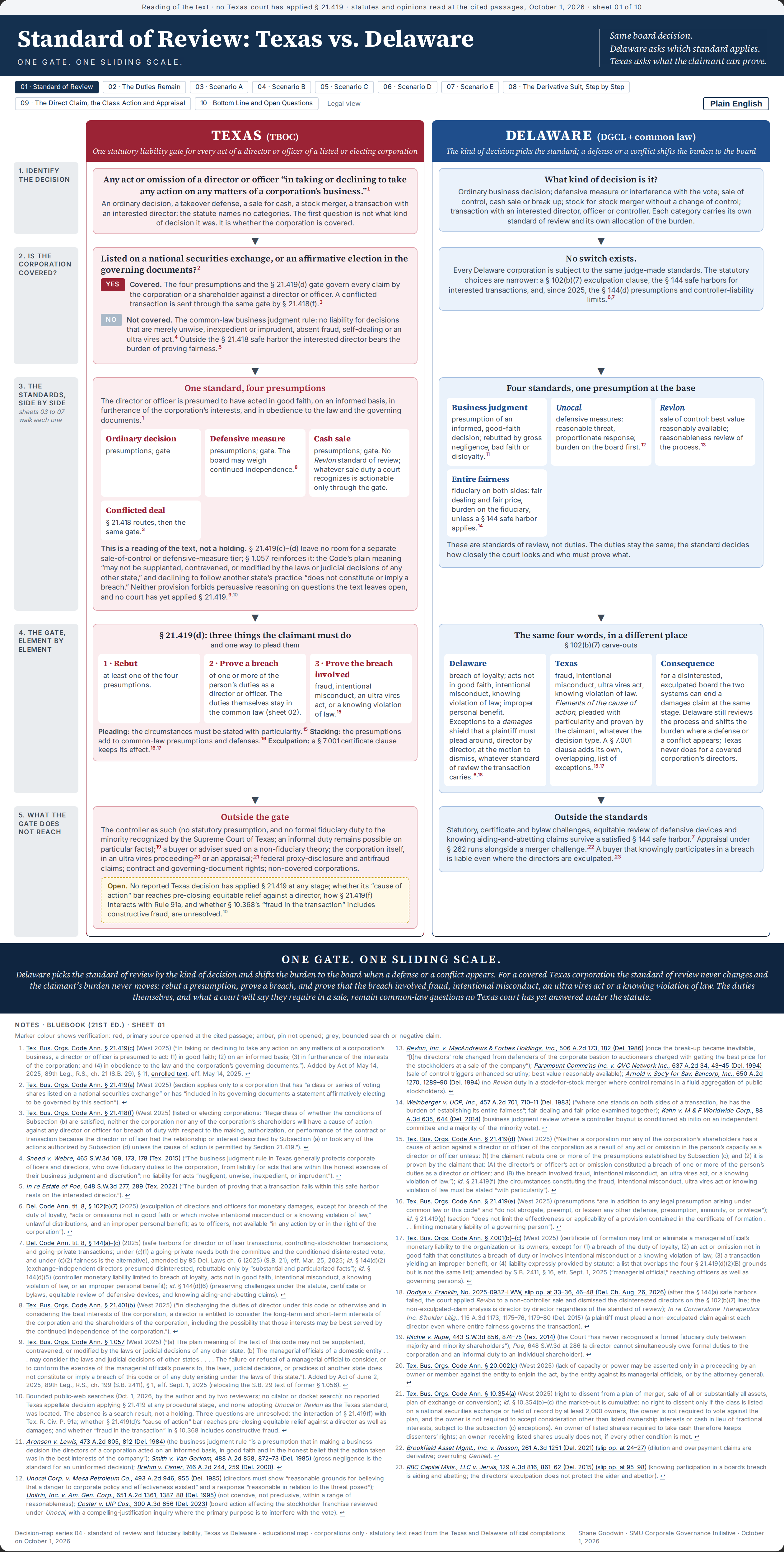
How to read it. Follow either column top to bottom. The grey rail names the question each row answers; the Texas and Delaware columns give each state’s answer with the section or opinion that supplies it. Markers lead to the Bluebook notes under the sheet. The Plain English button at the top of the sheet swaps every cell for an everyday-words version; the legal view and its notes remain the text of record.
The sheets read in order, and each stands alone: 01 and 02 set the frame, 03 to 07 walk one board decision each down both columns, 08 and 09 walk the lawsuit, 10 is the bottom line and the open questions.
Reading of the text · no Texas court has applied § 21.419 · statutes and opinions read at the cited passages, October 1, 2026 · sheet 01 of 10
Standard of Review: Texas vs. Delaware
One gate. One sliding scale.
Same board decision.
Delaware asks which standard applies.
Texas asks what the claimant can prove.
Plain-English view: the same sheet in everyday words, for readers who are not lawyers. It summarizes; the legal view and its notes are the source of record. Click the button again to return.
TEXAS (TBOC)One statutory liability gate for every act of a director or officer of a listed or electing corporation
DELAWARE (DGCL + common law)The kind of decision picks the standard; a defense or a conflict shifts the burden to the board
1. Identify the decision
Any act or omission of a director or officer “in taking or declining to take any action on any matters of a corporation’s business.”1
An ordinary decision, a takeover defense, a sale for cash, a stock merger, a transaction with an interested director: the statute names no categories. The first question is not what kind of decision it was. It is whether the corporation is covered.
In Texas the statute does not care what kind of decision the board made. Whether it was routine, a takeover defense, a sale for cash, a stock merger or a deal with an insider, the first question is simply whether the company is one the statute covers.
What kind of decision is it?
Ordinary business decision; defensive measure or interference with the vote; sale of control, cash sale or break-up; stock-for-stock merger without a change of control; transaction with an interested director, officer or controller. Each category carries its own standard of review and its own allocation of the burden.
In Delaware the type of decision decides how hard the court looks. A routine decision gets a light touch; a takeover defense, a cash sale or a deal with an insider each gets its own stricter test.
2. Is the corporation covered?
Listed on a national securities exchange, or an affirmative election in the governing documents?2
YESCovered. The four presumptions and the § 21.419(d) gate govern every claim by the corporation or a shareholder against a director or officer. A conflicted transaction is sent through the same gate by § 21.418(f).3
NONot covered. The common-law business judgment rule: no liability for decisions that are merely unwise, inexpedient or imprudent, absent fraud, self-dealing or an ultra vires act.4 Outside the § 21.418 safe harbor the interested director bears the burden of proving fairness.5
Covered means the company’s shares trade on a national stock exchange, or the company wrote into its charter or bylaws that it opts in. If covered, the directors get the statute’s protection. If not, the older judge-made rule applies: honest mistakes are protected, but an insider who did a deal with the company has to prove it was fair.
No switch exists.
Every Delaware corporation is subject to the same judge-made standards. The statutory choices are narrower: a § 102(b)(7) exculpation clause, the § 144 safe harbors for interested transactions, and, since 2025, the § 144(d) presumptions and controller-liability limits.67
Delaware has no on-off switch. Every Delaware company lives under the same judge-made rules. The only things a company can choose are a charter clause that shields directors from paying for careless mistakes and the statutory safe harbors for insider deals.
3. The standards, side by sidesheets 03 to 07 walk each one
One standard, four presumptions
The director or officer is presumed to have acted in good faith, on an informed basis, in furtherance of the corporation’s interests, and in obedience to the law and the governing documents.1
Ordinary decisionpresumptions; gate
Defensive measurepresumptions; gate. The board may weigh continued independence.
8 Cash salepresumptions; gate. No Revlon standard of review; whatever sale duty a court recognizes is actionable only through the gate.
Conflicted deal§ 21.418 routes, then the same gate.
3 This is a reading of the text, not a holding. § 21.419(c)–(d) leave no room for a separate sale-of-control or defensive-measure tier; § 1.057 reinforces it: the Code’s plain meaning “may not be supplanted, contravened, or modified by the laws or judicial decisions of any other state,” and declining to follow another state’s practice “does not constitute or imply a breach.” Neither provision forbids persuasive reasoning on questions the text leaves open, and no court has yet applied § 21.419.910
Texas gives covered directors four presumptions: that they acted honestly, with enough information, for the company’s benefit and within the rules. Those presumptions apply to every decision. The statute also says another state’s case law cannot override what the Texas statute plainly says. This is our reading of the text; no court has ruled on it yet.
Four standards, one presumption at the base
Business judgmentpresumption of an informed, good-faith decision; rebutted by gross negligence, bad faith or disloyalty.
11 Unocaldefensive measures: reasonable threat, proportionate response; burden on the board first.
12 Revlonsale of control: best value reasonably available; reasonableness review of the process.
13 Entire fairnessfiduciary on both sides: fair dealing and fair price, burden on the fiduciary, unless a § 144 safe harbor applies.
14 These are standards of review, not duties. The duties stay the same; the standard decides how closely the court looks and who must prove what.
Delaware starts from the same kind of presumption, then layers tougher tests on top for particular situations: a takeover defense, a sale of the company, or a deal where an insider is on both sides. Those tests are ways of looking at a decision, not extra duties.
4. The gate, element by element
§ 21.419(d): three things the claimant must doand one way to plead them
1 · Rebutat least one of the four presumptions.
2 · Prove a breachof one or more of the person’s duties as a director or officer. The duties themselves stay in the common law (sheet 02).
3 · Prove the breach involvedfraud, intentional misconduct, an ultra vires act, or a knowing violation of law.
15 Pleading: the circumstances must be stated with particularity.15 Stacking: the presumptions add to common-law presumptions and defenses.16 Exculpation: a § 7.001 certificate clause keeps its effect.1617
To sue a covered director in Texas you must do three things: knock down at least one of the four presumptions, prove the director broke a duty, and prove the breach involved fraud, deliberate wrongdoing, an act outside the company’s powers or a knowing violation of law. And you must spell out those facts in the complaint. Carelessness alone, even serious carelessness, is not on the list.
The same four words, in a different place§ 102(b)(7) carve-outs
Delawarebreach of loyalty; acts not in good faith, intentional misconduct, knowing violation of law; improper personal benefit. Exceptions to a
damages shield that a plaintiff must plead around, director by director, at the motion to dismiss, whatever standard of review the transaction carries.
618 Texasfraud, intentional misconduct, ultra vires act, knowing violation of law.
Elements of the cause of action, pleaded with particularity and proven by the claimant, whatever the decision type. A § 7.001 clause adds its own, overlapping, list of exceptions.
1517 Consequencefor a disinterested, exculpated board the two systems can end a damages claim at the same stage. Delaware still reviews the process and shifts the burden where a defense or a conflict appears; Texas never does for a covered corporation’s directors.
Delaware uses similar words, but in a different place. There they are exceptions to a charter shield against paying damages, and a plaintiff has to plead around that shield for each director at the very start of the case. In Texas the four grounds are part of what the plaintiff must prove to have a case at all.
5. What the gate does not reach
Outside the gate
The controller as such (no statutory presumption, and no formal fiduciary duty to the minority recognized by the Supreme Court of Texas; an informal duty remains possible on particular facts);19 a buyer or adviser sued on a non-fiduciary theory; the corporation itself, in an ultra vires proceeding20 or an appraisal;21 federal proxy-disclosure and antifraud claims; contract and governing-document rights; non-covered corporations.
Open. No reported Texas decision has applied § 21.419 at any stage; whether its “cause of action” bar reaches pre-closing equitable relief against a director, how § 21.419(f) interacts with Rule 91a, and whether § 10.368’s “fraud in the transaction” includes constructive fraud, are unresolved.
10 The Texas statute protects directors and officers only. It does not protect a controlling shareholder acting as a shareholder, a buyer, or the company itself. A shareholder can still sue the company to stop an act outside its powers, can demand a court-set price for shares in a cash deal, and can bring federal securities claims. No court has yet applied the statute, so some questions remain open.
Outside the standards
Statutory, certificate and bylaw challenges, equitable review of defensive devices and knowing aiding-and-abetting claims survive a satisfied § 144 safe harbor.7 Appraisal under § 262 runs alongside a merger challenge.22 A buyer that knowingly participates in a breach is liable even where the directors are exculpated.23
Even when a Delaware safe harbor is satisfied, shareholders can still challenge violations of the statute, the charter or the bylaws, can ask a court to review a takeover defense, and can sue a buyer that knowingly helped directors breach their duties. The court-set-price remedy runs alongside.
ONE GATE. ONE SLIDING SCALE.Delaware picks the standard of review by the kind of decision and shifts the burden to the board when a defense or a conflict appears. For a covered Texas corporation the standard of review never changes and the claimant’s burden never moves: rebut a presumption, prove a breach, and prove that the breach involved fraud, intentional misconduct, an ultra vires act or a knowing violation of law. The duties themselves, and what a court will say they require in a sale, remain common-law questions no Texas court has yet answered under the statute.
Notes · Bluebook (21st ed.) · sheet 01
Marker colour shows verification: red, primary source opened at the cited passage; amber, pin not opened; grey, bounded search or negative claim.
- Tex. Bus. Orgs. Code Ann. § 21.419(c) (West 2025) (“In taking or declining to take any action on any matters of a corporation’s business, a director or officer is presumed to act: (1) in good faith; (2) on an informed basis; (3) in furtherance of the interests of the corporation; and (4) in obedience to the law and the corporation’s governing documents.”). Added by Act of May 14, 2025, 89th Leg., R.S., ch. 21 (S.B. 29), § 11, enrolled text, eff. May 14, 2025. ↩
- Tex. Bus. Orgs. Code Ann. § 21.419(a) (West 2025) (section applies only to a corporation that has “a class or series of voting shares listed on a national securities exchange” or has “included in its governing documents a statement affirmatively electing to be governed by this section”). ↩
- Tex. Bus. Orgs. Code Ann. § 21.418(f) (West 2025) (listed or electing corporations: “Regardless of whether the conditions of Subsection (b) are satisfied, neither the corporation nor any of the corporation’s shareholders will have a cause of action against any director or officer for breach of duty with respect to the making, authorization, or performance of the contract or transaction because the director or officer had the relationship or interest described by Subsection (a) or took any of the actions authorized by Subsection (d) unless the cause of action is permitted by Section 21.419.”). ↩
- Sneed v. Webre, 465 S.W.3d 169, 173, 178 (Tex. 2015) (“The business judgment rule in Texas generally protects corporate officers and directors, who owe fiduciary duties to the corporation, from liability for acts that are within the honest exercise of their business judgment and discretion”; no liability for acts “negligent, unwise, inexpedient, or imprudent”). ↩
- In re Estate of Poe, 648 S.W.3d 277, 289 (Tex. 2022) (“The burden of proving that a transaction falls within this safe harbor rests on the interested director.”). ↩
- Del. Code Ann. tit. 8, § 102(b)(7) (2025) (exculpation of directors and officers for monetary damages, except for breach of the duty of loyalty, “acts or omissions not in good faith or which involve intentional misconduct or a knowing violation of law,” unlawful distributions, and an improper personal benefit; as to officers, not available “in any action by or in the right of the corporation”). ↩
- Del. Code Ann. tit. 8, § 144(a)–(c) (2025) (safe harbors for director or officer transactions, controlling-stockholder transactions, and going-private transactions; under (c)(1) a going-private needs both the committee and the conditioned disinterested vote, and under (c)(2) fairness is the alternative), amended by 85 Del. Laws ch. 6 (2025) (S.B. 21), eff. Mar. 25, 2025; id. § 144(d)(2) (exchange-independent directors presumed disinterested, rebuttable only by “substantial and particularized facts”); id. § 144(d)(5) (controller monetary liability limited to breach of loyalty, acts not in good faith, intentional misconduct, a knowing violation of law, or an improper personal benefit); id. § 144(d)(6) (preserving challenges under the statute, certificate or bylaws, equitable review of defensive devices, and knowing aiding-and-abetting claims). ↩
- Tex. Bus. Orgs. Code Ann. § 21.401(b) (West 2025) (“In discharging the duties of director under this code or otherwise and in considering the best interests of the corporation, a director is entitled to consider the long-term and short-term interests of the corporation and the shareholders of the corporation, including the possibility that those interests may be best served by the continued independence of the corporation.”). ↩
- Tex. Bus. Orgs. Code Ann. § 1.057 (West 2025) (“(a) The plain meaning of the text of this code may not be supplanted, contravened, or modified by the laws or judicial decisions of any other state. (b) The managerial officials of a domestic entity . . . may consider the laws and judicial decisions of other states . . . . The failure or refusal of a managerial official to consider, or to conform the exercise of the managerial official’s powers to, the laws, judicial decisions, or practices of another state does not constitute or imply a breach of this code or of any duty existing under the laws of this state.”). Added by Act of June 2, 2025, 89th Leg., R.S., ch. 199 (S.B. 2411), § 1, eff. Sept. 1, 2025 (relocating the S.B. 29 text of former § 1.056). ↩
- Bounded public-web searches (Oct. 1, 2026, by the author and by two reviewers; no citator or docket search): no reported Texas appellate decision applying § 21.419 at any procedural stage, and none adopting Unocal or Revlon as the Texas standard, was located. The absence is a search result, not a holding. Three questions are unresolved: the interaction of § 21.419(f) with Tex. R. Civ. P. 91a; whether § 21.419(d)’s “cause of action” bar reaches pre-closing equitable relief against a director as well as damages; and whether “fraud in the transaction” in § 10.368 includes constructive fraud. ↩
- Aronson v. Lewis, 473 A.2d 805, 812 (Del. 1984) (the business judgment rule “is a presumption that in making a business decision the directors of a corporation acted on an informed basis, in good faith and in the honest belief that the action taken was in the best interests of the company”); Smith v. Van Gorkom, 488 A.2d 858, 872–73 (Del. 1985) (gross negligence is the standard for an uninformed decision); Brehm v. Eisner, 746 A.2d 244, 259 (Del. 2000). ↩
- Unocal Corp. v. Mesa Petroleum Co., 493 A.2d 946, 955 (Del. 1985) (directors must show “reasonable grounds for believing that a danger to corporate policy and effectiveness existed” and a response “reasonable in relation to the threat posed”); Unitrin, Inc. v. Am. Gen. Corp., 651 A.2d 1361, 1387–88 (Del. 1995) (not coercive, not preclusive, within a range of reasonableness); Coster v. UIP Cos., 300 A.3d 656 (Del. 2023) (board action affecting the stockholder franchise reviewed under Unocal, with a compelling-justification inquiry where the primary purpose is to interfere with the vote). ↩
- Revlon, Inc. v. MacAndrews & Forbes Holdings, Inc., 506 A.2d 173, 182 (Del. 1986) (once the break-up became inevitable, “[t]he directors’ role changed from defenders of the corporate bastion to auctioneers charged with getting the best price for the stockholders at a sale of the company”); Paramount Commc’ns Inc. v. QVC Network Inc., 637 A.2d 34, 43–45 (Del. 1994) (sale of control triggers enhanced scrutiny; best value reasonably available); Arnold v. Soc’y for Sav. Bancorp, Inc., 650 A.2d 1270, 1289–90 (Del. 1994) (no Revlon duty in a stock-for-stock merger where control remains in a fluid aggregation of public stockholders). ↩
- Weinberger v. UOP, Inc., 457 A.2d 701, 710–11 (Del. 1983) (“where one stands on both sides of a transaction, he has the burden of establishing its entire fairness”; fair dealing and fair price examined together); Kahn v. M & F Worldwide Corp., 88 A.3d 635, 644 (Del. 2014) (business judgment review where a controller buyout is conditioned ab initio on an independent committee and a majority-of-the-minority vote). ↩
- Tex. Bus. Orgs. Code Ann. § 21.419(d) (West 2025) (“Neither a corporation nor any of the corporation’s shareholders has a cause of action against a director or officer of the corporation as a result of any act or omission in the person’s capacity as a director or officer unless: (1) the claimant rebuts one or more of the presumptions established by Subsection (c); and (2) it is proven by the claimant that: (A) the director’s or officer’s act or omission constituted a breach of one or more of the person’s duties as a director or officer; and (B) the breach involved fraud, intentional misconduct, an ultra vires act, or a knowing violation of law.”); id. § 21.419(f) (the circumstances constituting the fraud, intentional misconduct, ultra vires act or knowing violation of law must be stated “with particularity”). ↩
- Tex. Bus. Orgs. Code Ann. § 21.419(e) (West 2025) (presumptions “are in addition to any legal presumption arising under common law or this code” and “do not abrogate, preempt, or lessen any other defense, presumption, immunity, or privilege”); id. § 21.419(g) (section “does not limit the effectiveness or applicability of a provision contained in the certificate of formation . . . limiting monetary liability of a governing person”). ↩
- Tex. Bus. Orgs. Code Ann. § 7.001(b)–(c) (West 2025) (certificate of formation may limit or eliminate a managerial official’s monetary liability to the organization or its owners, except for (1) a breach of the duty of loyalty, (2) an act or omission not in good faith that constitutes a breach of duty or involves intentional misconduct or a knowing violation of law, (3) a transaction yielding an improper benefit, or (4) liability expressly provided by statute: a list that overlaps the four § 21.419(d)(2)(B) grounds but is not the same list); amended by S.B. 2411, § 16, eff. Sept. 1, 2025 (“managerial official,” reaching officers as well as governing persons). ↩
- Dodiya v. Franklin, No. 2025-0932-LWW, slip op. at 33–36, 46–48 (Del. Ch. Aug. 26, 2026) (after the § 144(a) safe harbors failed, the court applied Revlon to a non-controller sale and dismissed the disinterested directors on the § 102(b)(7) line; the non-exculpated-claim analysis is director by director regardless of the standard of review); In re Cornerstone Therapeutics Inc. S’holder Litig., 115 A.3d 1173, 1175–76, 1179–80 (Del. 2015) (a plaintiff must plead a non-exculpated claim against each director even where entire fairness governs the transaction). ↩
- Ritchie v. Rupe, 443 S.W.3d 856, 874–75 (Tex. 2014) (the Court “has never recognized a formal fiduciary duty between majority and minority shareholders”); Poe, 648 S.W.3d at 286 (a director cannot simultaneously owe formal duties to the corporation and an informal duty to an individual shareholder). ↩
- Tex. Bus. Orgs. Code Ann. § 20.002(c) (West 2025) (lack of capacity or power may be asserted only in a proceeding by an owner or member against the entity to enjoin the act, by the entity against its managerial officials, or by the attorney general). ↩
- Tex. Bus. Orgs. Code Ann. § 10.354(a) (West 2025) (right to dissent from a plan of merger, sale of all or substantially all assets, plan of exchange or conversion); id. § 10.354(b)–(c) (the market-out is cumulative: no right to dissent only if the class is listed on a national securities exchange or held of record by at least 2,000 owners, the owner is not required to vote against the plan, and the owner is not required to accept consideration other than listed ownership interests or cash in lieu of fractional interests, subject to the subsection (c) exceptions). An owner of listed shares required to take cash therefore keeps dissenters’ rights; an owner receiving listed shares usually does not, if every other condition is met. ↩
- Brookfield Asset Mgmt., Inc. v. Rosson, 261 A.3d 1251 (Del. 2021) (slip op. at 24–27) (dilution and overpayment claims are derivative; overruling Gentile). ↩
- RBC Capital Mkts., LLC v. Jervis, 129 A.3d 816, 861–62 (Del. 2015) (slip op. at 95–98) (knowing participation in a board’s breach is aiding and abetting; the directors’ exculpation does not protect the aider and abettor). ↩
Sources behind this sheet (23 notes)
- Tex. Bus. Orgs. Code Ann. § 21.419(c) (West 2025) (“In taking or declining to take any action on any matters of a corporation’s business, a director or officer is presumed to act: (1) in good faith; (2) on an informed basis; (3) in furtherance of the interests of the corporation; and (4) in obedience to the law and the corporation’s governing documents.”). Added by Act of May 14, 2025, 89th Leg., R.S., ch. 21 (S.B. 29), § 11, enrolled text, eff. May 14, 2025. ↩
- Tex. Bus. Orgs. Code Ann. § 21.419(a) (West 2025) (section applies only to a corporation that has “a class or series of voting shares listed on a national securities exchange” or has “included in its governing documents a statement affirmatively electing to be governed by this section”). ↩
- Tex. Bus. Orgs. Code Ann. § 21.418(f) (West 2025) (listed or electing corporations: “Regardless of whether the conditions of Subsection (b) are satisfied, neither the corporation nor any of the corporation’s shareholders will have a cause of action against any director or officer for breach of duty with respect to the making, authorization, or performance of the contract or transaction because the director or officer had the relationship or interest described by Subsection (a) or took any of the actions authorized by Subsection (d) unless the cause of action is permitted by Section 21.419.”). ↩
- Sneed v. Webre, 465 S.W.3d 169, 173, 178 (Tex. 2015) (“The business judgment rule in Texas generally protects corporate officers and directors, who owe fiduciary duties to the corporation, from liability for acts that are within the honest exercise of their business judgment and discretion”; no liability for acts “negligent, unwise, inexpedient, or imprudent”). ↩
- In re Estate of Poe, 648 S.W.3d 277, 289 (Tex. 2022) (“The burden of proving that a transaction falls within this safe harbor rests on the interested director.”). ↩
- Del. Code Ann. tit. 8, § 102(b)(7) (2025) (exculpation of directors and officers for monetary damages, except for breach of the duty of loyalty, “acts or omissions not in good faith or which involve intentional misconduct or a knowing violation of law,” unlawful distributions, and an improper personal benefit; as to officers, not available “in any action by or in the right of the corporation”). ↩
- Del. Code Ann. tit. 8, § 144(a)–(c) (2025) (safe harbors for director or officer transactions, controlling-stockholder transactions, and going-private transactions; under (c)(1) a going-private needs both the committee and the conditioned disinterested vote, and under (c)(2) fairness is the alternative), amended by 85 Del. Laws ch. 6 (2025) (S.B. 21), eff. Mar. 25, 2025; id. § 144(d)(2) (exchange-independent directors presumed disinterested, rebuttable only by “substantial and particularized facts”); id. § 144(d)(5) (controller monetary liability limited to breach of loyalty, acts not in good faith, intentional misconduct, a knowing violation of law, or an improper personal benefit); id. § 144(d)(6) (preserving challenges under the statute, certificate or bylaws, equitable review of defensive devices, and knowing aiding-and-abetting claims). ↩
- Tex. Bus. Orgs. Code Ann. § 21.401(b) (West 2025) (“In discharging the duties of director under this code or otherwise and in considering the best interests of the corporation, a director is entitled to consider the long-term and short-term interests of the corporation and the shareholders of the corporation, including the possibility that those interests may be best served by the continued independence of the corporation.”). ↩
- Tex. Bus. Orgs. Code Ann. § 1.057 (West 2025) (“(a) The plain meaning of the text of this code may not be supplanted, contravened, or modified by the laws or judicial decisions of any other state. (b) The managerial officials of a domestic entity . . . may consider the laws and judicial decisions of other states . . . . The failure or refusal of a managerial official to consider, or to conform the exercise of the managerial official’s powers to, the laws, judicial decisions, or practices of another state does not constitute or imply a breach of this code or of any duty existing under the laws of this state.”). Added by Act of June 2, 2025, 89th Leg., R.S., ch. 199 (S.B. 2411), § 1, eff. Sept. 1, 2025 (relocating the S.B. 29 text of former § 1.056). ↩
- Bounded public-web searches (Oct. 1, 2026, by the author and by two reviewers; no citator or docket search): no reported Texas appellate decision applying § 21.419 at any procedural stage, and none adopting Unocal or Revlon as the Texas standard, was located. The absence is a search result, not a holding. Three questions are unresolved: the interaction of § 21.419(f) with Tex. R. Civ. P. 91a; whether § 21.419(d)’s “cause of action” bar reaches pre-closing equitable relief against a director as well as damages; and whether “fraud in the transaction” in § 10.368 includes constructive fraud. ↩
- Aronson v. Lewis, 473 A.2d 805, 812 (Del. 1984) (the business judgment rule “is a presumption that in making a business decision the directors of a corporation acted on an informed basis, in good faith and in the honest belief that the action taken was in the best interests of the company”); Smith v. Van Gorkom, 488 A.2d 858, 872–73 (Del. 1985) (gross negligence is the standard for an uninformed decision); Brehm v. Eisner, 746 A.2d 244, 259 (Del. 2000). ↩
- Unocal Corp. v. Mesa Petroleum Co., 493 A.2d 946, 955 (Del. 1985) (directors must show “reasonable grounds for believing that a danger to corporate policy and effectiveness existed” and a response “reasonable in relation to the threat posed”); Unitrin, Inc. v. Am. Gen. Corp., 651 A.2d 1361, 1387–88 (Del. 1995) (not coercive, not preclusive, within a range of reasonableness); Coster v. UIP Cos., 300 A.3d 656 (Del. 2023) (board action affecting the stockholder franchise reviewed under Unocal, with a compelling-justification inquiry where the primary purpose is to interfere with the vote). ↩
- Revlon, Inc. v. MacAndrews & Forbes Holdings, Inc., 506 A.2d 173, 182 (Del. 1986) (once the break-up became inevitable, “[t]he directors’ role changed from defenders of the corporate bastion to auctioneers charged with getting the best price for the stockholders at a sale of the company”); Paramount Commc’ns Inc. v. QVC Network Inc., 637 A.2d 34, 43–45 (Del. 1994) (sale of control triggers enhanced scrutiny; best value reasonably available); Arnold v. Soc’y for Sav. Bancorp, Inc., 650 A.2d 1270, 1289–90 (Del. 1994) (no Revlon duty in a stock-for-stock merger where control remains in a fluid aggregation of public stockholders). ↩
- Weinberger v. UOP, Inc., 457 A.2d 701, 710–11 (Del. 1983) (“where one stands on both sides of a transaction, he has the burden of establishing its entire fairness”; fair dealing and fair price examined together); Kahn v. M & F Worldwide Corp., 88 A.3d 635, 644 (Del. 2014) (business judgment review where a controller buyout is conditioned ab initio on an independent committee and a majority-of-the-minority vote). ↩
- Tex. Bus. Orgs. Code Ann. § 21.419(d) (West 2025) (“Neither a corporation nor any of the corporation’s shareholders has a cause of action against a director or officer of the corporation as a result of any act or omission in the person’s capacity as a director or officer unless: (1) the claimant rebuts one or more of the presumptions established by Subsection (c); and (2) it is proven by the claimant that: (A) the director’s or officer’s act or omission constituted a breach of one or more of the person’s duties as a director or officer; and (B) the breach involved fraud, intentional misconduct, an ultra vires act, or a knowing violation of law.”); id. § 21.419(f) (the circumstances constituting the fraud, intentional misconduct, ultra vires act or knowing violation of law must be stated “with particularity”). ↩
- Tex. Bus. Orgs. Code Ann. § 21.419(e) (West 2025) (presumptions “are in addition to any legal presumption arising under common law or this code” and “do not abrogate, preempt, or lessen any other defense, presumption, immunity, or privilege”); id. § 21.419(g) (section “does not limit the effectiveness or applicability of a provision contained in the certificate of formation . . . limiting monetary liability of a governing person”). ↩
- Tex. Bus. Orgs. Code Ann. § 7.001(b)–(c) (West 2025) (certificate of formation may limit or eliminate a managerial official’s monetary liability to the organization or its owners, except for (1) a breach of the duty of loyalty, (2) an act or omission not in good faith that constitutes a breach of duty or involves intentional misconduct or a knowing violation of law, (3) a transaction yielding an improper benefit, or (4) liability expressly provided by statute: a list that overlaps the four § 21.419(d)(2)(B) grounds but is not the same list); amended by S.B. 2411, § 16, eff. Sept. 1, 2025 (“managerial official,” reaching officers as well as governing persons). ↩
- Dodiya v. Franklin, No. 2025-0932-LWW, slip op. at 33–36, 46–48 (Del. Ch. Aug. 26, 2026) (after the § 144(a) safe harbors failed, the court applied Revlon to a non-controller sale and dismissed the disinterested directors on the § 102(b)(7) line; the non-exculpated-claim analysis is director by director regardless of the standard of review); In re Cornerstone Therapeutics Inc. S’holder Litig., 115 A.3d 1173, 1175–76, 1179–80 (Del. 2015) (a plaintiff must plead a non-exculpated claim against each director even where entire fairness governs the transaction). ↩
- Ritchie v. Rupe, 443 S.W.3d 856, 874–75 (Tex. 2014) (the Court “has never recognized a formal fiduciary duty between majority and minority shareholders”); Poe, 648 S.W.3d at 286 (a director cannot simultaneously owe formal duties to the corporation and an informal duty to an individual shareholder). ↩
- Tex. Bus. Orgs. Code Ann. § 20.002(c) (West 2025) (lack of capacity or power may be asserted only in a proceeding by an owner or member against the entity to enjoin the act, by the entity against its managerial officials, or by the attorney general). ↩
- Tex. Bus. Orgs. Code Ann. § 10.354(a) (West 2025) (right to dissent from a plan of merger, sale of all or substantially all assets, plan of exchange or conversion); id. § 10.354(b)–(c) (the market-out is cumulative: no right to dissent only if the class is listed on a national securities exchange or held of record by at least 2,000 owners, the owner is not required to vote against the plan, and the owner is not required to accept consideration other than listed ownership interests or cash in lieu of fractional interests, subject to the subsection (c) exceptions). An owner of listed shares required to take cash therefore keeps dissenters’ rights; an owner receiving listed shares usually does not, if every other condition is met. ↩
- Brookfield Asset Mgmt., Inc. v. Rosson, 261 A.3d 1251 (Del. 2021) (slip op. at 24–27) (dilution and overpayment claims are derivative; overruling Gentile). ↩
- RBC Capital Mkts., LLC v. Jervis, 129 A.3d 816, 861–62 (Del. 2015) (slip op. at 95–98) (knowing participation in a board’s breach is aiding and abetting; the directors’ exculpation does not protect the aider and abettor). ↩
Decision-map series 04 · standard of review and fiduciary liability, Texas vs Delaware · educational map · corporations only · statutory text read from the Texas and Delaware official compilations on October 1, 2026Shane Goodwin · SMU Corporate Governance Initiative · October 1, 2026
Read the statutes and the opinions
- Tex. S.B. 29, 89th Leg., R.S. (2025) (enrolled) — §§ 21.416(g), 21.4161, 21.418, 21.419, 21.552, 2.115, 2.116, eff. May 14, 2025.
- Tex. Bus. Orgs. Code § 21.419 (the liability gate); § 21.401 (what a board may consider); § 21.418 (interested directors and officers); §§ 21.551–21.563 (derivative proceedings); § 7.001 (exculpation); § 20.002 (ultra vires); §§ 10.354 and 10.368 (dissent and appraisal); § 1.057 (construction).
- Del. Code Ann. tit. 8, § 144 (as amended by 85 Del. Laws c. 6, S.B. 21, eff. Mar. 25, 2025); § 102(b)(7) (exculpation); § 262 (appraisal).
- Delaware: Aronson v. Lewis, 473 A.2d 805 (Del. 1984); Unocal Corp. v. Mesa Petroleum Co., 493 A.2d 946 (Del. 1985); Revlon, Inc. v. MacAndrews & Forbes Holdings, Inc., 506 A.2d 173 (Del. 1986); Paramount Communications Inc. v. QVC Network Inc., 637 A.2d 34 (Del. 1994); Weinberger v. UOP, Inc., 457 A.2d 701 (Del. 1983); Cede & Co. v. Technicolor, Inc., 634 A.2d 345 (Del. 1993); Zapata Corp. v. Maldonado, 430 A.2d 779 (Del. 1981); RBC Capital Markets, LLC v. Jervis, 129 A.3d 816 (Del. 2015); Lyondell Chemical Co. v. Ryan, 970 A.2d 235 (Del. 2009); Corwin v. KKR Financial Holdings LLC, 125 A.3d 304 (Del. 2015); Stone v. Ritter, 911 A.2d 362 (Del. 2006); Tooley v. Donaldson, Lufkin & Jenrette, Inc., 845 A.2d 1031 (Del. 2004); Brookfield Asset Management, Inc. v. Rosson, 261 A.3d 1251 (Del. 2021); United Food & Commercial Workers Union v. Zuckerberg, 262 A.3d 1034 (Del. 2021); Dodiya v. Franklin, C.A. No. 2025-0932-LWW (Del. Ch. Aug. 26, 2026).
- Texas: In re Estate of Poe, 648 S.W.3d 277 (Tex. 2022); Ritchie v. Rupe, 443 S.W.3d 856 (Tex. 2014); Sneed v. Webre, 465 S.W.3d 169 (Tex. 2015); Gearhart Industries, Inc. v. Smith International, Inc., 741 F.2d 707 (5th Cir. 1984); Wingate v. Hajdik, 795 S.W.2d 717 (Tex. 1990); International Bankers Life Insurance Co. v. Holloway, 368 S.W.2d 567 (Tex. 1963); Cates v. Sparkman, 73 Tex. 619, 11 S.W. 846 (1889); Gusinsky v. Reynolds, No. 3:25-cv-01816-K (N.D. Tex. Mar. 17, 2026). Each sheet carries its own Bluebook notes beneath the chart, with a link to each opinion; the marker colour says whether the cited passage was opened. Opinions are collected on the vertical’s sources page.
Educational map. Corporations only; LLC and partnership analogues differ. A reading of the statutory text: no Texas court has applied § 21.419 to a sale, a defense or a conflicted deal. Nothing here is legal advice.