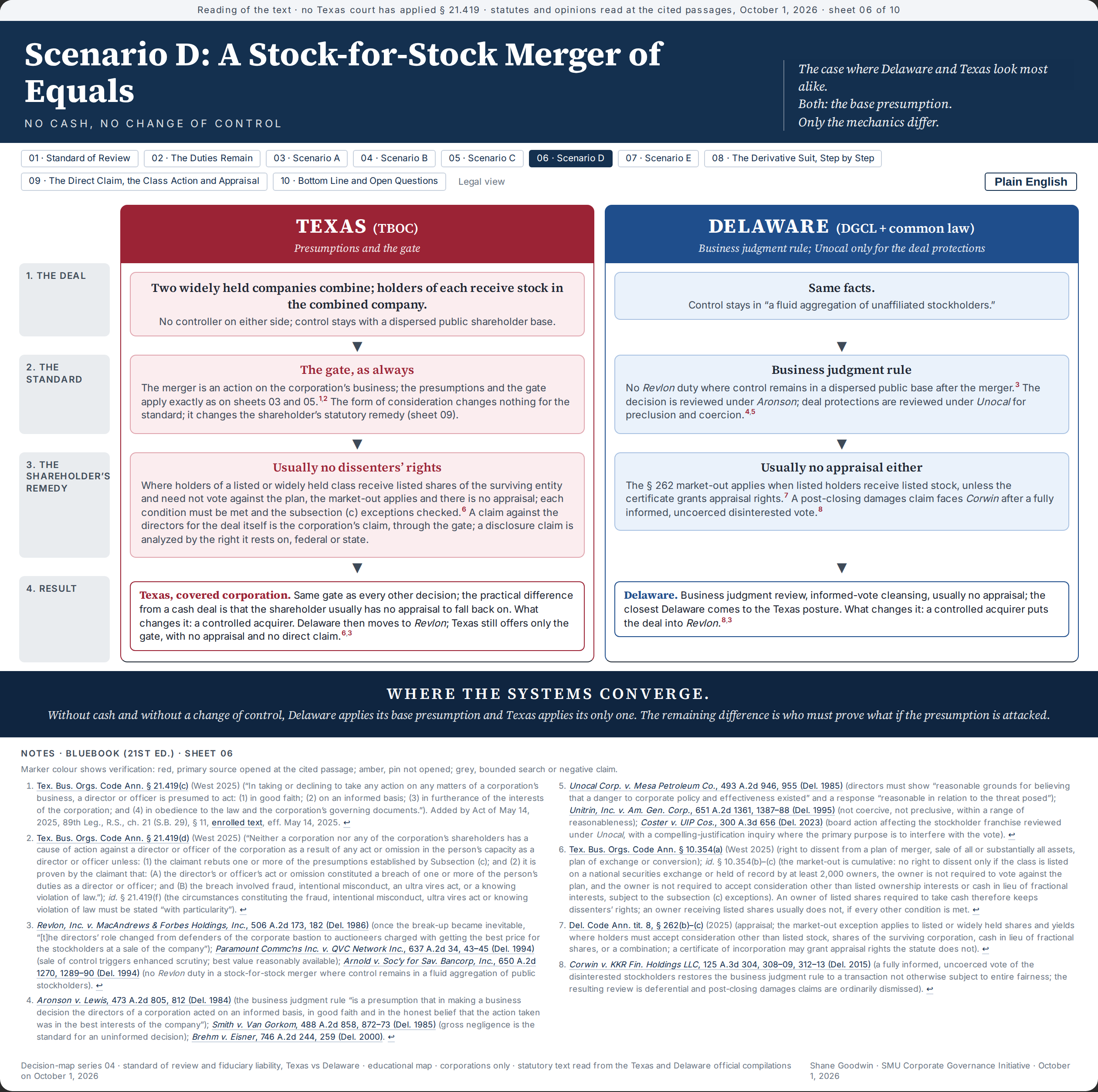
How to read it. Follow either column top to bottom. The grey rail names the question each row answers; the Texas and Delaware columns give each state’s answer with the section or opinion that supplies it. Markers lead to the Bluebook notes under the sheet. The Plain English button at the top of the sheet swaps every cell for an everyday-words version; the legal view and its notes remain the text of record.
The sheets read in order, and each stands alone: 01 and 02 set the frame, 03 to 07 walk one board decision each down both columns, 08 and 09 walk the lawsuit, 10 is the bottom line and the open questions.
Reading of the text · no Texas court has applied § 21.419 · statutes and opinions read at the cited passages, October 1, 2026 · sheet 06 of 10
Scenario D: A Stock-for-Stock Merger of Equals
No cash, no change of control
The case where Delaware and Texas look most alike.
Both: the base presumption.
Only the mechanics differ.
Plain-English view: the same sheet in everyday words, for readers who are not lawyers. It summarizes; the legal view and its notes are the source of record. Click the button again to return.
TEXAS (TBOC)Presumptions and the gate
DELAWARE (DGCL + common law)Business judgment rule; Unocal only for the deal protections
1. The deal
Two widely held companies combine; holders of each receive stock in the combined company.
No controller on either side; control stays with a dispersed public shareholder base.
Two widely held companies combine and everyone receives shares in the combined company. No controlling shareholder on either side.
Same facts.
Control stays in “a fluid aggregation of unaffiliated stockholders.”
Same facts.
2. The standard
The gate, as always
The merger is an action on the corporation’s business; the presumptions and the gate apply exactly as on sheets 03 and 05.12 The form of consideration changes nothing for the standard; it changes the shareholder’s statutory remedy (sheet 09).
Same test as every other decision. The form of payment changes the shareholder’s statutory remedy, not the standard.
Business judgment rule
No Revlon duty where control remains in a dispersed public base after the merger.3 The decision is reviewed under Aronson; deal protections are reviewed under Unocal for preclusion and coercion.45
No best-price duty, because control stays with the public. The ordinary deferential test applies; deal protections are checked for lock-outs.
3. The shareholder’s remedy
Usually no dissenters’ rights
Where holders of a listed or widely held class receive listed shares of the surviving entity and need not vote against the plan, the market-out applies and there is no appraisal; each condition must be met and the subsection (c) exceptions checked.6 A claim against the directors for the deal itself is the corporation’s claim, through the gate; a disclosure claim is analyzed by the right it rests on, federal or state.
Listed shareholders who receive listed shares usually have no appraisal right, if every condition of the exception is met. A claim against the directors over the deal runs through the gate; a disclosure claim depends on which law it rests on.
Usually no appraisal either
The § 262 market-out applies when listed holders receive listed stock, unless the certificate grants appraisal rights.7 A post-closing damages claim faces Corwin after a fully informed, uncoerced disinterested vote.8
Usually no appraisal here either, unless the charter grants it. A later damages claim faces the informed-vote defense.
4. Result
Texas, covered corporation. Same gate as every other decision; the practical difference from a cash deal is that the shareholder usually has no appraisal to fall back on. What changes it: a controlled acquirer. Delaware then moves to
Revlon; Texas still offers only the gate, with no appraisal and no direct claim.
63 Same gate as always; the practical difference from a cash deal is that there is usually no appraisal to fall back on. If the acquirer is controlled by one holder, Delaware moves to its best-value test while Texas still offers only the gate.
Delaware. Business judgment review, informed-vote cleansing, usually no appraisal; the closest Delaware comes to the Texas posture. What changes it: a controlled acquirer puts the deal into
Revlon.
83 Deferential review, vote cleansing, no appraisal: the closest Delaware comes to the Texas posture.
WHERE THE SYSTEMS CONVERGE.Without cash and without a change of control, Delaware applies its base presumption and Texas applies its only one. The remaining difference is who must prove what if the presumption is attacked.
Notes · Bluebook (21st ed.) · sheet 06
Marker colour shows verification: red, primary source opened at the cited passage; amber, pin not opened; grey, bounded search or negative claim.
- Tex. Bus. Orgs. Code Ann. § 21.419(c) (West 2025) (“In taking or declining to take any action on any matters of a corporation’s business, a director or officer is presumed to act: (1) in good faith; (2) on an informed basis; (3) in furtherance of the interests of the corporation; and (4) in obedience to the law and the corporation’s governing documents.”). Added by Act of May 14, 2025, 89th Leg., R.S., ch. 21 (S.B. 29), § 11, enrolled text, eff. May 14, 2025. ↩
- Tex. Bus. Orgs. Code Ann. § 21.419(d) (West 2025) (“Neither a corporation nor any of the corporation’s shareholders has a cause of action against a director or officer of the corporation as a result of any act or omission in the person’s capacity as a director or officer unless: (1) the claimant rebuts one or more of the presumptions established by Subsection (c); and (2) it is proven by the claimant that: (A) the director’s or officer’s act or omission constituted a breach of one or more of the person’s duties as a director or officer; and (B) the breach involved fraud, intentional misconduct, an ultra vires act, or a knowing violation of law.”); id. § 21.419(f) (the circumstances constituting the fraud, intentional misconduct, ultra vires act or knowing violation of law must be stated “with particularity”). ↩
- Revlon, Inc. v. MacAndrews & Forbes Holdings, Inc., 506 A.2d 173, 182 (Del. 1986) (once the break-up became inevitable, “[t]he directors’ role changed from defenders of the corporate bastion to auctioneers charged with getting the best price for the stockholders at a sale of the company”); Paramount Commc’ns Inc. v. QVC Network Inc., 637 A.2d 34, 43–45 (Del. 1994) (sale of control triggers enhanced scrutiny; best value reasonably available); Arnold v. Soc’y for Sav. Bancorp, Inc., 650 A.2d 1270, 1289–90 (Del. 1994) (no Revlon duty in a stock-for-stock merger where control remains in a fluid aggregation of public stockholders). ↩
- Aronson v. Lewis, 473 A.2d 805, 812 (Del. 1984) (the business judgment rule “is a presumption that in making a business decision the directors of a corporation acted on an informed basis, in good faith and in the honest belief that the action taken was in the best interests of the company”); Smith v. Van Gorkom, 488 A.2d 858, 872–73 (Del. 1985) (gross negligence is the standard for an uninformed decision); Brehm v. Eisner, 746 A.2d 244, 259 (Del. 2000). ↩
- Unocal Corp. v. Mesa Petroleum Co., 493 A.2d 946, 955 (Del. 1985) (directors must show “reasonable grounds for believing that a danger to corporate policy and effectiveness existed” and a response “reasonable in relation to the threat posed”); Unitrin, Inc. v. Am. Gen. Corp., 651 A.2d 1361, 1387–88 (Del. 1995) (not coercive, not preclusive, within a range of reasonableness); Coster v. UIP Cos., 300 A.3d 656 (Del. 2023) (board action affecting the stockholder franchise reviewed under Unocal, with a compelling-justification inquiry where the primary purpose is to interfere with the vote). ↩
- Tex. Bus. Orgs. Code Ann. § 10.354(a) (West 2025) (right to dissent from a plan of merger, sale of all or substantially all assets, plan of exchange or conversion); id. § 10.354(b)–(c) (the market-out is cumulative: no right to dissent only if the class is listed on a national securities exchange or held of record by at least 2,000 owners, the owner is not required to vote against the plan, and the owner is not required to accept consideration other than listed ownership interests or cash in lieu of fractional interests, subject to the subsection (c) exceptions). An owner of listed shares required to take cash therefore keeps dissenters’ rights; an owner receiving listed shares usually does not, if every other condition is met. ↩
- Del. Code Ann. tit. 8, § 262(b)–(c) (2025) (appraisal; the market-out exception applies to listed or widely held shares and yields where holders must accept consideration other than listed stock, shares of the surviving corporation, cash in lieu of fractional shares, or a combination; a certificate of incorporation may grant appraisal rights the statute does not). ↩
- Corwin v. KKR Fin. Holdings LLC, 125 A.3d 304, 308–09, 312–13 (Del. 2015) (a fully informed, uncoerced vote of the disinterested stockholders restores the business judgment rule to a transaction not otherwise subject to entire fairness; the resulting review is deferential and post-closing damages claims are ordinarily dismissed). ↩
Sources behind this sheet (8 notes)
- Tex. Bus. Orgs. Code Ann. § 21.419(c) (West 2025) (“In taking or declining to take any action on any matters of a corporation’s business, a director or officer is presumed to act: (1) in good faith; (2) on an informed basis; (3) in furtherance of the interests of the corporation; and (4) in obedience to the law and the corporation’s governing documents.”). Added by Act of May 14, 2025, 89th Leg., R.S., ch. 21 (S.B. 29), § 11, enrolled text, eff. May 14, 2025. ↩
- Tex. Bus. Orgs. Code Ann. § 21.419(d) (West 2025) (“Neither a corporation nor any of the corporation’s shareholders has a cause of action against a director or officer of the corporation as a result of any act or omission in the person’s capacity as a director or officer unless: (1) the claimant rebuts one or more of the presumptions established by Subsection (c); and (2) it is proven by the claimant that: (A) the director’s or officer’s act or omission constituted a breach of one or more of the person’s duties as a director or officer; and (B) the breach involved fraud, intentional misconduct, an ultra vires act, or a knowing violation of law.”); id. § 21.419(f) (the circumstances constituting the fraud, intentional misconduct, ultra vires act or knowing violation of law must be stated “with particularity”). ↩
- Revlon, Inc. v. MacAndrews & Forbes Holdings, Inc., 506 A.2d 173, 182 (Del. 1986) (once the break-up became inevitable, “[t]he directors’ role changed from defenders of the corporate bastion to auctioneers charged with getting the best price for the stockholders at a sale of the company”); Paramount Commc’ns Inc. v. QVC Network Inc., 637 A.2d 34, 43–45 (Del. 1994) (sale of control triggers enhanced scrutiny; best value reasonably available); Arnold v. Soc’y for Sav. Bancorp, Inc., 650 A.2d 1270, 1289–90 (Del. 1994) (no Revlon duty in a stock-for-stock merger where control remains in a fluid aggregation of public stockholders). ↩
- Aronson v. Lewis, 473 A.2d 805, 812 (Del. 1984) (the business judgment rule “is a presumption that in making a business decision the directors of a corporation acted on an informed basis, in good faith and in the honest belief that the action taken was in the best interests of the company”); Smith v. Van Gorkom, 488 A.2d 858, 872–73 (Del. 1985) (gross negligence is the standard for an uninformed decision); Brehm v. Eisner, 746 A.2d 244, 259 (Del. 2000). ↩
- Unocal Corp. v. Mesa Petroleum Co., 493 A.2d 946, 955 (Del. 1985) (directors must show “reasonable grounds for believing that a danger to corporate policy and effectiveness existed” and a response “reasonable in relation to the threat posed”); Unitrin, Inc. v. Am. Gen. Corp., 651 A.2d 1361, 1387–88 (Del. 1995) (not coercive, not preclusive, within a range of reasonableness); Coster v. UIP Cos., 300 A.3d 656 (Del. 2023) (board action affecting the stockholder franchise reviewed under Unocal, with a compelling-justification inquiry where the primary purpose is to interfere with the vote). ↩
- Tex. Bus. Orgs. Code Ann. § 10.354(a) (West 2025) (right to dissent from a plan of merger, sale of all or substantially all assets, plan of exchange or conversion); id. § 10.354(b)–(c) (the market-out is cumulative: no right to dissent only if the class is listed on a national securities exchange or held of record by at least 2,000 owners, the owner is not required to vote against the plan, and the owner is not required to accept consideration other than listed ownership interests or cash in lieu of fractional interests, subject to the subsection (c) exceptions). An owner of listed shares required to take cash therefore keeps dissenters’ rights; an owner receiving listed shares usually does not, if every other condition is met. ↩
- Del. Code Ann. tit. 8, § 262(b)–(c) (2025) (appraisal; the market-out exception applies to listed or widely held shares and yields where holders must accept consideration other than listed stock, shares of the surviving corporation, cash in lieu of fractional shares, or a combination; a certificate of incorporation may grant appraisal rights the statute does not). ↩
- Corwin v. KKR Fin. Holdings LLC, 125 A.3d 304, 308–09, 312–13 (Del. 2015) (a fully informed, uncoerced vote of the disinterested stockholders restores the business judgment rule to a transaction not otherwise subject to entire fairness; the resulting review is deferential and post-closing damages claims are ordinarily dismissed). ↩
Decision-map series 04 · standard of review and fiduciary liability, Texas vs Delaware · educational map · corporations only · statutory text read from the Texas and Delaware official compilations on October 1, 2026Shane Goodwin · SMU Corporate Governance Initiative · October 1, 2026
Read the statutes and the opinions
- Tex. S.B. 29, 89th Leg., R.S. (2025) (enrolled) — §§ 21.416(g), 21.4161, 21.418, 21.419, 21.552, 2.115, 2.116, eff. May 14, 2025.
- Tex. Bus. Orgs. Code § 21.419 (the liability gate); § 21.401 (what a board may consider); § 21.418 (interested directors and officers); §§ 21.551–21.563 (derivative proceedings); § 7.001 (exculpation); § 20.002 (ultra vires); §§ 10.354 and 10.368 (dissent and appraisal); § 1.057 (construction).
- Del. Code Ann. tit. 8, § 144 (as amended by 85 Del. Laws c. 6, S.B. 21, eff. Mar. 25, 2025); § 102(b)(7) (exculpation); § 262 (appraisal).
- Delaware: Aronson v. Lewis, 473 A.2d 805 (Del. 1984); Unocal Corp. v. Mesa Petroleum Co., 493 A.2d 946 (Del. 1985); Revlon, Inc. v. MacAndrews & Forbes Holdings, Inc., 506 A.2d 173 (Del. 1986); Paramount Communications Inc. v. QVC Network Inc., 637 A.2d 34 (Del. 1994); Weinberger v. UOP, Inc., 457 A.2d 701 (Del. 1983); Cede & Co. v. Technicolor, Inc., 634 A.2d 345 (Del. 1993); Zapata Corp. v. Maldonado, 430 A.2d 779 (Del. 1981); RBC Capital Markets, LLC v. Jervis, 129 A.3d 816 (Del. 2015); Lyondell Chemical Co. v. Ryan, 970 A.2d 235 (Del. 2009); Corwin v. KKR Financial Holdings LLC, 125 A.3d 304 (Del. 2015); Stone v. Ritter, 911 A.2d 362 (Del. 2006); Tooley v. Donaldson, Lufkin & Jenrette, Inc., 845 A.2d 1031 (Del. 2004); Brookfield Asset Management, Inc. v. Rosson, 261 A.3d 1251 (Del. 2021); United Food & Commercial Workers Union v. Zuckerberg, 262 A.3d 1034 (Del. 2021); Dodiya v. Franklin, C.A. No. 2025-0932-LWW (Del. Ch. Aug. 26, 2026).
- Texas: In re Estate of Poe, 648 S.W.3d 277 (Tex. 2022); Ritchie v. Rupe, 443 S.W.3d 856 (Tex. 2014); Sneed v. Webre, 465 S.W.3d 169 (Tex. 2015); Gearhart Industries, Inc. v. Smith International, Inc., 741 F.2d 707 (5th Cir. 1984); Wingate v. Hajdik, 795 S.W.2d 717 (Tex. 1990); International Bankers Life Insurance Co. v. Holloway, 368 S.W.2d 567 (Tex. 1963); Cates v. Sparkman, 73 Tex. 619, 11 S.W. 846 (1889); Gusinsky v. Reynolds, No. 3:25-cv-01816-K (N.D. Tex. Mar. 17, 2026). Each sheet carries its own Bluebook notes beneath the chart, with a link to each opinion; the marker colour says whether the cited passage was opened. Opinions are collected on the vertical’s sources page.
Educational map. Corporations only; LLC and partnership analogues differ. A reading of the statutory text: no Texas court has applied § 21.419 to a sale, a defense or a conflicted deal. Nothing here is legal advice.