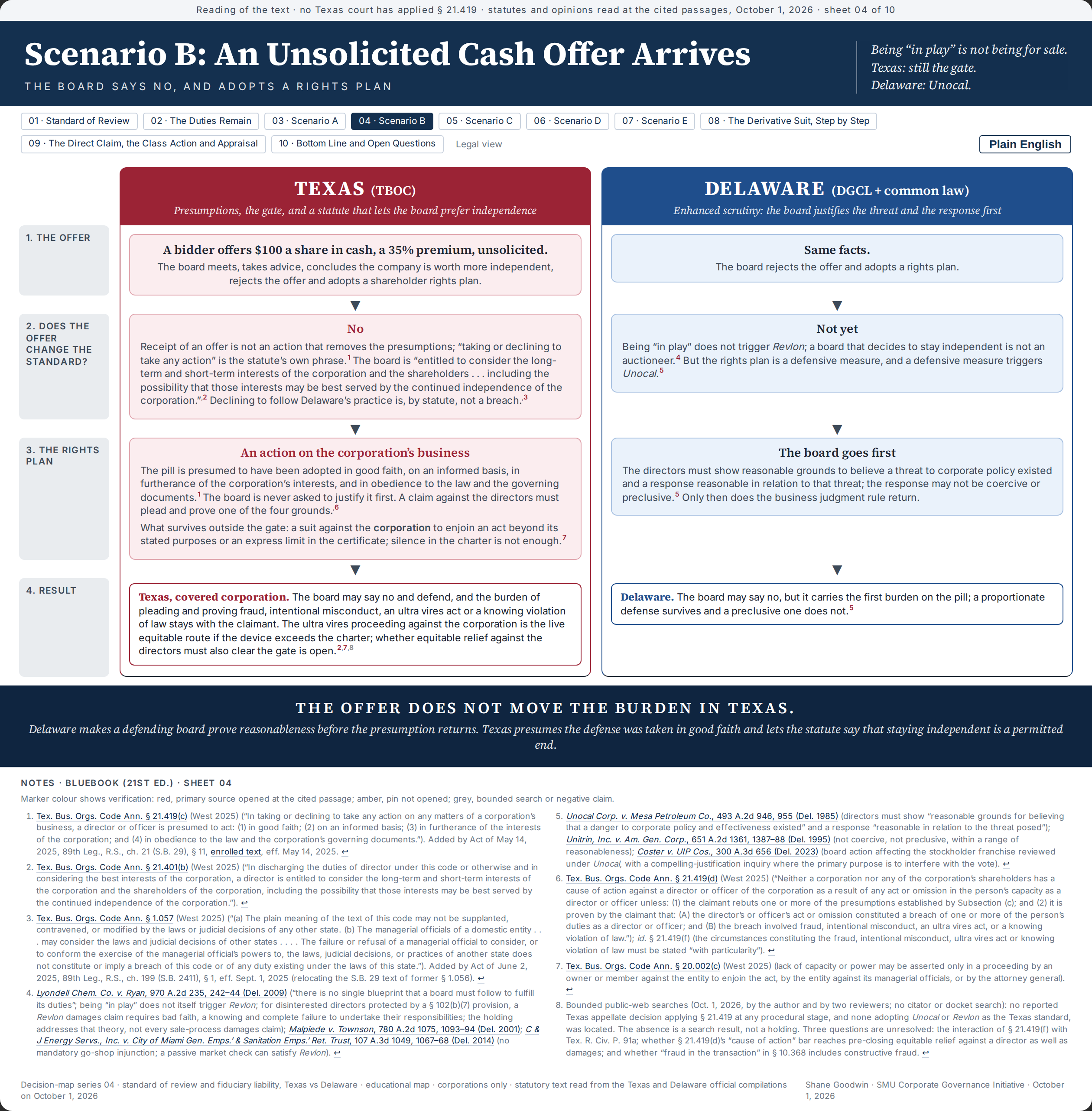
How to read it. Follow either column top to bottom. The grey rail names the question each row answers; the Texas and Delaware columns give each state’s answer with the section or opinion that supplies it. Markers lead to the Bluebook notes under the sheet. The Plain English button at the top of the sheet swaps every cell for an everyday-words version; the legal view and its notes remain the text of record.
The sheets read in order, and each stands alone: 01 and 02 set the frame, 03 to 07 walk one board decision each down both columns, 08 and 09 walk the lawsuit, 10 is the bottom line and the open questions.
Reading of the text · no Texas court has applied § 21.419 · statutes and opinions read at the cited passages, October 1, 2026 · sheet 04 of 10
Scenario B: An Unsolicited Cash Offer Arrives
The board says no, and adopts a rights plan
Being “in play” is not being for sale.
Texas: still the gate.
Delaware: Unocal.
Plain-English view: the same sheet in everyday words, for readers who are not lawyers. It summarizes; the legal view and its notes are the source of record. Click the button again to return.
TEXAS (TBOC)Presumptions, the gate, and a statute that lets the board prefer independence
DELAWARE (DGCL + common law)Enhanced scrutiny: the board justifies the threat and the response first
1. The offer
A bidder offers $100 a share in cash, a 35% premium, unsolicited.
The board meets, takes advice, concludes the company is worth more independent, rejects the offer and adopts a shareholder rights plan.
A bidder offers $100 a share in cash, a big premium, out of the blue. The board meets, takes advice, decides the company is worth more on its own, says no, and adopts a ‘poison pill’ to block a hostile takeover.
Same facts.
The board rejects the offer and adopts a rights plan.
Same facts.
2. Does the offer change the standard?
No
Receipt of an offer is not an action that removes the presumptions; “taking or declining to take any action” is the statute’s own phrase.1 The board is “entitled to consider the long-term and short-term interests of the corporation and the shareholders . . . including the possibility that those interests may be best served by the continued independence of the corporation.”2 Declining to follow Delaware’s practice is, by statute, not a breach.3
Receiving an offer changes nothing. The statute expressly lets directors consider the long term, including the possibility that the company is better off staying independent, and says that declining to follow another state’s practice is not a breach.
Not yet
Being “in play” does not trigger Revlon; a board that decides to stay independent is not an auctioneer.4 But the rights plan is a defensive measure, and a defensive measure triggers Unocal.5
Simply being a target does not put the company up for sale, so the ‘sell for the best price’ duty is not triggered. But the poison pill is a defensive move, and Delaware reviews defensive moves under a stricter test.
3. The rights plan
An action on the corporation’s business
The pill is presumed to have been adopted in good faith, on an informed basis, in furtherance of the corporation’s interests, and in obedience to the law and the governing documents.1 The board is never asked to justify it first. A claim against the directors must plead and prove one of the four grounds.6
What survives outside the gate: a suit against the corporation to enjoin an act beyond its stated purposes or an express limit in the certificate; silence in the charter is not enough.7
The pill is just another board action, presumed proper. The board does not have to justify it first. A shareholder who wants to sue the directors must plead and prove one of the four grounds. Separately, a shareholder can sue the company itself to stop a pill that goes beyond the company’s stated powers or an express limit in its charter. A pill aimed at blocking a pending shareholder vote has no special Texas test; it would have to be pleaded as deliberate wrongdoing or a knowing violation of the company’s own rules.
The board goes first
The directors must show reasonable grounds to believe a threat to corporate policy existed and a response reasonable in relation to that threat; the response may not be coercive or preclusive.5 Only then does the business judgment rule return.
The directors go first. They must show there was a real threat and that the pill was a proportionate response, not one that makes a takeover impossible or forces shareholders’ hands. Only after that does the usual deference return.
4. Result
Texas, covered corporation. The board may say no and defend, and the burden of pleading and proving fraud, intentional misconduct, an ultra vires act or a knowing violation of law stays with the claimant. The ultra vires proceeding against the corporation is the live equitable route if the device exceeds the charter; whether equitable relief against the directors must also clear the gate is open.
278 In Texas the board may say no and defend itself, and the shareholder must plead and prove one of the four grounds. The live route is a suit against the company itself if the device goes beyond the charter.
Delaware. The board may say no, but it carries the first burden on the pill; a proportionate defense survives and a preclusive one does not.
5 In Delaware the board may say no, but it must prove the defense was reasonable before the court defers.
THE OFFER DOES NOT MOVE THE BURDEN IN TEXAS.Delaware makes a defending board prove reasonableness before the presumption returns. Texas presumes the defense was taken in good faith and lets the statute say that staying independent is a permitted end.
Notes · Bluebook (21st ed.) · sheet 04
Marker colour shows verification: red, primary source opened at the cited passage; amber, pin not opened; grey, bounded search or negative claim.
- Tex. Bus. Orgs. Code Ann. § 21.419(c) (West 2025) (“In taking or declining to take any action on any matters of a corporation’s business, a director or officer is presumed to act: (1) in good faith; (2) on an informed basis; (3) in furtherance of the interests of the corporation; and (4) in obedience to the law and the corporation’s governing documents.”). Added by Act of May 14, 2025, 89th Leg., R.S., ch. 21 (S.B. 29), § 11, enrolled text, eff. May 14, 2025. ↩
- Tex. Bus. Orgs. Code Ann. § 21.401(b) (West 2025) (“In discharging the duties of director under this code or otherwise and in considering the best interests of the corporation, a director is entitled to consider the long-term and short-term interests of the corporation and the shareholders of the corporation, including the possibility that those interests may be best served by the continued independence of the corporation.”). ↩
- Tex. Bus. Orgs. Code Ann. § 1.057 (West 2025) (“(a) The plain meaning of the text of this code may not be supplanted, contravened, or modified by the laws or judicial decisions of any other state. (b) The managerial officials of a domestic entity . . . may consider the laws and judicial decisions of other states . . . . The failure or refusal of a managerial official to consider, or to conform the exercise of the managerial official’s powers to, the laws, judicial decisions, or practices of another state does not constitute or imply a breach of this code or of any duty existing under the laws of this state.”). Added by Act of June 2, 2025, 89th Leg., R.S., ch. 199 (S.B. 2411), § 1, eff. Sept. 1, 2025 (relocating the S.B. 29 text of former § 1.056). ↩
- Lyondell Chem. Co. v. Ryan, 970 A.2d 235, 242–44 (Del. 2009) (“there is no single blueprint that a board must follow to fulfill its duties”; being “in play” does not itself trigger Revlon; for disinterested directors protected by a § 102(b)(7) provision, a Revlon damages claim requires bad faith, a knowing and complete failure to undertake their responsibilities; the holding addresses that theory, not every sale-process damages claim); Malpiede v. Townson, 780 A.2d 1075, 1093–94 (Del. 2001); C & J Energy Servs., Inc. v. City of Miami Gen. Emps.’ & Sanitation Emps.’ Ret. Trust, 107 A.3d 1049, 1067–68 (Del. 2014) (no mandatory go-shop injunction; a passive market check can satisfy Revlon). ↩
- Unocal Corp. v. Mesa Petroleum Co., 493 A.2d 946, 955 (Del. 1985) (directors must show “reasonable grounds for believing that a danger to corporate policy and effectiveness existed” and a response “reasonable in relation to the threat posed”); Unitrin, Inc. v. Am. Gen. Corp., 651 A.2d 1361, 1387–88 (Del. 1995) (not coercive, not preclusive, within a range of reasonableness); Coster v. UIP Cos., 300 A.3d 656 (Del. 2023) (board action affecting the stockholder franchise reviewed under Unocal, with a compelling-justification inquiry where the primary purpose is to interfere with the vote). ↩
- Tex. Bus. Orgs. Code Ann. § 21.419(d) (West 2025) (“Neither a corporation nor any of the corporation’s shareholders has a cause of action against a director or officer of the corporation as a result of any act or omission in the person’s capacity as a director or officer unless: (1) the claimant rebuts one or more of the presumptions established by Subsection (c); and (2) it is proven by the claimant that: (A) the director’s or officer’s act or omission constituted a breach of one or more of the person’s duties as a director or officer; and (B) the breach involved fraud, intentional misconduct, an ultra vires act, or a knowing violation of law.”); id. § 21.419(f) (the circumstances constituting the fraud, intentional misconduct, ultra vires act or knowing violation of law must be stated “with particularity”). ↩
- Tex. Bus. Orgs. Code Ann. § 20.002(c) (West 2025) (lack of capacity or power may be asserted only in a proceeding by an owner or member against the entity to enjoin the act, by the entity against its managerial officials, or by the attorney general). ↩
- Bounded public-web searches (Oct. 1, 2026, by the author and by two reviewers; no citator or docket search): no reported Texas appellate decision applying § 21.419 at any procedural stage, and none adopting Unocal or Revlon as the Texas standard, was located. The absence is a search result, not a holding. Three questions are unresolved: the interaction of § 21.419(f) with Tex. R. Civ. P. 91a; whether § 21.419(d)’s “cause of action” bar reaches pre-closing equitable relief against a director as well as damages; and whether “fraud in the transaction” in § 10.368 includes constructive fraud. ↩
Sources behind this sheet (8 notes)
- Tex. Bus. Orgs. Code Ann. § 21.419(c) (West 2025) (“In taking or declining to take any action on any matters of a corporation’s business, a director or officer is presumed to act: (1) in good faith; (2) on an informed basis; (3) in furtherance of the interests of the corporation; and (4) in obedience to the law and the corporation’s governing documents.”). Added by Act of May 14, 2025, 89th Leg., R.S., ch. 21 (S.B. 29), § 11, enrolled text, eff. May 14, 2025. ↩
- Tex. Bus. Orgs. Code Ann. § 21.401(b) (West 2025) (“In discharging the duties of director under this code or otherwise and in considering the best interests of the corporation, a director is entitled to consider the long-term and short-term interests of the corporation and the shareholders of the corporation, including the possibility that those interests may be best served by the continued independence of the corporation.”). ↩
- Tex. Bus. Orgs. Code Ann. § 1.057 (West 2025) (“(a) The plain meaning of the text of this code may not be supplanted, contravened, or modified by the laws or judicial decisions of any other state. (b) The managerial officials of a domestic entity . . . may consider the laws and judicial decisions of other states . . . . The failure or refusal of a managerial official to consider, or to conform the exercise of the managerial official’s powers to, the laws, judicial decisions, or practices of another state does not constitute or imply a breach of this code or of any duty existing under the laws of this state.”). Added by Act of June 2, 2025, 89th Leg., R.S., ch. 199 (S.B. 2411), § 1, eff. Sept. 1, 2025 (relocating the S.B. 29 text of former § 1.056). ↩
- Lyondell Chem. Co. v. Ryan, 970 A.2d 235, 242–44 (Del. 2009) (“there is no single blueprint that a board must follow to fulfill its duties”; being “in play” does not itself trigger Revlon; for disinterested directors protected by a § 102(b)(7) provision, a Revlon damages claim requires bad faith, a knowing and complete failure to undertake their responsibilities; the holding addresses that theory, not every sale-process damages claim); Malpiede v. Townson, 780 A.2d 1075, 1093–94 (Del. 2001); C & J Energy Servs., Inc. v. City of Miami Gen. Emps.’ & Sanitation Emps.’ Ret. Trust, 107 A.3d 1049, 1067–68 (Del. 2014) (no mandatory go-shop injunction; a passive market check can satisfy Revlon). ↩
- Unocal Corp. v. Mesa Petroleum Co., 493 A.2d 946, 955 (Del. 1985) (directors must show “reasonable grounds for believing that a danger to corporate policy and effectiveness existed” and a response “reasonable in relation to the threat posed”); Unitrin, Inc. v. Am. Gen. Corp., 651 A.2d 1361, 1387–88 (Del. 1995) (not coercive, not preclusive, within a range of reasonableness); Coster v. UIP Cos., 300 A.3d 656 (Del. 2023) (board action affecting the stockholder franchise reviewed under Unocal, with a compelling-justification inquiry where the primary purpose is to interfere with the vote). ↩
- Tex. Bus. Orgs. Code Ann. § 21.419(d) (West 2025) (“Neither a corporation nor any of the corporation’s shareholders has a cause of action against a director or officer of the corporation as a result of any act or omission in the person’s capacity as a director or officer unless: (1) the claimant rebuts one or more of the presumptions established by Subsection (c); and (2) it is proven by the claimant that: (A) the director’s or officer’s act or omission constituted a breach of one or more of the person’s duties as a director or officer; and (B) the breach involved fraud, intentional misconduct, an ultra vires act, or a knowing violation of law.”); id. § 21.419(f) (the circumstances constituting the fraud, intentional misconduct, ultra vires act or knowing violation of law must be stated “with particularity”). ↩
- Tex. Bus. Orgs. Code Ann. § 20.002(c) (West 2025) (lack of capacity or power may be asserted only in a proceeding by an owner or member against the entity to enjoin the act, by the entity against its managerial officials, or by the attorney general). ↩
- Bounded public-web searches (Oct. 1, 2026, by the author and by two reviewers; no citator or docket search): no reported Texas appellate decision applying § 21.419 at any procedural stage, and none adopting Unocal or Revlon as the Texas standard, was located. The absence is a search result, not a holding. Three questions are unresolved: the interaction of § 21.419(f) with Tex. R. Civ. P. 91a; whether § 21.419(d)’s “cause of action” bar reaches pre-closing equitable relief against a director as well as damages; and whether “fraud in the transaction” in § 10.368 includes constructive fraud. ↩
Decision-map series 04 · standard of review and fiduciary liability, Texas vs Delaware · educational map · corporations only · statutory text read from the Texas and Delaware official compilations on October 1, 2026Shane Goodwin · SMU Corporate Governance Initiative · October 1, 2026
Read the statutes and the opinions
- Tex. S.B. 29, 89th Leg., R.S. (2025) (enrolled) — §§ 21.416(g), 21.4161, 21.418, 21.419, 21.552, 2.115, 2.116, eff. May 14, 2025.
- Tex. Bus. Orgs. Code § 21.419 (the liability gate); § 21.401 (what a board may consider); § 21.418 (interested directors and officers); §§ 21.551–21.563 (derivative proceedings); § 7.001 (exculpation); § 20.002 (ultra vires); §§ 10.354 and 10.368 (dissent and appraisal); § 1.057 (construction).
- Del. Code Ann. tit. 8, § 144 (as amended by 85 Del. Laws c. 6, S.B. 21, eff. Mar. 25, 2025); § 102(b)(7) (exculpation); § 262 (appraisal).
- Delaware: Aronson v. Lewis, 473 A.2d 805 (Del. 1984); Unocal Corp. v. Mesa Petroleum Co., 493 A.2d 946 (Del. 1985); Revlon, Inc. v. MacAndrews & Forbes Holdings, Inc., 506 A.2d 173 (Del. 1986); Paramount Communications Inc. v. QVC Network Inc., 637 A.2d 34 (Del. 1994); Weinberger v. UOP, Inc., 457 A.2d 701 (Del. 1983); Cede & Co. v. Technicolor, Inc., 634 A.2d 345 (Del. 1993); Zapata Corp. v. Maldonado, 430 A.2d 779 (Del. 1981); RBC Capital Markets, LLC v. Jervis, 129 A.3d 816 (Del. 2015); Lyondell Chemical Co. v. Ryan, 970 A.2d 235 (Del. 2009); Corwin v. KKR Financial Holdings LLC, 125 A.3d 304 (Del. 2015); Stone v. Ritter, 911 A.2d 362 (Del. 2006); Tooley v. Donaldson, Lufkin & Jenrette, Inc., 845 A.2d 1031 (Del. 2004); Brookfield Asset Management, Inc. v. Rosson, 261 A.3d 1251 (Del. 2021); United Food & Commercial Workers Union v. Zuckerberg, 262 A.3d 1034 (Del. 2021); Dodiya v. Franklin, C.A. No. 2025-0932-LWW (Del. Ch. Aug. 26, 2026).
- Texas: In re Estate of Poe, 648 S.W.3d 277 (Tex. 2022); Ritchie v. Rupe, 443 S.W.3d 856 (Tex. 2014); Sneed v. Webre, 465 S.W.3d 169 (Tex. 2015); Gearhart Industries, Inc. v. Smith International, Inc., 741 F.2d 707 (5th Cir. 1984); Wingate v. Hajdik, 795 S.W.2d 717 (Tex. 1990); International Bankers Life Insurance Co. v. Holloway, 368 S.W.2d 567 (Tex. 1963); Cates v. Sparkman, 73 Tex. 619, 11 S.W. 846 (1889); Gusinsky v. Reynolds, No. 3:25-cv-01816-K (N.D. Tex. Mar. 17, 2026). Each sheet carries its own Bluebook notes beneath the chart, with a link to each opinion; the marker colour says whether the cited passage was opened. Opinions are collected on the vertical’s sources page.
Educational map. Corporations only; LLC and partnership analogues differ. A reading of the statutory text: no Texas court has applied § 21.419 to a sale, a defense or a conflicted deal. Nothing here is legal advice.