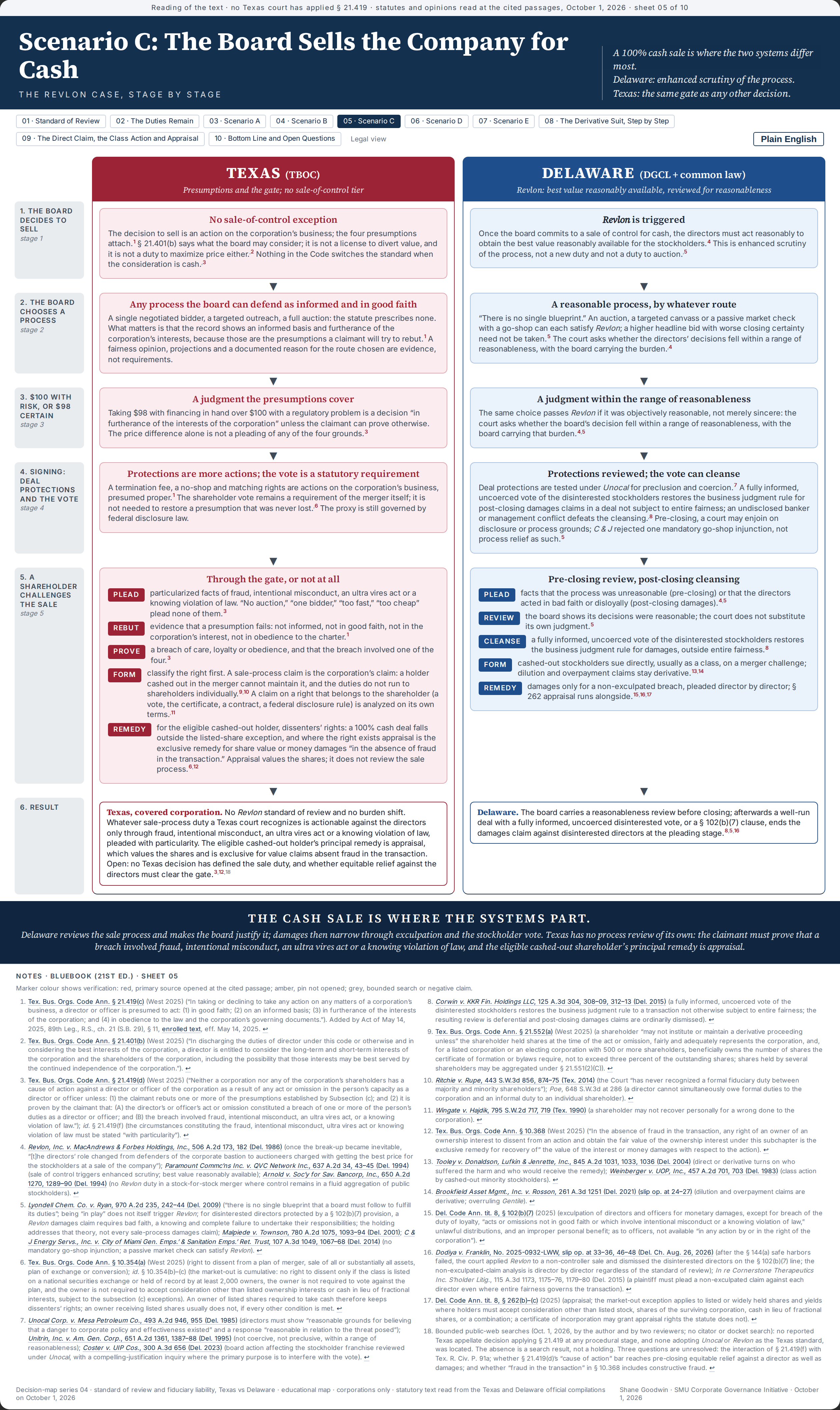
How to read it. Follow either column top to bottom. The grey rail names the question each row answers; the Texas and Delaware columns give each state’s answer with the section or opinion that supplies it. Markers lead to the Bluebook notes under the sheet. The Plain English button at the top of the sheet swaps every cell for an everyday-words version; the legal view and its notes remain the text of record.
The sheets read in order, and each stands alone: 01 and 02 set the frame, 03 to 07 walk one board decision each down both columns, 08 and 09 walk the lawsuit, 10 is the bottom line and the open questions.
Reading of the text · no Texas court has applied § 21.419 · statutes and opinions read at the cited passages, October 1, 2026 · sheet 05 of 10
Scenario C: The Board Sells the Company for Cash
The Revlon case, stage by stage
A 100% cash sale is where the two systems differ most.
Delaware: enhanced scrutiny of the process.
Texas: the same gate as any other decision.
Plain-English view: the same sheet in everyday words, for readers who are not lawyers. It summarizes; the legal view and its notes are the source of record. Click the button again to return.
TEXAS (TBOC)Presumptions and the gate; no sale-of-control tier
DELAWARE (DGCL + common law)Revlon: best value reasonably available, reviewed for reasonableness
1. The board decides to sellstage 1
No sale-of-control exception
The decision to sell is an action on the corporation’s business; the four presumptions attach.1 § 21.401(b) says what the board may consider; it is not a license to divert value, and it is not a duty to maximize price either.2 Nothing in the Code switches the standard when the consideration is cash.3
The board decides to sell the whole company for cash. In Texas this is just another board decision. The statute tells directors what they may consider; it does not order them to get the highest price, and nothing in it changes the test because the payment is cash. What a Texas court will say a selling board owes is still an open question; whatever it is, suing over it goes through the same gate.
Revlon is triggered
Once the board commits to a sale of control for cash, the directors must act reasonably to obtain the best value reasonably available for the stockholders.4 This is enhanced scrutiny of the process, not a new duty and not a duty to auction.5
Once a Delaware board commits to selling control for cash, it must act reasonably to get the best value reasonably available. The court looks hard at the process. This is not a duty to run an auction.
2. The board chooses a processstage 2
Any process the board can defend as informed and in good faith
A single negotiated bidder, a targeted outreach, a full auction: the statute prescribes none. What matters is that the record shows an informed basis and furtherance of the corporation’s interests, because those are the presumptions a claimant will try to rebut.1 A fairness opinion, projections and a documented reason for the route chosen are evidence, not requirements.
The board can pick any sales process it can defend as informed and in good faith: one negotiated buyer, a few invited bidders, or a full auction. A valuation opinion and a written reason for the route chosen are helpful evidence, not legal requirements.
A reasonable process, by whatever route
“There is no single blueprint.” An auction, a targeted canvass or a passive market check with a go-shop can each satisfy Revlon; a higher headline bid with worse closing certainty need not be taken.5 The court asks whether the directors’ decisions fell within a range of reasonableness, with the board carrying the burden.4
There is no single recipe. An auction, a targeted canvass or a quiet market check can each pass. A higher headline price with more closing risk need not be taken. The question is whether the board’s choices were reasonable, and the board carries that burden.
3. $100 with risk, or $98 certainstage 3
A judgment the presumptions cover
Taking $98 with financing in hand over $100 with a regulatory problem is a decision “in furtherance of the interests of the corporation” unless the claimant can prove otherwise. The price difference alone is not a pleading of any of the four grounds.3
Taking $98 with financing in hand over $100 with a regulatory problem is a judgment the presumptions cover. The price gap by itself is not a claim.
A judgment within the range of reasonableness
The same choice passes Revlon if it was objectively reasonable, not merely sincere: the court asks whether the board’s decision fell within a range of reasonableness, with the board carrying that burden.45
The same choice passes if it was reasonable, not just sincere; the board has to show its decision was within the range of reasonable choices.
4. Signing: deal protections and the votestage 4
Protections are more actions; the vote is a statutory requirement
A termination fee, a no-shop and matching rights are actions on the corporation’s business, presumed proper.1 The shareholder vote remains a requirement of the merger itself; it is not needed to restore a presumption that was never lost.6 The proxy is still governed by federal disclosure law.
Break-up fees and no-shop clauses are more board actions, presumed proper. Shareholders still vote on the merger because the merger statute requires it, not to restore a presumption. The proxy statement is still governed by federal law.
Protections reviewed; the vote can cleanse
Deal protections are tested under Unocal for preclusion and coercion.7 A fully informed, uncoerced vote of the disinterested stockholders restores the business judgment rule for post-closing damages claims in a deal not subject to entire fairness; an undisclosed banker or management conflict defeats the cleansing.8 Pre-closing, a court may enjoin on disclosure or process grounds; C & J rejected one mandatory go-shop injunction, not process relief as such.5
Deal protections are tested for whether they lock out other bidders. A fully informed vote by shareholders who have no stake in the deal, with nothing hidden from them, restores the deferential standard for later damages claims. Before closing, a court can still step in on disclosure or process grounds.
5. A shareholder challenges the salestage 5
Through the gate, or not at all
PLEADparticularized facts of fraud, intentional misconduct, an ultra vires act or a knowing violation of law. “No auction,” “one bidder,” “too fast,” “too cheap” plead none of them.3
REBUTevidence that a presumption fails: not informed, not in good faith, not in the corporation’s interest, not in obedience to the charter.1
PROVEa breach of care, loyalty or obedience, and that the breach involved one of the four.3
FORMclassify the right first. A sale-process claim is the corporation’s claim: a holder cashed out in the merger cannot maintain it, and the duties do not run to shareholders individually.910 A claim on a right that belongs to the shareholder (a vote, the certificate, a contract, a federal disclosure rule) is analyzed on its own terms.11
REMEDYfor the eligible cashed-out holder, dissenters’ rights: a 100% cash deal falls outside the listed-share exception, and where the right exists appraisal is the exclusive remedy for share value or money damages “in the absence of fraud in the transaction.” Appraisal values the shares; it does not review the sale process.612
A shareholder who wants to sue the directors must spell out fraud, deliberate wrongdoing, an act beyond the company’s powers or a knowing violation of law. ‘No auction’, ‘one bidder’, ‘too fast’ and ‘too cheap’ are none of those. A complaint about the sale process belongs to the company, and a shareholder who has been cashed out can no longer bring it. That shareholder’s main remedy is appraisal: a court sets the fair price. Where that right exists, it is the only price remedy unless there was fraud in the deal; it does not judge how the board ran the sale.
Pre-closing review, post-closing cleansing
PLEADfacts that the process was unreasonable (pre-closing) or that the directors acted in bad faith or disloyally (post-closing damages).45
REVIEWthe board shows its decisions were reasonable; the court does not substitute its own judgment.5
CLEANSEa fully informed, uncoerced vote of the disinterested stockholders restores the business judgment rule for damages, outside entire fairness.8
FORMcashed-out stockholders sue directly, usually as a class, on a merger challenge; dilution and overpayment claims stay derivative.1314
REMEDYdamages only for a non-exculpated breach, pleaded director by director; § 262 appraisal runs alongside.151617
A Delaware shareholder can ask the court to review the process before closing, and after closing can sue for damages, usually as a class. An informed vote restores deference, and a charter clause blocks damages for carelessness. Appraisal runs alongside.
6. Result
Texas, covered corporation. No
Revlon standard of review and no burden shift. Whatever sale-process duty a Texas court recognizes is actionable against the directors only through fraud, intentional misconduct, an ultra vires act or a knowing violation of law, pleaded with particularity. The eligible cashed-out holder’s principal remedy is appraisal, which values the shares and is exclusive for value claims absent fraud in the transaction. Open: no Texas decision has defined the sale duty, and whether equitable relief against the directors must clear the gate.
31218 Texas: no best-price test, no process review, no burden shift. Whatever a selling board owes, suing over it requires fraud, deliberate wrongdoing, an act beyond the company’s powers or a knowing violation of law, and the cashed-out shareholder’s main remedy is a court-set price.
Delaware. The board carries a reasonableness review before closing; afterwards a well-run deal with a fully informed, uncoerced disinterested vote, or a § 102(b)(7) clause, ends the damages claim against disinterested directors at the pleading stage.
8516 Delaware: the board must justify its process before closing; afterward a well-run deal with a clean, informed vote, or a charter clause, ends the money claim against independent directors early.
THE CASH SALE IS WHERE THE SYSTEMS PART.Delaware reviews the sale process and makes the board justify it; damages then narrow through exculpation and the stockholder vote. Texas has no process review of its own: the claimant must prove that a breach involved fraud, intentional misconduct, an ultra vires act or a knowing violation of law, and the eligible cashed-out shareholder’s principal remedy is appraisal.
Notes · Bluebook (21st ed.) · sheet 05
Marker colour shows verification: red, primary source opened at the cited passage; amber, pin not opened; grey, bounded search or negative claim.
- Tex. Bus. Orgs. Code Ann. § 21.419(c) (West 2025) (“In taking or declining to take any action on any matters of a corporation’s business, a director or officer is presumed to act: (1) in good faith; (2) on an informed basis; (3) in furtherance of the interests of the corporation; and (4) in obedience to the law and the corporation’s governing documents.”). Added by Act of May 14, 2025, 89th Leg., R.S., ch. 21 (S.B. 29), § 11, enrolled text, eff. May 14, 2025. ↩
- Tex. Bus. Orgs. Code Ann. § 21.401(b) (West 2025) (“In discharging the duties of director under this code or otherwise and in considering the best interests of the corporation, a director is entitled to consider the long-term and short-term interests of the corporation and the shareholders of the corporation, including the possibility that those interests may be best served by the continued independence of the corporation.”). ↩
- Tex. Bus. Orgs. Code Ann. § 21.419(d) (West 2025) (“Neither a corporation nor any of the corporation’s shareholders has a cause of action against a director or officer of the corporation as a result of any act or omission in the person’s capacity as a director or officer unless: (1) the claimant rebuts one or more of the presumptions established by Subsection (c); and (2) it is proven by the claimant that: (A) the director’s or officer’s act or omission constituted a breach of one or more of the person’s duties as a director or officer; and (B) the breach involved fraud, intentional misconduct, an ultra vires act, or a knowing violation of law.”); id. § 21.419(f) (the circumstances constituting the fraud, intentional misconduct, ultra vires act or knowing violation of law must be stated “with particularity”). ↩
- Revlon, Inc. v. MacAndrews & Forbes Holdings, Inc., 506 A.2d 173, 182 (Del. 1986) (once the break-up became inevitable, “[t]he directors’ role changed from defenders of the corporate bastion to auctioneers charged with getting the best price for the stockholders at a sale of the company”); Paramount Commc’ns Inc. v. QVC Network Inc., 637 A.2d 34, 43–45 (Del. 1994) (sale of control triggers enhanced scrutiny; best value reasonably available); Arnold v. Soc’y for Sav. Bancorp, Inc., 650 A.2d 1270, 1289–90 (Del. 1994) (no Revlon duty in a stock-for-stock merger where control remains in a fluid aggregation of public stockholders). ↩
- Lyondell Chem. Co. v. Ryan, 970 A.2d 235, 242–44 (Del. 2009) (“there is no single blueprint that a board must follow to fulfill its duties”; being “in play” does not itself trigger Revlon; for disinterested directors protected by a § 102(b)(7) provision, a Revlon damages claim requires bad faith, a knowing and complete failure to undertake their responsibilities; the holding addresses that theory, not every sale-process damages claim); Malpiede v. Townson, 780 A.2d 1075, 1093–94 (Del. 2001); C & J Energy Servs., Inc. v. City of Miami Gen. Emps.’ & Sanitation Emps.’ Ret. Trust, 107 A.3d 1049, 1067–68 (Del. 2014) (no mandatory go-shop injunction; a passive market check can satisfy Revlon). ↩
- Tex. Bus. Orgs. Code Ann. § 10.354(a) (West 2025) (right to dissent from a plan of merger, sale of all or substantially all assets, plan of exchange or conversion); id. § 10.354(b)–(c) (the market-out is cumulative: no right to dissent only if the class is listed on a national securities exchange or held of record by at least 2,000 owners, the owner is not required to vote against the plan, and the owner is not required to accept consideration other than listed ownership interests or cash in lieu of fractional interests, subject to the subsection (c) exceptions). An owner of listed shares required to take cash therefore keeps dissenters’ rights; an owner receiving listed shares usually does not, if every other condition is met. ↩
- Unocal Corp. v. Mesa Petroleum Co., 493 A.2d 946, 955 (Del. 1985) (directors must show “reasonable grounds for believing that a danger to corporate policy and effectiveness existed” and a response “reasonable in relation to the threat posed”); Unitrin, Inc. v. Am. Gen. Corp., 651 A.2d 1361, 1387–88 (Del. 1995) (not coercive, not preclusive, within a range of reasonableness); Coster v. UIP Cos., 300 A.3d 656 (Del. 2023) (board action affecting the stockholder franchise reviewed under Unocal, with a compelling-justification inquiry where the primary purpose is to interfere with the vote). ↩
- Corwin v. KKR Fin. Holdings LLC, 125 A.3d 304, 308–09, 312–13 (Del. 2015) (a fully informed, uncoerced vote of the disinterested stockholders restores the business judgment rule to a transaction not otherwise subject to entire fairness; the resulting review is deferential and post-closing damages claims are ordinarily dismissed). ↩
- Tex. Bus. Orgs. Code Ann. § 21.552(a) (West 2025) (a shareholder “may not institute or maintain a derivative proceeding unless” the shareholder held shares at the time of the act or omission, fairly and adequately represents the corporation, and, for a listed corporation or an electing corporation with 500 or more shareholders, beneficially owns the number of shares the certificate of formation or bylaws require, not to exceed three percent of the outstanding shares; shares held by several shareholders may be aggregated under § 21.551(2)(C)). ↩
- Ritchie v. Rupe, 443 S.W.3d 856, 874–75 (Tex. 2014) (the Court “has never recognized a formal fiduciary duty between majority and minority shareholders”); Poe, 648 S.W.3d at 286 (a director cannot simultaneously owe formal duties to the corporation and an informal duty to an individual shareholder). ↩
- Wingate v. Hajdik, 795 S.W.2d 717, 719 (Tex. 1990) (a shareholder may not recover personally for a wrong done to the corporation). ↩
- Tex. Bus. Orgs. Code Ann. § 10.368 (West 2025) (“In the absence of fraud in the transaction, any right of an owner of an ownership interest to dissent from an action and obtain the fair value of the ownership interest under this subchapter is the exclusive remedy for recovery of” the value of the interest or money damages with respect to the action). ↩
- Tooley v. Donaldson, Lufkin & Jenrette, Inc., 845 A.2d 1031, 1033, 1036 (Del. 2004) (direct or derivative turns on who suffered the harm and who would receive the remedy); Weinberger v. UOP, Inc., 457 A.2d 701, 703 (Del. 1983) (class action by cashed-out minority stockholders). ↩
- Brookfield Asset Mgmt., Inc. v. Rosson, 261 A.3d 1251 (Del. 2021) (slip op. at 24–27) (dilution and overpayment claims are derivative; overruling Gentile). ↩
- Del. Code Ann. tit. 8, § 102(b)(7) (2025) (exculpation of directors and officers for monetary damages, except for breach of the duty of loyalty, “acts or omissions not in good faith or which involve intentional misconduct or a knowing violation of law,” unlawful distributions, and an improper personal benefit; as to officers, not available “in any action by or in the right of the corporation”). ↩
- Dodiya v. Franklin, No. 2025-0932-LWW, slip op. at 33–36, 46–48 (Del. Ch. Aug. 26, 2026) (after the § 144(a) safe harbors failed, the court applied Revlon to a non-controller sale and dismissed the disinterested directors on the § 102(b)(7) line; the non-exculpated-claim analysis is director by director regardless of the standard of review); In re Cornerstone Therapeutics Inc. S’holder Litig., 115 A.3d 1173, 1175–76, 1179–80 (Del. 2015) (a plaintiff must plead a non-exculpated claim against each director even where entire fairness governs the transaction). ↩
- Del. Code Ann. tit. 8, § 262(b)–(c) (2025) (appraisal; the market-out exception applies to listed or widely held shares and yields where holders must accept consideration other than listed stock, shares of the surviving corporation, cash in lieu of fractional shares, or a combination; a certificate of incorporation may grant appraisal rights the statute does not). ↩
- Bounded public-web searches (Oct. 1, 2026, by the author and by two reviewers; no citator or docket search): no reported Texas appellate decision applying § 21.419 at any procedural stage, and none adopting Unocal or Revlon as the Texas standard, was located. The absence is a search result, not a holding. Three questions are unresolved: the interaction of § 21.419(f) with Tex. R. Civ. P. 91a; whether § 21.419(d)’s “cause of action” bar reaches pre-closing equitable relief against a director as well as damages; and whether “fraud in the transaction” in § 10.368 includes constructive fraud. ↩
Sources behind this sheet (18 notes)
- Tex. Bus. Orgs. Code Ann. § 21.419(c) (West 2025) (“In taking or declining to take any action on any matters of a corporation’s business, a director or officer is presumed to act: (1) in good faith; (2) on an informed basis; (3) in furtherance of the interests of the corporation; and (4) in obedience to the law and the corporation’s governing documents.”). Added by Act of May 14, 2025, 89th Leg., R.S., ch. 21 (S.B. 29), § 11, enrolled text, eff. May 14, 2025. ↩
- Tex. Bus. Orgs. Code Ann. § 21.401(b) (West 2025) (“In discharging the duties of director under this code or otherwise and in considering the best interests of the corporation, a director is entitled to consider the long-term and short-term interests of the corporation and the shareholders of the corporation, including the possibility that those interests may be best served by the continued independence of the corporation.”). ↩
- Tex. Bus. Orgs. Code Ann. § 21.419(d) (West 2025) (“Neither a corporation nor any of the corporation’s shareholders has a cause of action against a director or officer of the corporation as a result of any act or omission in the person’s capacity as a director or officer unless: (1) the claimant rebuts one or more of the presumptions established by Subsection (c); and (2) it is proven by the claimant that: (A) the director’s or officer’s act or omission constituted a breach of one or more of the person’s duties as a director or officer; and (B) the breach involved fraud, intentional misconduct, an ultra vires act, or a knowing violation of law.”); id. § 21.419(f) (the circumstances constituting the fraud, intentional misconduct, ultra vires act or knowing violation of law must be stated “with particularity”). ↩
- Revlon, Inc. v. MacAndrews & Forbes Holdings, Inc., 506 A.2d 173, 182 (Del. 1986) (once the break-up became inevitable, “[t]he directors’ role changed from defenders of the corporate bastion to auctioneers charged with getting the best price for the stockholders at a sale of the company”); Paramount Commc’ns Inc. v. QVC Network Inc., 637 A.2d 34, 43–45 (Del. 1994) (sale of control triggers enhanced scrutiny; best value reasonably available); Arnold v. Soc’y for Sav. Bancorp, Inc., 650 A.2d 1270, 1289–90 (Del. 1994) (no Revlon duty in a stock-for-stock merger where control remains in a fluid aggregation of public stockholders). ↩
- Lyondell Chem. Co. v. Ryan, 970 A.2d 235, 242–44 (Del. 2009) (“there is no single blueprint that a board must follow to fulfill its duties”; being “in play” does not itself trigger Revlon; for disinterested directors protected by a § 102(b)(7) provision, a Revlon damages claim requires bad faith, a knowing and complete failure to undertake their responsibilities; the holding addresses that theory, not every sale-process damages claim); Malpiede v. Townson, 780 A.2d 1075, 1093–94 (Del. 2001); C & J Energy Servs., Inc. v. City of Miami Gen. Emps.’ & Sanitation Emps.’ Ret. Trust, 107 A.3d 1049, 1067–68 (Del. 2014) (no mandatory go-shop injunction; a passive market check can satisfy Revlon). ↩
- Tex. Bus. Orgs. Code Ann. § 10.354(a) (West 2025) (right to dissent from a plan of merger, sale of all or substantially all assets, plan of exchange or conversion); id. § 10.354(b)–(c) (the market-out is cumulative: no right to dissent only if the class is listed on a national securities exchange or held of record by at least 2,000 owners, the owner is not required to vote against the plan, and the owner is not required to accept consideration other than listed ownership interests or cash in lieu of fractional interests, subject to the subsection (c) exceptions). An owner of listed shares required to take cash therefore keeps dissenters’ rights; an owner receiving listed shares usually does not, if every other condition is met. ↩
- Unocal Corp. v. Mesa Petroleum Co., 493 A.2d 946, 955 (Del. 1985) (directors must show “reasonable grounds for believing that a danger to corporate policy and effectiveness existed” and a response “reasonable in relation to the threat posed”); Unitrin, Inc. v. Am. Gen. Corp., 651 A.2d 1361, 1387–88 (Del. 1995) (not coercive, not preclusive, within a range of reasonableness); Coster v. UIP Cos., 300 A.3d 656 (Del. 2023) (board action affecting the stockholder franchise reviewed under Unocal, with a compelling-justification inquiry where the primary purpose is to interfere with the vote). ↩
- Corwin v. KKR Fin. Holdings LLC, 125 A.3d 304, 308–09, 312–13 (Del. 2015) (a fully informed, uncoerced vote of the disinterested stockholders restores the business judgment rule to a transaction not otherwise subject to entire fairness; the resulting review is deferential and post-closing damages claims are ordinarily dismissed). ↩
- Tex. Bus. Orgs. Code Ann. § 21.552(a) (West 2025) (a shareholder “may not institute or maintain a derivative proceeding unless” the shareholder held shares at the time of the act or omission, fairly and adequately represents the corporation, and, for a listed corporation or an electing corporation with 500 or more shareholders, beneficially owns the number of shares the certificate of formation or bylaws require, not to exceed three percent of the outstanding shares; shares held by several shareholders may be aggregated under § 21.551(2)(C)). ↩
- Ritchie v. Rupe, 443 S.W.3d 856, 874–75 (Tex. 2014) (the Court “has never recognized a formal fiduciary duty between majority and minority shareholders”); Poe, 648 S.W.3d at 286 (a director cannot simultaneously owe formal duties to the corporation and an informal duty to an individual shareholder). ↩
- Wingate v. Hajdik, 795 S.W.2d 717, 719 (Tex. 1990) (a shareholder may not recover personally for a wrong done to the corporation). ↩
- Tex. Bus. Orgs. Code Ann. § 10.368 (West 2025) (“In the absence of fraud in the transaction, any right of an owner of an ownership interest to dissent from an action and obtain the fair value of the ownership interest under this subchapter is the exclusive remedy for recovery of” the value of the interest or money damages with respect to the action). ↩
- Tooley v. Donaldson, Lufkin & Jenrette, Inc., 845 A.2d 1031, 1033, 1036 (Del. 2004) (direct or derivative turns on who suffered the harm and who would receive the remedy); Weinberger v. UOP, Inc., 457 A.2d 701, 703 (Del. 1983) (class action by cashed-out minority stockholders). ↩
- Brookfield Asset Mgmt., Inc. v. Rosson, 261 A.3d 1251 (Del. 2021) (slip op. at 24–27) (dilution and overpayment claims are derivative; overruling Gentile). ↩
- Del. Code Ann. tit. 8, § 102(b)(7) (2025) (exculpation of directors and officers for monetary damages, except for breach of the duty of loyalty, “acts or omissions not in good faith or which involve intentional misconduct or a knowing violation of law,” unlawful distributions, and an improper personal benefit; as to officers, not available “in any action by or in the right of the corporation”). ↩
- Dodiya v. Franklin, No. 2025-0932-LWW, slip op. at 33–36, 46–48 (Del. Ch. Aug. 26, 2026) (after the § 144(a) safe harbors failed, the court applied Revlon to a non-controller sale and dismissed the disinterested directors on the § 102(b)(7) line; the non-exculpated-claim analysis is director by director regardless of the standard of review); In re Cornerstone Therapeutics Inc. S’holder Litig., 115 A.3d 1173, 1175–76, 1179–80 (Del. 2015) (a plaintiff must plead a non-exculpated claim against each director even where entire fairness governs the transaction). ↩
- Del. Code Ann. tit. 8, § 262(b)–(c) (2025) (appraisal; the market-out exception applies to listed or widely held shares and yields where holders must accept consideration other than listed stock, shares of the surviving corporation, cash in lieu of fractional shares, or a combination; a certificate of incorporation may grant appraisal rights the statute does not). ↩
- Bounded public-web searches (Oct. 1, 2026, by the author and by two reviewers; no citator or docket search): no reported Texas appellate decision applying § 21.419 at any procedural stage, and none adopting Unocal or Revlon as the Texas standard, was located. The absence is a search result, not a holding. Three questions are unresolved: the interaction of § 21.419(f) with Tex. R. Civ. P. 91a; whether § 21.419(d)’s “cause of action” bar reaches pre-closing equitable relief against a director as well as damages; and whether “fraud in the transaction” in § 10.368 includes constructive fraud. ↩
Decision-map series 04 · standard of review and fiduciary liability, Texas vs Delaware · educational map · corporations only · statutory text read from the Texas and Delaware official compilations on October 1, 2026Shane Goodwin · SMU Corporate Governance Initiative · October 1, 2026
Read the statutes and the opinions
- Tex. S.B. 29, 89th Leg., R.S. (2025) (enrolled) — §§ 21.416(g), 21.4161, 21.418, 21.419, 21.552, 2.115, 2.116, eff. May 14, 2025.
- Tex. Bus. Orgs. Code § 21.419 (the liability gate); § 21.401 (what a board may consider); § 21.418 (interested directors and officers); §§ 21.551–21.563 (derivative proceedings); § 7.001 (exculpation); § 20.002 (ultra vires); §§ 10.354 and 10.368 (dissent and appraisal); § 1.057 (construction).
- Del. Code Ann. tit. 8, § 144 (as amended by 85 Del. Laws c. 6, S.B. 21, eff. Mar. 25, 2025); § 102(b)(7) (exculpation); § 262 (appraisal).
- Delaware: Aronson v. Lewis, 473 A.2d 805 (Del. 1984); Unocal Corp. v. Mesa Petroleum Co., 493 A.2d 946 (Del. 1985); Revlon, Inc. v. MacAndrews & Forbes Holdings, Inc., 506 A.2d 173 (Del. 1986); Paramount Communications Inc. v. QVC Network Inc., 637 A.2d 34 (Del. 1994); Weinberger v. UOP, Inc., 457 A.2d 701 (Del. 1983); Cede & Co. v. Technicolor, Inc., 634 A.2d 345 (Del. 1993); Zapata Corp. v. Maldonado, 430 A.2d 779 (Del. 1981); RBC Capital Markets, LLC v. Jervis, 129 A.3d 816 (Del. 2015); Lyondell Chemical Co. v. Ryan, 970 A.2d 235 (Del. 2009); Corwin v. KKR Financial Holdings LLC, 125 A.3d 304 (Del. 2015); Stone v. Ritter, 911 A.2d 362 (Del. 2006); Tooley v. Donaldson, Lufkin & Jenrette, Inc., 845 A.2d 1031 (Del. 2004); Brookfield Asset Management, Inc. v. Rosson, 261 A.3d 1251 (Del. 2021); United Food & Commercial Workers Union v. Zuckerberg, 262 A.3d 1034 (Del. 2021); Dodiya v. Franklin, C.A. No. 2025-0932-LWW (Del. Ch. Aug. 26, 2026).
- Texas: In re Estate of Poe, 648 S.W.3d 277 (Tex. 2022); Ritchie v. Rupe, 443 S.W.3d 856 (Tex. 2014); Sneed v. Webre, 465 S.W.3d 169 (Tex. 2015); Gearhart Industries, Inc. v. Smith International, Inc., 741 F.2d 707 (5th Cir. 1984); Wingate v. Hajdik, 795 S.W.2d 717 (Tex. 1990); International Bankers Life Insurance Co. v. Holloway, 368 S.W.2d 567 (Tex. 1963); Cates v. Sparkman, 73 Tex. 619, 11 S.W. 846 (1889); Gusinsky v. Reynolds, No. 3:25-cv-01816-K (N.D. Tex. Mar. 17, 2026). Each sheet carries its own Bluebook notes beneath the chart, with a link to each opinion; the marker colour says whether the cited passage was opened. Opinions are collected on the vertical’s sources page.
Educational map. Corporations only; LLC and partnership analogues differ. A reading of the statutory text: no Texas court has applied § 21.419 to a sale, a defense or a conflicted deal. Nothing here is legal advice.