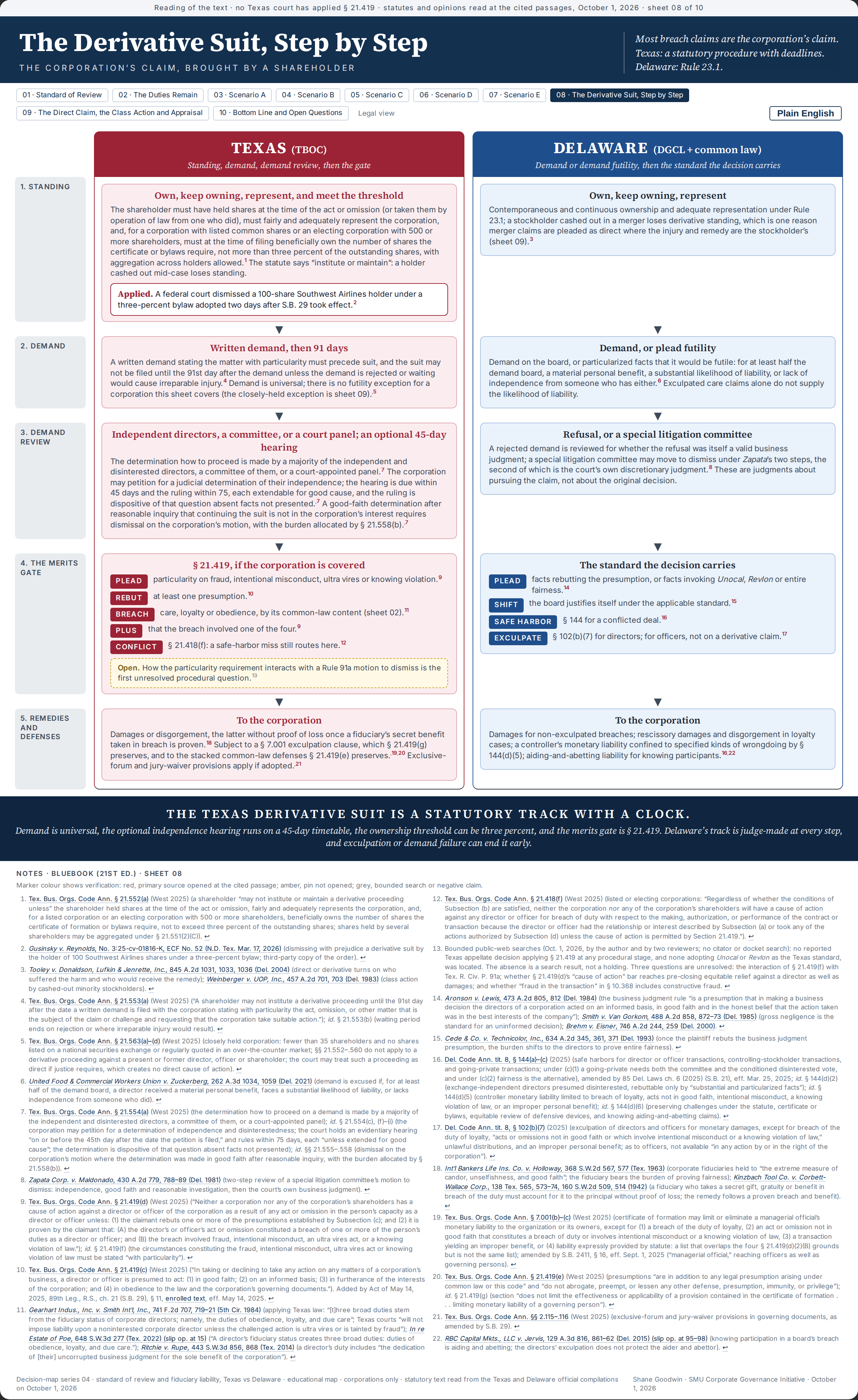
How to read it. Follow either column top to bottom. The grey rail names the question each row answers; the Texas and Delaware columns give each state’s answer with the section or opinion that supplies it. Markers lead to the Bluebook notes under the sheet. The Plain English button at the top of the sheet swaps every cell for an everyday-words version; the legal view and its notes remain the text of record.
The sheets read in order, and each stands alone: 01 and 02 set the frame, 03 to 07 walk one board decision each down both columns, 08 and 09 walk the lawsuit, 10 is the bottom line and the open questions.
Reading of the text · no Texas court has applied § 21.419 · statutes and opinions read at the cited passages, October 1, 2026 · sheet 08 of 10
The Derivative Suit, Step by Step
The corporation’s claim, brought by a shareholder
Most breach claims are the corporation’s claim.
Texas: a statutory procedure with deadlines.
Delaware: Rule 23.1.
Plain-English view: the same sheet in everyday words, for readers who are not lawyers. It summarizes; the legal view and its notes are the source of record. Click the button again to return.
TEXAS (TBOC)Standing, demand, demand review, then the gate
DELAWARE (DGCL + common law)Demand or demand futility, then the standard the decision carries
1. Standing
Own, keep owning, represent, and meet the threshold
The shareholder must have held shares at the time of the act or omission (or taken them by operation of law from one who did), must fairly and adequately represent the corporation, and, for a corporation with listed common shares or an electing corporation with 500 or more shareholders, must at the time of filing beneficially own the number of shares the certificate or bylaws require, not more than three percent of the outstanding shares, with aggregation across holders allowed.1 The statute says “institute or maintain”: a holder cashed out mid-case loses standing.
Applied. A federal court dismissed a 100-share Southwest Airlines holder under a three-percent bylaw adopted two days after S.B. 29 took effect.
2 To sue on the company’s behalf a shareholder must have owned shares at the time, keep owning them, fairly represent the company, and, at a listed or opted-in company, meet any ownership threshold the company set, up to three percent of all shares; several holders can pool their shares. A federal court has already thrown out a 100-share holder under a three-percent bylaw.
Own, keep owning, represent
Contemporaneous and continuous ownership and adequate representation under Rule 23.1; a stockholder cashed out in a merger loses derivative standing, which is one reason merger claims are pleaded as direct where the injury and remedy are the stockholder’s (sheet 09).3
Delaware requires the same ownership and representation. A shareholder cashed out in a merger can no longer sue on the company’s behalf, which is why merger claims are brought directly.
2. Demand
Written demand, then 91 days
A written demand stating the matter with particularity must precede suit, and the suit may not be filed until the 91st day after the demand unless the demand is rejected or waiting would cause irreparable injury.4 Demand is universal; there is no futility exception for a corporation this sheet covers (the closely-held exception is sheet 09).5
The shareholder must first send a written demand and wait 91 days, unless the board rejects it sooner or the delay would cause irreparable harm. There is no ‘demand would be futile’ shortcut.
Demand, or plead futility
Demand on the board, or particularized facts that it would be futile: for at least half the demand board, a material personal benefit, a substantial likelihood of liability, or lack of independence from someone who has either.6 Exculpated care claims alone do not supply the likelihood of liability.
The shareholder must demand that the board sue, or plead specific facts that at least half the board could not decide fairly.
3. Demand review
Independent directors, a committee, or a court panel; an optional 45-day hearing
The determination how to proceed is made by a majority of the independent and disinterested directors, a committee of them, or a court-appointed panel.7 The corporation may petition for a judicial determination of their independence; the hearing is due within 45 days and the ruling within 75, each extendable for good cause, and the ruling is dispositive of that question absent facts not presented.7 A good-faith determination after reasonable inquiry that continuing the suit is not in the corporation’s interest requires dismissal on the corporation’s motion, with the burden allocated by § 21.558(b).7
Independent directors, a committee of them, or a court-appointed panel decide whether the company should pursue the claim. The company can ask the court to rule on their independence; the hearing is due within 45 days and the ruling within 75, unless the court extends for good cause, and the ruling sticks unless new facts emerge. A good-faith decision not to sue, after reasonable inquiry, ends the case on the company’s motion.
Refusal, or a special litigation committee
A rejected demand is reviewed for whether the refusal was itself a valid business judgment; a special litigation committee may move to dismiss under Zapata’s two steps, the second of which is the court’s own discretionary judgment.8 These are judgments about pursuing the claim, not about the original decision.
If the board refuses a demand, the court asks whether the refusal was itself a reasonable business decision; a special committee can move to dismiss under a two-step review.
4. The merits gate
§ 21.419, if the corporation is covered
PLEADparticularity on fraud, intentional misconduct, ultra vires or knowing violation.9
REBUTat least one presumption.10
BREACHcare, loyalty or obedience, by its common-law content (sheet 02).11
PLUSthat the breach involved one of the four.9
CONFLICT§ 21.418(f): a safe-harbor miss still routes here.12
Open. How the particularity requirement interacts with a Rule 91a motion to dismiss is the first unresolved procedural question.
13 Then the merits gate: spell out one of the four grounds, knock down a presumption, prove a breach, prove the breach involved one of the four. A conflicted deal is routed here too. How this interacts with Texas’s early-dismissal rule is not yet decided.
The standard the decision carries
PLEADfacts rebutting the presumption, or facts invoking Unocal, Revlon or entire fairness.14
SHIFTthe board justifies itself under the applicable standard.15
SAFE HARBOR§ 144 for a conflicted deal.16
EXCULPATE§ 102(b)(7) for directors; for officers, not on a derivative claim.17
Then the merits: plead facts that rebut the presumption or invoke a stricter test; the board justifies itself; the safe harbor applies to conflicted deals; the charter clause applies to directors but not to officers on this kind of claim.
5. Remedies and defenses
To the corporation
Damages or disgorgement, the latter without proof of loss once a fiduciary’s secret benefit taken in breach is proven.18 Subject to a § 7.001 exculpation clause, which § 21.419(g) preserves, and to the stacked common-law defenses § 21.419(e) preserves.1920 Exclusive-forum and jury-waiver provisions apply if adopted.21
Any recovery goes to the company: damages, or disgorgement of a secret benefit without proof of loss. A charter clause can limit the damages, and other defenses still apply.
To the corporation
Damages for non-exculpated breaches; rescissory damages and disgorgement in loyalty cases; a controller’s monetary liability confined to specified kinds of wrongdoing by § 144(d)(5); aiding-and-abetting liability for knowing participants.1622
Any recovery goes to the company: damages for non-excused breaches, disgorgement in disloyalty cases, controller liability limited to specified kinds of wrongdoing, and liability for buyers who knowingly helped.
THE TEXAS DERIVATIVE SUIT IS A STATUTORY TRACK WITH A CLOCK.Demand is universal, the optional independence hearing runs on a 45-day timetable, the ownership threshold can be three percent, and the merits gate is § 21.419. Delaware’s track is judge-made at every step, and exculpation or demand failure can end it early.
Notes · Bluebook (21st ed.) · sheet 08
Marker colour shows verification: red, primary source opened at the cited passage; amber, pin not opened; grey, bounded search or negative claim.
- Tex. Bus. Orgs. Code Ann. § 21.552(a) (West 2025) (a shareholder “may not institute or maintain a derivative proceeding unless” the shareholder held shares at the time of the act or omission, fairly and adequately represents the corporation, and, for a listed corporation or an electing corporation with 500 or more shareholders, beneficially owns the number of shares the certificate of formation or bylaws require, not to exceed three percent of the outstanding shares; shares held by several shareholders may be aggregated under § 21.551(2)(C)). ↩
- Gusinsky v. Reynolds, No. 3:25-cv-01816-K, ECF No. 52 (N.D. Tex. Mar. 17, 2026) (dismissing with prejudice a derivative suit by the holder of 100 Southwest Airlines shares under a three-percent bylaw; third-party copy of the order). ↩
- Tooley v. Donaldson, Lufkin & Jenrette, Inc., 845 A.2d 1031, 1033, 1036 (Del. 2004) (direct or derivative turns on who suffered the harm and who would receive the remedy); Weinberger v. UOP, Inc., 457 A.2d 701, 703 (Del. 1983) (class action by cashed-out minority stockholders). ↩
- Tex. Bus. Orgs. Code Ann. § 21.553(a) (West 2025) (“A shareholder may not institute a derivative proceeding until the 91st day after the date a written demand is filed with the corporation stating with particularity the act, omission, or other matter that is the subject of the claim or challenge and requesting that the corporation take suitable action.”); id. § 21.553(b) (waiting period ends on rejection or where irreparable injury would result). ↩
- Tex. Bus. Orgs. Code Ann. § 21.563(a)–(d) (West 2025) (closely held corporation: fewer than 35 shareholders and no shares listed on a national securities exchange or regularly quoted in an over-the-counter market; §§ 21.552–.560 do not apply to a derivative proceeding against a present or former director, officer or shareholder; the court may treat such a proceeding as direct if justice requires, which creates no direct cause of action). ↩
- United Food & Commercial Workers Union v. Zuckerberg, 262 A.3d 1034, 1059 (Del. 2021) (demand is excused if, for at least half of the demand board, a director received a material personal benefit, faces a substantial likelihood of liability, or lacks independence from someone who did). ↩
- Tex. Bus. Orgs. Code Ann. § 21.554(a) (West 2025) (the determination how to proceed on a demand is made by a majority of the independent and disinterested directors, a committee of them, or a court-appointed panel); id. § 21.554(c), (f)–(i) (the corporation may petition for a determination of independence and disinterestedness; the court holds an evidentiary hearing “on or before the 45th day after the date the petition is filed,” and rules within 75 days, each “unless extended for good cause”; the determination is dispositive of that question absent facts not presented); id. §§ 21.555–.558 (dismissal on the corporation’s motion where the determination was made in good faith after reasonable inquiry, with the burden allocated by § 21.558(b)). ↩
- Zapata Corp. v. Maldonado, 430 A.2d 779, 788–89 (Del. 1981) (two-step review of a special litigation committee’s motion to dismiss: independence, good faith and reasonable investigation, then the court’s own business judgment). ↩
- Tex. Bus. Orgs. Code Ann. § 21.419(d) (West 2025) (“Neither a corporation nor any of the corporation’s shareholders has a cause of action against a director or officer of the corporation as a result of any act or omission in the person’s capacity as a director or officer unless: (1) the claimant rebuts one or more of the presumptions established by Subsection (c); and (2) it is proven by the claimant that: (A) the director’s or officer’s act or omission constituted a breach of one or more of the person’s duties as a director or officer; and (B) the breach involved fraud, intentional misconduct, an ultra vires act, or a knowing violation of law.”); id. § 21.419(f) (the circumstances constituting the fraud, intentional misconduct, ultra vires act or knowing violation of law must be stated “with particularity”). ↩
- Tex. Bus. Orgs. Code Ann. § 21.419(c) (West 2025) (“In taking or declining to take any action on any matters of a corporation’s business, a director or officer is presumed to act: (1) in good faith; (2) on an informed basis; (3) in furtherance of the interests of the corporation; and (4) in obedience to the law and the corporation’s governing documents.”). Added by Act of May 14, 2025, 89th Leg., R.S., ch. 21 (S.B. 29), § 11, enrolled text, eff. May 14, 2025. ↩
- Gearhart Indus., Inc. v. Smith Int’l, Inc., 741 F.2d 707, 719–21 (5th Cir. 1984) (applying Texas law: “[t]hree broad duties stem from the fiduciary status of corporate directors; namely, the duties of obedience, loyalty, and due care”; Texas courts “will not impose liability upon a noninterested corporate director unless the challenged action is ultra vires or is tainted by fraud”); In re Estate of Poe, 648 S.W.3d 277 (Tex. 2022) (slip op. at 15) (“A director’s fiduciary status creates three broad duties: duties of obedience, loyalty, and due care.”); Ritchie v. Rupe, 443 S.W.3d 856, 868 (Tex. 2014) (a director’s duty includes “the dedication of [their] uncorrupted business judgment for the sole benefit of the corporation”). ↩
- Tex. Bus. Orgs. Code Ann. § 21.418(f) (West 2025) (listed or electing corporations: “Regardless of whether the conditions of Subsection (b) are satisfied, neither the corporation nor any of the corporation’s shareholders will have a cause of action against any director or officer for breach of duty with respect to the making, authorization, or performance of the contract or transaction because the director or officer had the relationship or interest described by Subsection (a) or took any of the actions authorized by Subsection (d) unless the cause of action is permitted by Section 21.419.”). ↩
- Bounded public-web searches (Oct. 1, 2026, by the author and by two reviewers; no citator or docket search): no reported Texas appellate decision applying § 21.419 at any procedural stage, and none adopting Unocal or Revlon as the Texas standard, was located. The absence is a search result, not a holding. Three questions are unresolved: the interaction of § 21.419(f) with Tex. R. Civ. P. 91a; whether § 21.419(d)’s “cause of action” bar reaches pre-closing equitable relief against a director as well as damages; and whether “fraud in the transaction” in § 10.368 includes constructive fraud. ↩
- Aronson v. Lewis, 473 A.2d 805, 812 (Del. 1984) (the business judgment rule “is a presumption that in making a business decision the directors of a corporation acted on an informed basis, in good faith and in the honest belief that the action taken was in the best interests of the company”); Smith v. Van Gorkom, 488 A.2d 858, 872–73 (Del. 1985) (gross negligence is the standard for an uninformed decision); Brehm v. Eisner, 746 A.2d 244, 259 (Del. 2000). ↩
- Cede & Co. v. Technicolor, Inc., 634 A.2d 345, 361, 371 (Del. 1993) (once the plaintiff rebuts the business judgment presumption, the burden shifts to the directors to prove entire fairness). ↩
- Del. Code Ann. tit. 8, § 144(a)–(c) (2025) (safe harbors for director or officer transactions, controlling-stockholder transactions, and going-private transactions; under (c)(1) a going-private needs both the committee and the conditioned disinterested vote, and under (c)(2) fairness is the alternative), amended by 85 Del. Laws ch. 6 (2025) (S.B. 21), eff. Mar. 25, 2025; id. § 144(d)(2) (exchange-independent directors presumed disinterested, rebuttable only by “substantial and particularized facts”); id. § 144(d)(5) (controller monetary liability limited to breach of loyalty, acts not in good faith, intentional misconduct, a knowing violation of law, or an improper personal benefit); id. § 144(d)(6) (preserving challenges under the statute, certificate or bylaws, equitable review of defensive devices, and knowing aiding-and-abetting claims). ↩
- Del. Code Ann. tit. 8, § 102(b)(7) (2025) (exculpation of directors and officers for monetary damages, except for breach of the duty of loyalty, “acts or omissions not in good faith or which involve intentional misconduct or a knowing violation of law,” unlawful distributions, and an improper personal benefit; as to officers, not available “in any action by or in the right of the corporation”). ↩
- Int’l Bankers Life Ins. Co. v. Holloway, 368 S.W.2d 567, 577 (Tex. 1963) (corporate fiduciaries held to “the extreme measure of candor, unselfishness, and good faith”; the fiduciary bears the burden of proving fairness); Kinzbach Tool Co. v. Corbett-Wallace Corp., 138 Tex. 565, 573–74, 160 S.W.2d 509, 514 (1942) (a fiduciary who takes a secret gift, gratuity or benefit in breach of the duty must account for it to the principal without proof of loss; the remedy follows a proven breach and benefit). ↩
- Tex. Bus. Orgs. Code Ann. § 7.001(b)–(c) (West 2025) (certificate of formation may limit or eliminate a managerial official’s monetary liability to the organization or its owners, except for (1) a breach of the duty of loyalty, (2) an act or omission not in good faith that constitutes a breach of duty or involves intentional misconduct or a knowing violation of law, (3) a transaction yielding an improper benefit, or (4) liability expressly provided by statute: a list that overlaps the four § 21.419(d)(2)(B) grounds but is not the same list); amended by S.B. 2411, § 16, eff. Sept. 1, 2025 (“managerial official,” reaching officers as well as governing persons). ↩
- Tex. Bus. Orgs. Code Ann. § 21.419(e) (West 2025) (presumptions “are in addition to any legal presumption arising under common law or this code” and “do not abrogate, preempt, or lessen any other defense, presumption, immunity, or privilege”); id. § 21.419(g) (section “does not limit the effectiveness or applicability of a provision contained in the certificate of formation . . . limiting monetary liability of a governing person”). ↩
- Tex. Bus. Orgs. Code Ann. §§ 2.115–.116 (West 2025) (exclusive-forum and jury-waiver provisions in governing documents, as amended by S.B. 29). ↩
- RBC Capital Mkts., LLC v. Jervis, 129 A.3d 816, 861–62 (Del. 2015) (slip op. at 95–98) (knowing participation in a board’s breach is aiding and abetting; the directors’ exculpation does not protect the aider and abettor). ↩
Sources behind this sheet (22 notes)
- Tex. Bus. Orgs. Code Ann. § 21.552(a) (West 2025) (a shareholder “may not institute or maintain a derivative proceeding unless” the shareholder held shares at the time of the act or omission, fairly and adequately represents the corporation, and, for a listed corporation or an electing corporation with 500 or more shareholders, beneficially owns the number of shares the certificate of formation or bylaws require, not to exceed three percent of the outstanding shares; shares held by several shareholders may be aggregated under § 21.551(2)(C)). ↩
- Gusinsky v. Reynolds, No. 3:25-cv-01816-K, ECF No. 52 (N.D. Tex. Mar. 17, 2026) (dismissing with prejudice a derivative suit by the holder of 100 Southwest Airlines shares under a three-percent bylaw; third-party copy of the order). ↩
- Tooley v. Donaldson, Lufkin & Jenrette, Inc., 845 A.2d 1031, 1033, 1036 (Del. 2004) (direct or derivative turns on who suffered the harm and who would receive the remedy); Weinberger v. UOP, Inc., 457 A.2d 701, 703 (Del. 1983) (class action by cashed-out minority stockholders). ↩
- Tex. Bus. Orgs. Code Ann. § 21.553(a) (West 2025) (“A shareholder may not institute a derivative proceeding until the 91st day after the date a written demand is filed with the corporation stating with particularity the act, omission, or other matter that is the subject of the claim or challenge and requesting that the corporation take suitable action.”); id. § 21.553(b) (waiting period ends on rejection or where irreparable injury would result). ↩
- Tex. Bus. Orgs. Code Ann. § 21.563(a)–(d) (West 2025) (closely held corporation: fewer than 35 shareholders and no shares listed on a national securities exchange or regularly quoted in an over-the-counter market; §§ 21.552–.560 do not apply to a derivative proceeding against a present or former director, officer or shareholder; the court may treat such a proceeding as direct if justice requires, which creates no direct cause of action). ↩
- United Food & Commercial Workers Union v. Zuckerberg, 262 A.3d 1034, 1059 (Del. 2021) (demand is excused if, for at least half of the demand board, a director received a material personal benefit, faces a substantial likelihood of liability, or lacks independence from someone who did). ↩
- Tex. Bus. Orgs. Code Ann. § 21.554(a) (West 2025) (the determination how to proceed on a demand is made by a majority of the independent and disinterested directors, a committee of them, or a court-appointed panel); id. § 21.554(c), (f)–(i) (the corporation may petition for a determination of independence and disinterestedness; the court holds an evidentiary hearing “on or before the 45th day after the date the petition is filed,” and rules within 75 days, each “unless extended for good cause”; the determination is dispositive of that question absent facts not presented); id. §§ 21.555–.558 (dismissal on the corporation’s motion where the determination was made in good faith after reasonable inquiry, with the burden allocated by § 21.558(b)). ↩
- Zapata Corp. v. Maldonado, 430 A.2d 779, 788–89 (Del. 1981) (two-step review of a special litigation committee’s motion to dismiss: independence, good faith and reasonable investigation, then the court’s own business judgment). ↩
- Tex. Bus. Orgs. Code Ann. § 21.419(d) (West 2025) (“Neither a corporation nor any of the corporation’s shareholders has a cause of action against a director or officer of the corporation as a result of any act or omission in the person’s capacity as a director or officer unless: (1) the claimant rebuts one or more of the presumptions established by Subsection (c); and (2) it is proven by the claimant that: (A) the director’s or officer’s act or omission constituted a breach of one or more of the person’s duties as a director or officer; and (B) the breach involved fraud, intentional misconduct, an ultra vires act, or a knowing violation of law.”); id. § 21.419(f) (the circumstances constituting the fraud, intentional misconduct, ultra vires act or knowing violation of law must be stated “with particularity”). ↩
- Tex. Bus. Orgs. Code Ann. § 21.419(c) (West 2025) (“In taking or declining to take any action on any matters of a corporation’s business, a director or officer is presumed to act: (1) in good faith; (2) on an informed basis; (3) in furtherance of the interests of the corporation; and (4) in obedience to the law and the corporation’s governing documents.”). Added by Act of May 14, 2025, 89th Leg., R.S., ch. 21 (S.B. 29), § 11, enrolled text, eff. May 14, 2025. ↩
- Gearhart Indus., Inc. v. Smith Int’l, Inc., 741 F.2d 707, 719–21 (5th Cir. 1984) (applying Texas law: “[t]hree broad duties stem from the fiduciary status of corporate directors; namely, the duties of obedience, loyalty, and due care”; Texas courts “will not impose liability upon a noninterested corporate director unless the challenged action is ultra vires or is tainted by fraud”); In re Estate of Poe, 648 S.W.3d 277 (Tex. 2022) (slip op. at 15) (“A director’s fiduciary status creates three broad duties: duties of obedience, loyalty, and due care.”); Ritchie v. Rupe, 443 S.W.3d 856, 868 (Tex. 2014) (a director’s duty includes “the dedication of [their] uncorrupted business judgment for the sole benefit of the corporation”). ↩
- Tex. Bus. Orgs. Code Ann. § 21.418(f) (West 2025) (listed or electing corporations: “Regardless of whether the conditions of Subsection (b) are satisfied, neither the corporation nor any of the corporation’s shareholders will have a cause of action against any director or officer for breach of duty with respect to the making, authorization, or performance of the contract or transaction because the director or officer had the relationship or interest described by Subsection (a) or took any of the actions authorized by Subsection (d) unless the cause of action is permitted by Section 21.419.”). ↩
- Bounded public-web searches (Oct. 1, 2026, by the author and by two reviewers; no citator or docket search): no reported Texas appellate decision applying § 21.419 at any procedural stage, and none adopting Unocal or Revlon as the Texas standard, was located. The absence is a search result, not a holding. Three questions are unresolved: the interaction of § 21.419(f) with Tex. R. Civ. P. 91a; whether § 21.419(d)’s “cause of action” bar reaches pre-closing equitable relief against a director as well as damages; and whether “fraud in the transaction” in § 10.368 includes constructive fraud. ↩
- Aronson v. Lewis, 473 A.2d 805, 812 (Del. 1984) (the business judgment rule “is a presumption that in making a business decision the directors of a corporation acted on an informed basis, in good faith and in the honest belief that the action taken was in the best interests of the company”); Smith v. Van Gorkom, 488 A.2d 858, 872–73 (Del. 1985) (gross negligence is the standard for an uninformed decision); Brehm v. Eisner, 746 A.2d 244, 259 (Del. 2000). ↩
- Cede & Co. v. Technicolor, Inc., 634 A.2d 345, 361, 371 (Del. 1993) (once the plaintiff rebuts the business judgment presumption, the burden shifts to the directors to prove entire fairness). ↩
- Del. Code Ann. tit. 8, § 144(a)–(c) (2025) (safe harbors for director or officer transactions, controlling-stockholder transactions, and going-private transactions; under (c)(1) a going-private needs both the committee and the conditioned disinterested vote, and under (c)(2) fairness is the alternative), amended by 85 Del. Laws ch. 6 (2025) (S.B. 21), eff. Mar. 25, 2025; id. § 144(d)(2) (exchange-independent directors presumed disinterested, rebuttable only by “substantial and particularized facts”); id. § 144(d)(5) (controller monetary liability limited to breach of loyalty, acts not in good faith, intentional misconduct, a knowing violation of law, or an improper personal benefit); id. § 144(d)(6) (preserving challenges under the statute, certificate or bylaws, equitable review of defensive devices, and knowing aiding-and-abetting claims). ↩
- Del. Code Ann. tit. 8, § 102(b)(7) (2025) (exculpation of directors and officers for monetary damages, except for breach of the duty of loyalty, “acts or omissions not in good faith or which involve intentional misconduct or a knowing violation of law,” unlawful distributions, and an improper personal benefit; as to officers, not available “in any action by or in the right of the corporation”). ↩
- Int’l Bankers Life Ins. Co. v. Holloway, 368 S.W.2d 567, 577 (Tex. 1963) (corporate fiduciaries held to “the extreme measure of candor, unselfishness, and good faith”; the fiduciary bears the burden of proving fairness); Kinzbach Tool Co. v. Corbett-Wallace Corp., 138 Tex. 565, 573–74, 160 S.W.2d 509, 514 (1942) (a fiduciary who takes a secret gift, gratuity or benefit in breach of the duty must account for it to the principal without proof of loss; the remedy follows a proven breach and benefit). ↩
- Tex. Bus. Orgs. Code Ann. § 7.001(b)–(c) (West 2025) (certificate of formation may limit or eliminate a managerial official’s monetary liability to the organization or its owners, except for (1) a breach of the duty of loyalty, (2) an act or omission not in good faith that constitutes a breach of duty or involves intentional misconduct or a knowing violation of law, (3) a transaction yielding an improper benefit, or (4) liability expressly provided by statute: a list that overlaps the four § 21.419(d)(2)(B) grounds but is not the same list); amended by S.B. 2411, § 16, eff. Sept. 1, 2025 (“managerial official,” reaching officers as well as governing persons). ↩
- Tex. Bus. Orgs. Code Ann. § 21.419(e) (West 2025) (presumptions “are in addition to any legal presumption arising under common law or this code” and “do not abrogate, preempt, or lessen any other defense, presumption, immunity, or privilege”); id. § 21.419(g) (section “does not limit the effectiveness or applicability of a provision contained in the certificate of formation . . . limiting monetary liability of a governing person”). ↩
- Tex. Bus. Orgs. Code Ann. §§ 2.115–.116 (West 2025) (exclusive-forum and jury-waiver provisions in governing documents, as amended by S.B. 29). ↩
- RBC Capital Mkts., LLC v. Jervis, 129 A.3d 816, 861–62 (Del. 2015) (slip op. at 95–98) (knowing participation in a board’s breach is aiding and abetting; the directors’ exculpation does not protect the aider and abettor). ↩
Decision-map series 04 · standard of review and fiduciary liability, Texas vs Delaware · educational map · corporations only · statutory text read from the Texas and Delaware official compilations on October 1, 2026Shane Goodwin · SMU Corporate Governance Initiative · October 1, 2026
Read the statutes and the opinions
- Tex. S.B. 29, 89th Leg., R.S. (2025) (enrolled) — §§ 21.416(g), 21.4161, 21.418, 21.419, 21.552, 2.115, 2.116, eff. May 14, 2025.
- Tex. Bus. Orgs. Code § 21.419 (the liability gate); § 21.401 (what a board may consider); § 21.418 (interested directors and officers); §§ 21.551–21.563 (derivative proceedings); § 7.001 (exculpation); § 20.002 (ultra vires); §§ 10.354 and 10.368 (dissent and appraisal); § 1.057 (construction).
- Del. Code Ann. tit. 8, § 144 (as amended by 85 Del. Laws c. 6, S.B. 21, eff. Mar. 25, 2025); § 102(b)(7) (exculpation); § 262 (appraisal).
- Delaware: Aronson v. Lewis, 473 A.2d 805 (Del. 1984); Unocal Corp. v. Mesa Petroleum Co., 493 A.2d 946 (Del. 1985); Revlon, Inc. v. MacAndrews & Forbes Holdings, Inc., 506 A.2d 173 (Del. 1986); Paramount Communications Inc. v. QVC Network Inc., 637 A.2d 34 (Del. 1994); Weinberger v. UOP, Inc., 457 A.2d 701 (Del. 1983); Cede & Co. v. Technicolor, Inc., 634 A.2d 345 (Del. 1993); Zapata Corp. v. Maldonado, 430 A.2d 779 (Del. 1981); RBC Capital Markets, LLC v. Jervis, 129 A.3d 816 (Del. 2015); Lyondell Chemical Co. v. Ryan, 970 A.2d 235 (Del. 2009); Corwin v. KKR Financial Holdings LLC, 125 A.3d 304 (Del. 2015); Stone v. Ritter, 911 A.2d 362 (Del. 2006); Tooley v. Donaldson, Lufkin & Jenrette, Inc., 845 A.2d 1031 (Del. 2004); Brookfield Asset Management, Inc. v. Rosson, 261 A.3d 1251 (Del. 2021); United Food & Commercial Workers Union v. Zuckerberg, 262 A.3d 1034 (Del. 2021); Dodiya v. Franklin, C.A. No. 2025-0932-LWW (Del. Ch. Aug. 26, 2026).
- Texas: In re Estate of Poe, 648 S.W.3d 277 (Tex. 2022); Ritchie v. Rupe, 443 S.W.3d 856 (Tex. 2014); Sneed v. Webre, 465 S.W.3d 169 (Tex. 2015); Gearhart Industries, Inc. v. Smith International, Inc., 741 F.2d 707 (5th Cir. 1984); Wingate v. Hajdik, 795 S.W.2d 717 (Tex. 1990); International Bankers Life Insurance Co. v. Holloway, 368 S.W.2d 567 (Tex. 1963); Cates v. Sparkman, 73 Tex. 619, 11 S.W. 846 (1889); Gusinsky v. Reynolds, No. 3:25-cv-01816-K (N.D. Tex. Mar. 17, 2026). Each sheet carries its own Bluebook notes beneath the chart, with a link to each opinion; the marker colour says whether the cited passage was opened. Opinions are collected on the vertical’s sources page.
Educational map. Corporations only; LLC and partnership analogues differ. A reading of the statutory text: no Texas court has applied § 21.419 to a sale, a defense or a conflicted deal. Nothing here is legal advice.